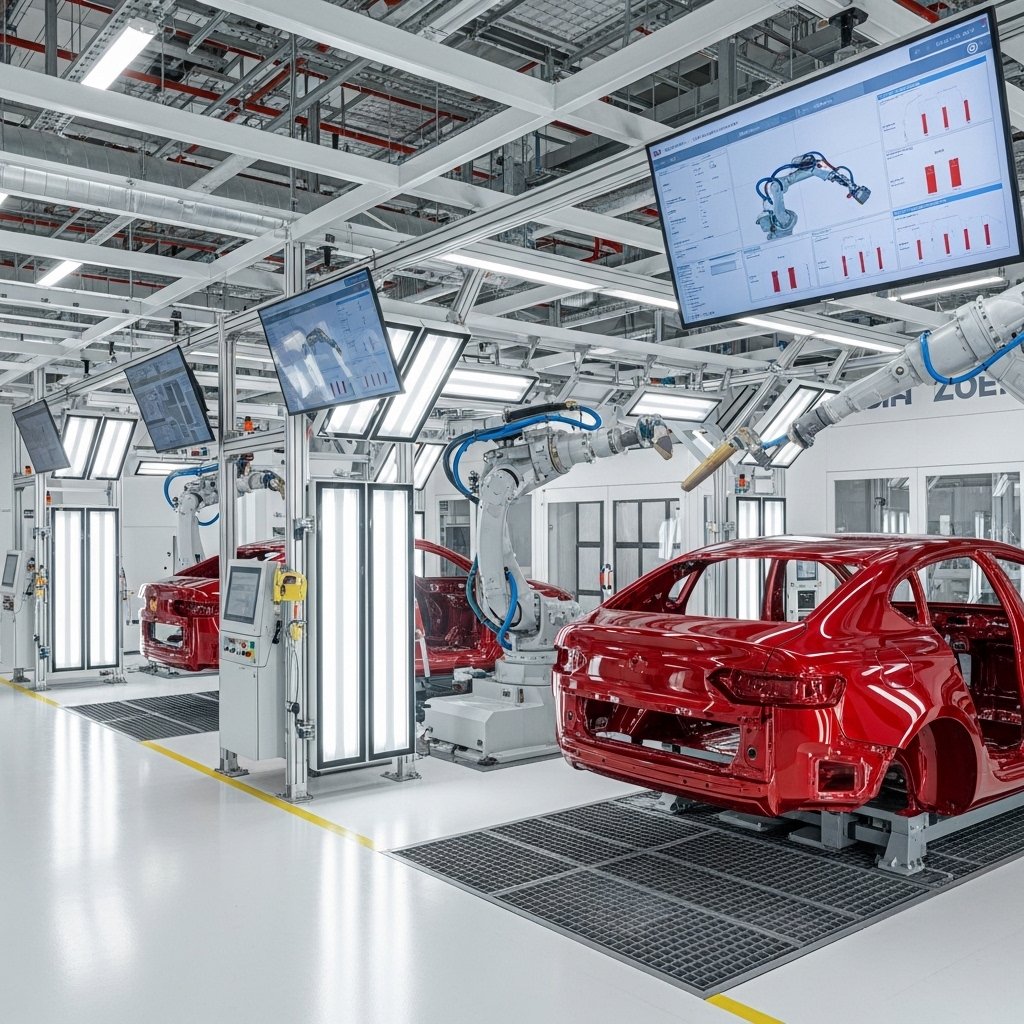
Automatic or robotic car painting is the use of programmed machines, usually 6-axis or 7-axis paint robots, to apply primer, basecoat, clearcoat, or special finishes to a vehicle body with high repeatability. Instead of a human painter holding a spray gun, a robot follows a digital path around the car and applies paint through a spray gun, rotary bell atomizer, or newer inkjet-style head.
Robotic car painting makes vehicle finishing more consistent, safer for workers, and less wasteful. It is now a core part of modern automotive manufacturing because car paint must look smooth, match color standards, resist weather, and be applied at scale. Global robot use in factories keeps rising, with 542,000 industrial robots installed in 2024, according to the International Federation of Robotics.
What does automatic or robotic car painting mean?
Automatic or robotic car painting means using computer-controlled machines to spray or apply coatings to vehicles without manual spraying for every pass. The robot moves with programmed speed, angle, distance, and paint flow so the finish stays even across doors, roofs, bumpers, hoods, and interior edges.
In a car plant, painting is not a quick “spray and dry” job. It is a carefully planned process. The car body is cleaned, treated, primed, painted, cleared, baked, checked, and sometimes repaired. Robots handle many of the repeatable coating steps because they can follow the same path thousands of times with little variation.
It doesn’t only provide a beautiful finish but the paint also protects the metal or plastic underneath. It helps guard against corrosion, sunlight, rain, road salt, stone chips, and daily wear. That is why robotic painting needs accuracy at every layer.
Modern paint robots are common in automotive plants, but they are also used for motorcycles, trucks, aircraft parts, appliances, furniture, and industrial equipment. That is why companies such as ABB design paint robots as systems built to raise productivity and finish quality in automotive and general painting applications.
How does robotic car painting work?
Robotic car painting works through programmed motion, controlled paint delivery, and a closed paint booth environment. The robot receives a path file, moves around the vehicle body, and applies paint at controlled pressure, flow rate, spray width, and distance from the surface.
The robot does not “see” a car the way a person does. It follows instructions based on the car model, part shape, coating type, and paint booth setup. Engineers program the robot’s route so it reaches hard areas without hitting the body, fixtures, or other robots.
Most systems use sensors, conveyors, booth controls, paint mixing systems, and software. The car body moves through the paint line while robots apply layers in set zones. In large plants, several robots may paint one vehicle at the same time.
How does the car body get ready before painting?
The car body is cleaned and treated before paint is applied. This step removes oil, dust, metal particles, and other surface problems that could ruin the final finish.
A vehicle usually goes through washing, chemical treatment, and sometimes electrocoat dipping before robotic spraying begins. The electrocoat layer helps protect against corrosion and gives later coatings a stable base. After that, primer helps smooth the surface and prepare it for color.
If the surface is not prepared well, even the best robot cannot hide the flaw. Dust, oil, uneven primer, or poor curing can lead to orange peel, pinholes, fisheyes, poor adhesion, or color mismatch.
How does the robot apply the paint?
The robot applies paint by moving an applicator across the vehicle surface at a fixed distance and angle. It controls how much paint comes out, how wide the spray pattern is, and how quickly the arm moves.
Many automotive paint shops use electrostatic rotary bell atomizers. In this method, a fast-spinning bell breaks liquid paint into fine droplets. The droplets are electrically charged, and the vehicle body is grounded, helping paint move toward the surface. High-speed rotation combined with high electric potential atomizes the paint into charged droplets, improving transfer efficiency and reducing overspray compared to conventional air spray methods.
This method helps reduce wasted paint compared with basic air spraying. Electrostatic rotating bell atomizers can make much better use of the paint because the droplets are charged and drawn toward the vehicle surface instead of drifting freely through the booth. In some comparisons, this method can use paint around three times more effectively than basic air spraying.
How does the paint dry or cure?
After paint is applied, the vehicle passes through drying or curing stages. Heat, airflow, and time help the coating harden and bond to the surface.
Different coatings need different curing settings. Primer, basecoat, and clearcoat do not all behave the same. The booth and oven settings are planned around the paint chemistry, layer thickness, plant speed, and finish target.
Curing matters because a car finish must survive years of washing, sunlight, rain, heat, cold, and road dirt. A coat that looks good when fresh can still fail later if it was not cured correctly.
What machines are used in robotic car painting?
Robotic car painting uses paint robots, atomizers, spray guns, paint supply systems, conveyors, sensors, booths, exhaust systems, and curing ovens. The robot arm is only one part of a larger finishing system.
The robot moves the applicator, but the rest of the system controls paint quality, booth air, color changes, safety, cleaning, and curing. This is why robotic painting is usually planned as a full paint shop process rather than a single robot purchase.
Paint robots
Paint robots are usually multi-axis arms built for smooth motion and safe use in paint booth environments. Many automotive paint robots have 6 or 7 axes, allowing them to reach curved body panels, roof edges, pillars, rocker panels, door openings, and tight spaces.
Durr’s automotive paint robots come in modular 6-axis and 7-axis designs, which gives the robot more freedom to move around curved panels, edges, and tight booth areas.
Paint robots are also built with special protection because paint booths can contain solvents, mist, and fine particles. Their design must support clean operation, safe wiring, controlled airflow, and easy maintenance.
Rotary bell atomizers
Rotary bell atomizers are common in automotive paint lines because they can produce a fine, controlled spray. A small bell spins at high speed while paint flows onto it. The spinning motion breaks paint into droplets.
Rotary atomizers can also be fitted to robots, reciprocators, or fixed mounts, depending on how the paint shop is set up.
These atomizers are popular because they offer good control over droplet size, spray shape, and paint transfer. They are often used for primer, basecoat, and clearcoat depending on the coating system.
Spray guns and applicators
Some systems use automatic spray guns instead of rotary bells, especially for certain parts, repairs, or smaller operations. Spray guns can be easier to set up in some cases, but rotary bells are often preferred in high-volume car production.
Newer systems may also use inkjet-style paint heads for custom graphics or two-tone finishes. ABB’s PixelPaint is one example. Older two-tone painting methods typically waste 20% to 30% of paint through overspray. ABB’s PixelPaint system addresses this directly, using an inkjet head that applies paint precisely to the surface and eliminates the overspray associated with conventional spray application.
Why do car factories use robotic painting?
Car factories use robotic painting because it gives repeatable quality, cuts worker exposure to paint booth hazards, reduces waste, and supports faster production. It also helps brands keep color and finish standards consistent across thousands of vehicles.
A human painter can be highly skilled, but fatigue, posture, booth heat, and long shifts can affect consistency. A robot does not get tired. Once the path and settings are right, it repeats the same motion again and again.
Better finish consistency
Robots help keep spray distance, angle, speed, and overlap steady. This matters because small changes can affect gloss, color shade, film thickness, and texture.
A car body has many curves. The hood, fenders, roof, doors, bumpers, and pillars all reflect light differently. Even a small paint thickness change can show up as a shade difference, especially with metallic or pearlescent paints.
Robotic systems reduce that risk because the motion is programmed. Engineers can tune the path until the coating lands evenly across the surface.
Less paint waste
Robotic painting can reduce overspray and wasted material, especially when paired with electrostatic applicators and good booth controls. Paint is expensive, and wasted paint also adds filtration, cleaning, and disposal costs.
The same idea applies across many automated paint systems: less overspray, less wasted paint, and better color consistency from one job to the next.
Inkjet-style systems can go further for some designs. ABB’s PixelPaint applies paint directly to the vehicle surface and avoids the overspray linked with older custom paint methods.
Safer working conditions
Painting can expose workers to solvents, fine particles, and repetitive physical strain. Robots take over the most repetitive spray work inside controlled booths.
This does not mean people disappear from the paint shop. Workers still program, inspect, clean, maintain, repair, measure, and manage the system. The job moves from manual spraying toward process control and quality work.
Faster production
Robots can work at a steady pace and can be arranged in groups around the vehicle. In a high-volume plant, this keeps the paint line moving while each vehicle receives the same coating steps.
Speed also matters for special finishes. In the past, two-tone paint often required masking, extra handling, and a second pass through parts of the line.
What are the main steps in automatic car painting?
Automatic car painting usually includes surface cleaning, pretreatment, electrocoat, primer, basecoat, clearcoat, curing, inspection, and repair. Each stage supports the next one, so the final shine depends on the whole process.
The exact steps vary by factory, paint chemistry, car model, and finish type. Still, most automotive paint lines follow a similar order.
1. Cleaning and pretreatment
The vehicle body is washed and chemically treated. This removes dirt and helps later coatings bond to the surface.
Pretreatment is one of the quiet heroes of car painting. You may never see it on a finished vehicle, but poor pretreatment can shorten paint life and raise corrosion risk.
2. Electrocoat
Electrocoat, often called e-coat, is a corrosion-protection layer applied before spray painting. The body is dipped into a coating bath, and electrical charge helps the coating cover hidden areas.
This is especially useful for seams, cavities, and places a spray applicator may not reach well.
3. Primer
Primer helps smooth the surface and creates a better base for the color coat. It can also improve chip resistance and help hide small surface changes.
Some plants use robotic spraying for primer. Others may use different methods depending on the body, coating system, and line design.
4. Basecoat
Basecoat gives the vehicle its color. This may be solid, metallic, pearl, matte, or special-effect paint.
Robotic control is very helpful here because color appearance can change with paint thickness, flake direction, spray distance, and drying behavior. Metallic paints are especially sensitive because tiny aluminum or mica flakes must settle in a controlled way.
5. Clearcoat
Clearcoat adds gloss, depth, and protection. It helps shield the color coat from sunlight, chemicals, light scratches, and weather.
A poor clearcoat application can lead to runs, dull spots, orange peel, or uneven gloss. Robots reduce these risks by keeping a steady spray pattern.
6. Curing
After coating, the body moves through ovens or controlled drying zones. The paint hardens and bonds to the surface.
Curing settings must match the coating system. Too little cure can weaken the finish. Too much heat can create other defects or waste energy.
7. Inspection and repair
The final finish is checked under controlled lighting. Workers and machine vision systems may look for dust, runs, thin spots, color mismatch, scratches, and surface texture issues.
Small defects may be sanded and polished. Larger defects may need repainting.
What types of robotic car painting systems exist?
The main types include fixed robotic paint booths, conveyor-based automotive paint lines, compact robot cells, electrostatic rotary bell systems, automatic spray gun systems, and inkjet-style robotic painting. Each type fits a different production need.
A global car plant needs a different setup than a small repair workshop or a parts supplier. The best system depends on volume, part shape, finish quality, paint chemistry, floor space, and budget.
Full automotive paint lines
Full paint lines are used by car manufacturers. They include many robots, conveyors, pretreatment systems, booths, ovens, cleaning systems, and inspection zones.
These lines are built for high output and strict quality control. A single plant may paint hundreds or thousands of vehicles per day, depending on its size.
Robotic paint booths
Robotic paint booths are enclosed spaces where robots apply coatings under controlled airflow. The booth captures overspray, controls contamination, and protects workers outside the spray zone.
These booths are used in car plants, parts factories, and some specialty coating operations.
Compact painting cells
Compact cells are smaller systems used for parts such as bumpers, mirrors, wheels, panels, motorcycle tanks, or industrial components.
They may use one robot, one spray gun, and a smaller booth. This can be a good fit for suppliers that paint repeatable parts but do not need a full vehicle line.
Inkjet robotic painting
Inkjet robotic painting applies paint more directly, almost like a printer following the surface of a car. It can help with two-tone finishes, graphics, and custom designs. This method can reduce masking and overspray in certain use cases.
What are the benefits of robotic car painting?
Robotic car painting brings better repeatability, less waste, cleaner working conditions, steady production speed, and stronger control over paint thickness. These benefits are why car makers have relied on paint robots for decades.
The value is not only in replacing manual spray work. The real value comes from process control. Paint quality depends on thousands of small choices, and robots help keep those choices stable.
Consistent color and gloss
Color matching matters because buyers notice paint flaws quickly. A door that looks slightly different from a fender can hurt trust in the vehicle.
Robots help control film thickness and spray pattern, which helps maintain a more even appearance. This is very helpful for metallic, pearl, and premium finishes.
Lower material cost
Paint is one of the more expensive consumables in vehicle finishing. Less overspray means more paint reaches the car and less ends up in filters or booth waste.
Electrostatic systems and accurate robot paths both help raise transfer efficiency. Newer direct-application methods may reduce waste even more for special designs.
Better worker safety
Robots reduce the need for workers to stand inside spray zones for long periods. That lowers exposure to paint mist and solvents.
People still play a key role, but they spend more time on setup, inspection, maintenance, and decision-making rather than repetitive spraying.
Repeatable production
Once a robot path is tested and approved, the same recipe can be used again and again. If a plant paints the same model in multiple colors, it can switch programs and settings based on the production schedule.
This makes robotic painting useful for high-volume plants where every minute of line time matters.
What are the limits of robotic car painting?
Robotic car painting has limits. It requires high upfront cost, skilled programming, regular maintenance, clean booth control, and careful process tuning. A robot can repeat a bad setup just as easily as a good one.
Robots are precise, but they are not magic. The finish still depends on coating chemistry, surface prep, booth cleanliness, air movement, humidity, temperature, curing, and inspection.
High setup cost
Paint robots, booths, applicators, pumps, controls, ventilation, and safety systems can cost a lot. This is why full robotic painting is easier to justify in high-volume production.
Smaller shops may use partial automation, compact cells, or manual spraying for custom work.
Programming takes skill
A paint robot needs a good path. The programmer must set spray angle, distance, overlap, speed, trigger points, and flow changes.
Complex vehicle shapes make this harder. Edges, openings, and curves need special care because paint can build up too much in some areas and stay thin in others.
Maintenance cannot be ignored
Nozzles, bells, hoses, filters, pumps, and booth systems need cleaning and service. Paint can clog, dry, or contaminate equipment.
A poorly maintained robot may still move correctly, but the finish can suffer.
Not every job needs a robot
Low-volume custom painting, restoration work, artistic finishes, and spot repairs may still need skilled human painters. A robot is strongest when the part shape and coating task repeat often.
Is robotic car painting better than manual painting?
Robotic car painting is better for repeatable factory work, while manual painting is still valuable for repairs, restorations, custom jobs, and small batches. The right choice depends on volume, finish type, cost, and flexibility.
In a car factory, robots usually win because they apply paint with steady quality at high speed. In a custom shop, a skilled painter may be better because every job can be different.
Manual painters can judge unusual surfaces, make quick adjustments, and handle artistic work. Robots need programming and stable conditions. When the job repeats thousands of times, robots offer the stronger business case.
Is automatic car painting used only by large car makers?
Automatic car painting is not only for large car makers, but full robotic paint lines are most common in high-volume production. Smaller companies may use compact robotic cells for parts, panels, wheels, cabinets, or industrial products.
The robotics market has grown as robot hardware and software have become more available. The annual industrial robot installations stayed above 500,000 units for the fourth year in a row in 2024.
That growth does not mean every shop should buy a robot. The business case is strongest when the same parts are painted often, quality demands are tight, and material waste is costly.
The painting robot market is growing with that demand. It was valued at $3.1 billion in 2024 and is expected to reach $5.8 billion by 2029.
How AI Is Changing Automatic Car Painting
Automotive refinishing has entered a new phase of process control. While spray equipment, automated booths, and robotic applicators handle coating application, artificial intelligence is now being integrated at the inspection, data analysis, and color formulation stages, giving paint shops a measurable improvement in first-pass quality and defect reduction.
AI-powered inspection systems combine high-resolution imaging, structured lighting arrays, and machine learning algorithms to scan painted surfaces after coating application. Paint defects that are difficult to detect consistently under booth lighting conditions, including:
- Orange peel, solvent pop, cratering, and pinholes
- Runs, sags, and dry spray
- Inadequate film build and gloss inconsistency
- Color variation across bumper fascias, door skins, hood assemblies, and quarter panels
are identified with greater accuracy and repeatability than manual visual inspection, particularly on surfaces where finish inconsistencies become most visible under natural daylight conditions.
AI inspection platforms do more than flag surface defects. They can correlate inspection data with real-time booth parameters to support systematic process optimization. Variables monitored and analyzed include:
- Airflow velocity, ambient temperature, and relative humidity
- Paint viscosity, atomization pressure, and transfer efficiency
- Spray gun distance, film thickness distribution, and cure cycle conditions
- Booth filter saturation and surface contamination levels
When recurring defects are mapped against these process variables, root causes can be identified and corrected at the process level rather than addressed on a panel-by-panel basis. This closed-loop approach to process control reduces rework rates, lowers material consumption, and improves overall throughput in both high-volume refinishing operations and independent auto body shops.
Color matching in automotive refinishing presents its own set of technical challenges. Paint fade, UV degradation, prior repair history, and factory color variation within the same vehicle model year mean the original OEM formula is rarely sufficient on its own. AI-assisted spectrophotometers and digital color matching tools address this by:
- Measuring the existing finish from multiple angles and lighting conditions
- Accounting for metamerism, pearl and flake orientation, and substrate differences
- Generating formula adjustments before the first spray pass
- Reducing test panels, blend corrections, and re-sprays required to achieve an acceptable finish
AI does not replace the refinishing technician. Panel preparation, primer selection, blend zone execution, and final finish evaluation remain skill-dependent processes.
AI-integrated systems provide higher-quality process data; earlier defect identification, more accurate color formulation, and better documentation of booth conditions, allowing technicians to make more informed decisions at each stage of the refinishing workflow. For auto body shops and OEM paint facilities, the measurable outcomes are fewer defects leaving the booth, reduced rework and material waste, and a finished product that more consistently meets customer and manufacturer quality standards.
Is Automatic Car Painting a Good Choice for Auto Body Shops?
Automatic car painting is a good choice for many auto body shops because it helps create a cleaner, smoother, and more consistent paint finish. It is especially useful for collision repair centers, car repainting shops, dent repair businesses, bumper repair services, and workshops that handle regular paint jobs.
For auto shops, automatic car painting does not always mean a large robotic factory line. It can include an automatic paint booth, computer-controlled spray settings, infrared curing, controlled airflow, or a robotic spray system for repeatable paint work.
This type of setup helps reduce common paint problems such as uneven coverage, dust in the finish, patchy color, overspray, and slow drying. It also helps shops complete more paint jobs with better control over quality.
A small car paint shop may not need a full robotic system. A busy collision repair center, though, can benefit from automatic painting equipment because it saves time, supports better color matching, and gives customers a finish that looks closer to the original factory paint.
What industries use robotic painting besides cars?
Robotic painting is used in automotive parts, aerospace, motorcycles, trucks, buses, rail, appliances, furniture, metal fabrication, plastics, agricultural equipment, and heavy machinery. Any business that paints repeatable parts may gain from automation.
Car manufacturing is the best-known use because paint quality is highly visible and production volume is high. A buyer may not see the engine casting, but they see the paint every day.
Other industries use painting robots for the same reasons: steady quality, lower waste, worker safety, and faster throughput.
How much does robotic car painting cost?
Robotic car painting cost varies widely because a small cell and a full automotive paint shop are completely different investments. Cost depends on robot count, booth size, safety systems, applicators, paint supply, software, installation, training, and maintenance.
A small robotic painting cell may need one robot and one booth. A full vehicle paint shop may need many robots, conveyors, ovens, pretreatment systems, filtration, controls, inspection tools, and building changes.
The robot arm is often not the largest cost. The booth, ventilation, explosion-safe design, paint circulation, curing, and integration can raise the total price.
For factories, the payback usually comes from lower rework, less paint waste, safer work, steadier output, and fewer finish defects.
What is the future of robotic car painting?
The future of robotic car painting is moving toward more direct paint application, smarter path planning, better sensors, lower overspray, and more flexible color changes. Car makers want high-quality finishes while using less material, energy, and booth time.
Inkjet-style systems are one sign of where the field is heading. They can apply patterns and two-tone finishes with less masking. That matters because buyers increasingly expect more personalization, while factories still need speed and consistency.
Robots may also become easier to program through simulation, scanning, and AI-assisted path tools. Paint shops already use digital models to plan robot motion and coating thickness. Software is already helping paint teams predict how thick the coating will be on curved vehicle parts, including shapes like car fenders.
A better car finish starts long before the color appears
Automatic or robotic car painting is not just a robot spraying shiny color onto a vehicle. It is a controlled system that joins surface prep, coating science, robot motion, airflow, curing, and inspection into one repeatable process.
For car makers, the reason is clear. Buyers judge paint with their eyes and their hands. They notice shine, smoothness, depth, and color match before they ever ask about the paint booth. Robotic painting helps factories meet that expectation at scale while reducing waste and keeping people away from the harshest spray tasks.
The next stage of car painting will likely feel more personal, not less. More two-tone finishes, more direct application, more digital control, and more careful use of paint are already shaping how vehicles get their final look. The car may still roll out wearing a color chosen by a person, but the finish itself is increasingly guided by robots built for patience, precision, and repetition.