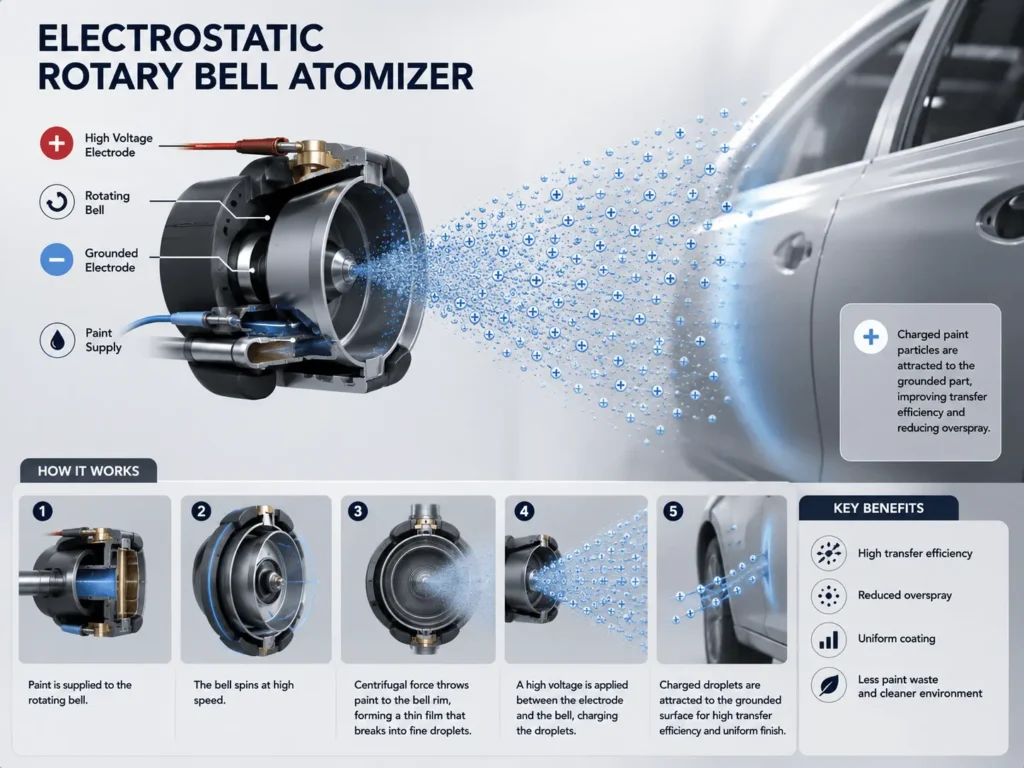
A rotary atomizer works by feeding liquid paint into the center of a rapidly spinning bell-shaped cup. The spinning surface spreads the paint into a thin film and drives it toward the outer edge, where centrifugal force breaks it into thousands of fine droplets. Shaping air then directs those droplets toward the part, while an electrostatic charge can pull the paint onto the grounded surface.
It is a carefully controlled process. Bell speed, paint flow, cup design, shaping-air pressure, voltage, viscosity, and robot distance all affect the spray pattern and finish.
Rotary atomizers are widely used on automated automotive paint lines because they can produce a fine, repeatable spray while placing a high share of the supplied coating onto the vehicle. They are particularly valuable where paint quality, material cost, cycle time, and overspray control matter at the same time.
What Is a Rotary Atomizer?
A rotary atomizer is a high-speed coating applicator that uses a spinning cup, disc, or wheel to turn liquid paint into small droplets. In automotive finishing, the most common version is the rotary bell atomizer.
The bell cup is mounted at the front of the applicator and driven by a compact air turbine. Paint enters near the cup’s center, spreads across its inner surface, and leaves from the outer rim as a fine spray.
Rotary atomizers differ from conventional spray guns because compressed air is not the main force breaking the paint apart. The mechanical motion of the spinning cup performs most of the atomization.
Compressed air still has an important role. A controlled air stream around the bell, known as shaping air, pushes the outward-moving droplets forward and controls the width of the spray pattern.
Many automotive rotary bells also use electrostatic charging. Charged paint droplets are attracted toward a grounded car body or component, helping more coating reach the target rather than booth walls, filters, and exhaust air.
How Does a Rotary Atomizer Work Step by Step?
A rotary atomizer turns a continuous stream of liquid coating into a controlled cloud of droplets through several linked stages. Each stage affects the next, so small changes in paint supply or operating settings can alter the final film.
Paint is delivered to the center of the bell cup
The process begins when a metering system sends paint through internal passages inside the atomizer. The coating exits through a paint tube or nozzle positioned near the center of the rotating bell.
The paint flow must remain stable. Sudden pressure changes, air bubbles, partially blocked passages, or inconsistent mixing can create an uneven supply at the cup.
Some systems place a splash plate or distributor inside the bell. This component spreads the incoming paint more evenly across the cup surface before the coating moves toward the rim.
A steady central feed matters because the rotary bell does not correct an unstable paint supply. It will atomize whatever reaches the cup, including pulses, foam, contaminants, or poorly mixed material.
An air turbine spins the bell cup
A small air-powered turbine rotates the bell cup at very high speed. Depending on the applicator and coating process, rotational speed may reach tens of thousands of revolutions per minute.
Some production units operate at speeds approaching 60,000 rpm. The exact setting depends on bell diameter, paint properties, desired droplet size, target appearance, and production requirements.
The turbine must hold its programmed speed while paint is flowing. Changes in bearing condition, turbine-air supply, contamination, or cup balance can cause speed fluctuations.
Modern controllers monitor actual rotational speed rather than relying only on the requested setting. A difference between commanded and measured speed may point to cup buildup, bearing wear, restricted turbine air, or physical damage.
Centrifugal action spreads paint across the cup
Once the liquid touches the rotating surface, it begins moving outward. The cup’s motion transfers energy into the coating and spreads it into a thin film.
The film travels from the center toward the atomizing edge. Its thickness and movement depend on several conditions, including:
- Paint flow rate
- Bell speed
- Cup diameter and inner geometry
- Paint viscosity
- Surface tension
- Density
- Cup surface condition
Higher flow generally creates a thicker liquid film because more material must pass across the cup during the same period. Greater rotational speed usually drives the liquid outward more forcefully and may reduce the resulting droplet size.
Paint rheology also affects how the film behaves. A low-viscosity clearcoat may spread differently from a high-solids primer, even when both coatings are run through the same bell.
The liquid film breaks apart at the bell edge
The outer rim is called the atomizing edge. When the thin paint film reaches this edge, it can no longer remain attached to the cup.
The spinning motion throws the liquid outward. Surface tension attempts to keep the coating together, while rotational forces pull it apart. Once those forces overcome the liquid’s resistance, the film forms ligaments and then breaks into droplets.
This is the main atomization stage.
Researchers studying electrostatic rotary bell sprayers describe the coating as a film that moves across the cup and disintegrates into droplets at the rim under centrifugal action.
The exact breakup pattern can vary. Under one set of settings, the coating may leave as fine filaments. Under another, it may form thicker ligaments or less stable jets before breaking apart.
A clean, undamaged edge supports consistent breakup. Dried paint, scratches, chips, or deposits on the rim may disturb the film and produce uneven droplets.
The droplets initially travel outward
Paint droplets do not naturally leave the cup in a straight line toward the vehicle. Their first movement is largely radial, meaning they travel outward from the rotating edge.
Without another force, much of the spray would expand sideways rather than form a practical forward-facing pattern.
This point is easy to miss. The bell creates the droplets, but it does not fully control where they go. Directional control comes from shaping air and, in many systems, electrostatic attraction.
Shaping air turns the spray toward the part
Shaping air exits through small passages or an annular ring behind the bell cup. This airflow surrounds the spray and redirects the outward-moving droplets toward the workpiece.
It also controls spray-pattern diameter.
Higher shaping-air flow usually tightens the pattern and increases forward droplet velocity. Lower flow allows the pattern to spread more widely. The relationship is not perfectly linear because bell design, cup size, paint flow, robot speed, and distance also affect the pattern.
Without shaping air, droplets leaving a rotary bell would continue moving mainly outward. The air curtain pushes them forward and forms the usable spray plume.
Some newer applicators use more than one shaping-air circuit. Separate inner and outer air paths can offer finer control over pattern width, edge softness, and paint distribution.
Too much shaping air may create excessive droplet speed, increased booth turbulence, bounce-back, or a narrow pattern that makes film build harder to control.
Too little shaping air may produce a wide, weak spray cloud with poor edge definition and reduced coverage in the intended path.
Electrostatic charging attracts paint to the surface
Many rotary atomizers apply high voltage to the bell or coating. As the paint leaves the atomizing edge, the droplets gain an electrical charge.
The part being painted is grounded. The charged droplets are attracted toward it because of the electrical field between the applicator and the workpiece.
This attraction can help paint reach curved areas and surfaces that are not pointed directly at the bell. Some droplets may bend around edges, a behavior often called wraparound.
Electrostatic force does not replace good robot programming. Deep recesses, narrow cavities, sharp edges, and shielded areas can still be difficult to coat because the electric field is not distributed evenly across every part shape.
Voltage also cannot fix poor atomization. Large droplets, unstable paint flow, dirty cups, incorrect distance, or excessive shaping air will still cause finish problems.
The droplets land, flow together, and form a film
Once the droplets reach the part, they strike the surface and join with nearby droplets. Solvents or water begin evaporating while the wet coating levels into a continuous film.
The finish depends partly on the balance between droplet size and wetness.
Very large droplets may produce coarse texture, poor color consistency, sagging, or uneven metallic appearance. Extremely fine droplets may lose too much solvent before reaching the panel and arrive partly dry.
A good rotary-bell process creates droplets fine enough for smooth coverage but wet enough to merge into a level film.
After application, the coating may flash, move through another paint stage, and then enter an oven or curing process, depending on the material.
What Are the Main Parts of a Rotary Bell Atomizer?
A rotary atomizer contains more than a spinning cup. Paint, air, electrical power, speed control, and cleaning fluids must all move through a compact applicator mounted on a robot or reciprocator.
Bell cup
The bell cup is the visible rotating component at the front. Its diameter, rim design, internal angle, serrations, and surface finish affect paint-film movement and droplet breakup.
Cup size also influences spray output and pattern behavior. Smaller cups may suit compact components or narrow patterns, while larger cups can support broader coverage and greater material delivery.
Cup selection should match the coating and application rather than being based on diameter alone.
Air turbine
The turbine drives the bell at high speed. Compressed air turns the turbine wheel, which rotates the connected shaft and cup.
Because the assembly spins so quickly, balance is highly sensitive. A small amount of hardened paint on one side of the cup may create vibration or place added stress on the bearings.
Paint valve and feed tube
The paint valve starts and stops coating flow. The feed tube carries material into the center of the bell.
Fast valve response is important on robotic paths where paint must turn on and off near panel edges. Slow response may create heavy spots, thin areas, or unwanted overspray.
Shaping-air ring
The shaping-air ring sits behind the cup and contains small outlets arranged around the atomizer. These outlets form an air curtain that directs and shapes the spray.
Blocked or uneven air holes can produce an off-center or distorted pattern.
High-voltage system
Electrostatic rotary atomizers include a high-voltage generator and electrical path to charge the coating. The system may use internal or external charging, depending on paint conductivity and equipment design.
Waterborne coatings require special attention because water conducts electricity. Automotive systems may use isolation equipment, voltage-block arrangements, or other designs that keep the paint supply electrically separated.
Speed sensor and controls
A sensor tracks bell speed and sends feedback to the controller. The control system may also monitor turbine air, shaping air, paint flow, voltage, current, and cleaning cycles.
This feedback helps identify changes before they become visible defects across a large production batch.
Cup-wash and cleaning circuits
Automatic cleaning circuits send solvent, water, air, or another approved cleaning material through the atomizer.
Cleaning may take place during color changes, production stops, or programmed maintenance cycles. The cup’s inner surface, feed passages, splash plate, and outer face must stay free of hardened coating.
What Controls Droplet Size in a Rotary Atomizer?
Droplet size is controlled by the interaction between bell speed, liquid flow, cup geometry, coating properties, and surrounding airflow. No single setting determines atomization quality on its own.
Bell speed
Increasing rotational speed generally adds more energy to the liquid film and tends to create finer droplets.
This does not mean the highest available speed always produces the best finish. Excessive speed may generate droplets that dry too quickly, become more sensitive to booth airflow, or create an appearance problem with certain coatings.
Bell speed also affects metallic and pearlescent paint. Flake orientation can change when droplet size, velocity, wetness, and electrostatic conditions change.
Paint flow rate
Higher paint flow places more liquid onto the cup. If bell speed remains unchanged, the film may become thicker and break into larger droplets or less uniform structures.
Lower flow may produce finer atomization, but reducing flow too far can cause poor coverage, longer cycle times, and unstable film formation across the cup.
Research on rotary bells has linked increasing liquid flow with changes in breakup behavior, including movement from thinner film breakup toward jet-like or turbulent disintegration.
Paint viscosity and surface tension
Viscosity describes a liquid’s resistance to flow. More viscous paint resists stretching and breakup, often requiring different bell speeds, flow settings, temperatures, or cup designs.
Surface tension also holds the liquid together. Coatings with higher surface tension may resist forming small droplets.
Paint temperature affects both properties. A cold coating may be thicker than expected, while warmer paint may spread and atomize more easily.
Bell-cup design
Cup diameter, internal contour, atomizing-edge shape, and serration pattern influence the liquid film.
A larger cup provides a different travel path and edge speed than a smaller cup. Two cups operating at the same rpm do not necessarily create identical spray conditions.
Cup choice is often tied to coating type, required flow, target pattern, robot movement, and expected surface appearance.
Shaping air
Shaping air mainly controls spray direction and pattern width, but it can also affect droplet movement and secondary breakup.
Strong airflow may alter the velocity of smaller droplets more than larger ones. It can also change how long droplets remain in the air before reaching the surface.
Why Are Rotary Atomizers Used in Automotive Painting?
Automotive paint lines need to coat large, complex bodies at high production rates while holding tight limits for film thickness, color, gloss, and surface texture. Rotary bells suit that work because one applicator can combine fine atomization, programmable spray control, and electrostatic deposition.
High paint transfer efficiency
Transfer efficiency is the percentage of supplied coating that reaches the part.
Electrostatic rotary bells can reach very high transfer efficiency under suitable conditions. Some equipment manufacturers report figures up to about 95%, though actual production results depend on part shape, paint properties, grounding, booth airflow, robot path, voltage, and operating settings.
A lower percentage is more realistic for difficult shapes, poorly grounded components, cavity work, or processes with wide safety margins.
Better transfer means less paint enters the booth exhaust system. This can reduce coating purchases, filter loading, booth cleaning, sludge, and waste handling.
Consistent droplet formation
The spinning cup can produce a fine, repeatable droplet range when the process is stable.
This repeatability supports smooth finishes and more consistent color across panels. It also gives process engineers clear adjustment points, such as bell speed, flow, voltage, shaping air, robot distance, and travel speed.
High coating output
Rotary atomizers can apply substantial paint flow while preserving fine atomization. That makes them suitable for vehicle bodies, bumpers, exterior trim, wheels, agricultural equipment, appliances, and other large production parts.
A conventional gun may require more applicators or passes to reach the same production rate.
Good compatibility with paint robots
Rotary bells are commonly mounted directly on six-axis paint robots. The robot controls distance, angle, speed, path overlap, triggering, and orientation while the atomizer controls the spray.
Some newer systems place paint metering or color-change components close to the applicator. Shorter paint paths can reduce retained material and waste during color changes.
Lower compressed-air demand for atomization
A conventional air-spray gun relies heavily on compressed air to tear the liquid stream apart. A rotary bell uses mechanical rotation for that task.
Shaping air is still required, but the air is mainly directing the already atomized spray rather than performing all droplet breakup.
Rotary Atomizer vs Conventional Spray Gun
A rotary atomizer breaks paint apart with a spinning bell, while a conventional spray gun uses air pressure, fluid pressure, or both. The difference changes spray behavior, equipment cost, maintenance, and suitable applications.
Rotary bells are usually the stronger choice for highly automated production where thousands of similar parts are painted. Conventional guns remain practical for manual refinishing, small batches, touch-up work, complex cavities, and jobs with frequent process changes.
Rotary atomizers commonly provide:
- Higher transfer efficiency with electrostatics
- Finer and more repeatable droplet formation
- Greater paint output on automated lines
- Better control through stored process recipes
- Strong compatibility with robotic motion
Conventional guns commonly provide:
- Lower purchase and installation cost
- Easier manual operation
- Faster setup for small jobs
- Better access in some recesses
- Simpler maintenance for low-volume shops
A rotary atomizer is not automatically better for every coating task. It earns its cost where production volume, finish consistency, paint savings, and automation justify the added controls.
What Problems Can Affect Rotary Atomizer Performance?
Rotary bells operate at high speed, so contamination or setting errors can appear quickly in the finish.
Paint buildup on the cup
Wet or dried paint on the inner surface changes how the liquid film spreads. Deposits on the rim disturb breakup and may produce tails, heavy bands, large droplets, or an uneven pattern.
Buildup can also unbalance the cup, causing vibration and turbine wear.
Damaged atomizing edge
A small chip or scratch on the rim may interrupt the liquid film every time that section passes through the paint.
At tens of thousands of revolutions per minute, that defect repeats rapidly and can create a consistent spray disturbance.
A damaged cup should not be repaired casually. Grinding or polishing may alter balance, edge geometry, or material strength.
Unstable bell speed
Speed changes alter droplet formation. Common causes include restricted turbine air, worn bearings, dirty components, damaged cups, weak supply pressure, or sensor problems.
The first sign may be a change in texture or metallic color rather than a complete equipment fault.
Blocked shaping-air holes
Uneven shaping air can push the spray to one side or create a nonuniform pattern. Cleaning must cover the air cap and passages, not just the visible bell surface.
Poor grounding
Electrostatic painting depends on a reliable path from the part to ground. Hooks, skids, carriers, and contact points may become coated over time, increasing electrical resistance.
Poor grounding reduces electrostatic attraction and may increase overspray. It can also create safety concerns in a flammable paint environment.
Incorrect paint viscosity
A coating outside its target viscosity or temperature range may form the wrong film thickness on the cup.
Changing bell speed may hide part of the problem, but it does not correct the material condition.
Excessive or weak shaping air
Excessive shaping air can narrow the pattern, increase bounce-back, and disturb wet-film formation. Weak shaping air can create a broad cloud that misses the intended area.
The correct setting depends on the complete spray recipe rather than one fixed value.
How Is a Rotary Atomizer Cleaned?
A rotary atomizer is cleaned by stopping paint flow, flushing internal passages, washing the bell cup, and blowing away remaining cleaning fluid. Automated systems perform these steps through programmed valves and cleaning sequences.
During a color change, the system may push old paint back toward the supply, purge it into a dump line, flush the paint passage, load the new color, and clean the bell.
The sequence must remove enough old coating to prevent color contamination without wasting excessive paint and solvent.
Regular physical inspection is still needed. Automatic washing may not remove cured deposits, blocked shaping-air ports, damaged seals, or scratches on the atomizing edge.
Maintenance teams commonly check:
- Bell-cup cleanliness and condition
- Turbine bearings
- Actual bell speed
- Air pressure and air quality
- Paint-valve response
- Shaping-air passages
- High-voltage output
- Ground resistance
- Hose and seal condition
- Vibration or abnormal noise
Cup handling deserves special care. A bell that looks clean may still be unsafe or unstable if it has been dropped, bent, or cleaned with an abrasive tool.
Does a Rotary Atomizer Always Use Electrostatics?
No. Rotary atomization and electrostatic charging are separate functions. A spinning bell can atomize paint through centrifugal force while low-pressure air directs the droplets, with electrostatic charging added when the process calls for it.
The spinning cup can atomize paint without applying voltage. Shaping air can then direct the droplets toward the target.
Electrostatics are added when the coating, substrate, booth, and safety system support charged spraying. The electrical field can raise deposition efficiency and improve coverage around some curved areas.
Nonconductive parts may need conductive primers, special fixtures, surface treatment, or another charging method. Highly conductive waterborne coatings also require equipment designed to isolate or safely manage electrical energy.
Where Are Rotary Atomizers Used Outside Car Factories?
Rotary bell atomizers are also used for vehicle components, commercial trucks, agricultural machinery, appliances, cookware, metal panels, aerospace parts, plastics, and other manufactured products.
A related form of rotary atomization is used in spray drying. In that process, a spinning wheel or disc breaks a liquid feed into droplets inside a heated chamber. The liquid evaporates, leaving dry powder particles.
The physical idea is similar: liquid moves across a rotating surface and leaves the edge as droplets. The equipment design, operating environment, droplet target, and final product are very different.
What Determines Whether a Rotary Atomizer Is the Right Choice?
A rotary atomizer makes sense when a finishing operation needs repeatable automated coating, high material delivery, controlled appearance, and reduced overspray over many production cycles.
The strongest business case usually appears on lines that paint similar parts every day. Paint savings may be large enough to offset the higher cost of applicators, controls, robots, isolation equipment, maintenance, and operator training.
Small repair shops rarely gain the same value. Their work changes often, production volume is lower, and manual access matters more than repeatability across thousands of parts.
The decision should be based on annual paint use, part geometry, color-change frequency, coating type, finish target, booth design, robot access, maintenance skills, and expected production rate.
A Spinning Bell Turns Paint Flow Into a Controlled Finish
A rotary atomizer works through a chain of controlled events. Paint enters the center of the bell, spreads into a thin film, moves toward the rim, and breaks into droplets under rotational force. Shaping air turns the outward spray toward the part, while electrostatic attraction helps draw charged droplets onto the grounded surface.
Its real strength does not come from rotation alone. Finish quality depends on the balance between bell speed, paint flow, cup design, viscosity, shaping air, voltage, robot motion, distance, booth airflow, and cleanliness.
When those conditions remain stable, a rotary bell can apply paint quickly with low waste and a highly repeatable surface. When one condition drifts, the same high-speed process can reveal the problem across many parts. That is why successful rotary atomization depends as much on process control and maintenance as it does on the bell itself.