A full paint job on a car usually costs $1,000 to $4,500 for a standard professional repaint, though prices can start near $300 for basic work and rise beyond $20,000 for restoration-grade or custom finishes. The final bill depends less on the paint itself and more on how much preparation the vehicle needs.
A car with faded clear coat may only need sanding, surface correction, and new coatings. A vehicle with rust, dents, peeling paint, or previous body repairs may need dozens of extra labor hours before anyone opens a paint can.
That is why two cars of the same size can receive estimates several thousand dollars apart. The most useful question is not simply, “How much does car painting cost?” It is, “What preparation, materials, and finish quality are included in the quoted price?”
What is the average cost of a full car paint job?
Most drivers can expect to spend between $1,000 and $4,500 for a complete mid-range car paint job. Basic resprays may cost $300 to $1,000, while premium work commonly runs from $5,000 to $10,000 or more.
A mid-range automotive paint job often falls between $1,000 and $4,500, while the wider price range can stretch from roughly $300 to more than $20,000. A quick exterior respray and a frame-off restoration involve very different levels of preparation, materials, and labor.
A typical daily driver rarely needs the most expensive level of work. Owners who want a clean, even finish in the original color often land somewhere in the middle of the range.
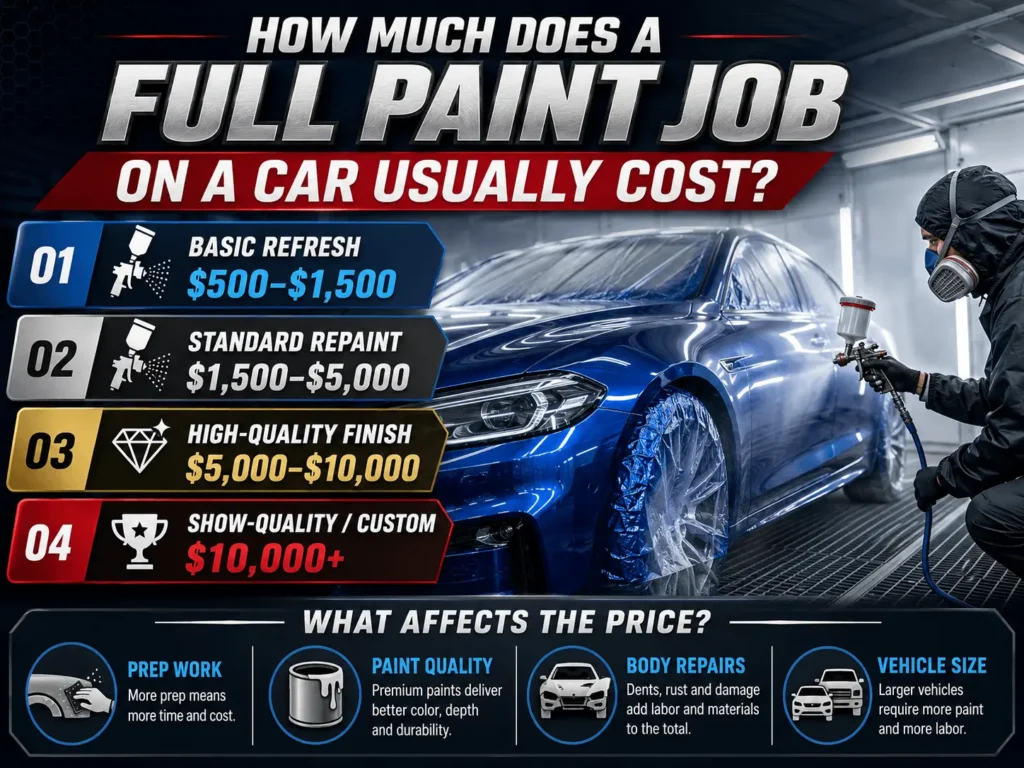
The broad price brackets usually look like this:
- Basic paint job: $300 to $1,000
- Standard professional repaint: $1,000 to $4,500
- Premium paint job: $5,000 to $10,000
- Custom or restoration paintwork: $10,000 to $20,000 or more
These figures are not fixed menu prices. Vehicle size, local labor rates, paint type, body condition, and the shop’s preparation process can move the quote in either direction.
What do you get with a $300 to $1,000 paint job?
A low-cost car paint job normally covers a limited exterior respray with minimal surface correction. It may improve the appearance of an older vehicle, but it will not usually produce a showroom-level finish.
The shop may wash and lightly sand the exterior, cover windows and trim, then spray a basic enamel or lower-cost coating over the existing finish. Small chips, dents, peeling areas, and waves in the body may remain visible afterward.
Door handles, lights, moldings, mirrors, and badges may be masked rather than removed. This saves labor, but it can leave hard paint edges or overspray around trim.
Lower-priced services often come with limits on color selection, preparation time, paint layers, and warranty coverage. Some shops advertise an attractive starting price, then add charges for sanding, primer, body repair, rust removal, or clear coat.
That does not make a budget paint job useless. It can make sense for:
- An older commuter car with low resale value
- A work vehicle that only needs to look cleaner
- A car being prepared for a quick sale
- A vehicle whose owner accepts minor surface flaws
- A project that does not justify several thousand dollars in cosmetic work
The result largely depends on the condition of the car before it enters the booth. New paint will not hide dents, corrosion, cracked filler, or deep sanding marks.
What does a $1,000 to $4,500 paint job include?
A mid-range repaint normally includes more careful sanding, minor body correction, primer where needed, multiple color coats, and a protective clear coat. This is the range most owners consider for a dependable daily driver.
The shop may remove or loosen selected trim pieces, repair small dents, feather damaged paint edges, fill minor scratches, and correct areas where the existing coating has failed.
Surface preparation is a major part of the work. Professional refinishing procedures may include initial cleaning, paint removal, feather-edging, filler shaping, primer application, block sanding, masking, basecoat application, clear coating, curing, polishing, and reassembly. Each stage affects how smooth the finish looks and how well the new coating holds onto the surface.
At this level, the shop is usually trying to create a uniform finish that looks good from normal viewing distance. Small texture differences or minor dust marks may still appear under bright inspection lights, but the work should be much cleaner than a basic respray.
A mid-range job is often the sensible choice when the car is mechanically sound, still has meaningful value, and needs a fresh exterior without becoming a restoration project.
How much does a high-quality paint job cost?
A high-quality full repaint often costs $5,000 to $10,000, while custom, collector, or restoration work can pass $20,000. Much of that money pays for disassembly, body correction, repeated sanding, and finishing labor.
Premium shops may remove bumpers, lights, handles, mirrors, badges, moldings, weather seals, and other exterior pieces before painting. Some jobs also include door jambs, the underside of the hood, the trunk opening, and visible engine-bay areas.
The body may be block-sanded several times to remove ripples and old repair marks. Rust may be cut out rather than covered. Previous filler may be removed and replaced. Panels may be realigned so gaps look even before any color is sprayed.
The shop may then apply epoxy primer, primer surfacer, sealer, basecoat, and several clear-coat layers. After curing, technicians may wet-sand and polish the finish to remove orange peel, nibs, and minor surface texture.
Custom colors add another layer of work. Pearls, candy finishes, metallics, matte coatings, color-changing pigments, and multi-tone patterns can require special ground coats, test panels, extra spray passes, and tighter control over application.
A factory matte finish may add $2,000 to $6,000 or more to the price of a vehicle. Applying a matte finish to a used car can cost even more because exterior parts may need to be removed and the existing surface must be prepared before the new coating goes on.
Why does painting an entire car cost so much?
A complete repaint is expensive because labor, preparation, shop equipment, materials, waste handling, and reassembly all appear in the final estimate. The visible spraying stage may be one of the shorter parts of the job.
A professional painter cannot simply coat over dirt, wax, rust, loose clear coat, or unstable body filler. Contaminants can cause fisheyes, poor adhesion, blistering, peeling, and uneven texture.
The surface must be cleaned and sanded with the correct abrasive grades. Different automotive sanding and preparation stages are used for shaping filler, removing damaged paint, feathering repair edges, and preparing the body for primer. Each finer abrasive reduces the scratches left by the stage before it.
Masking also takes time. Glass, tires, openings, interior surfaces, wiring, cooling components, and unpainted trim must be protected. Poor masking can leave overspray in door openings, wheel wells, exhaust parts, rubber seals, and engine-bay areas.
Paint materials add hundreds or thousands of dollars, depending on the coating system. A full job may require cleaners, abrasives, tape, masking paper, body filler, primer, sealer, basecoat, reducer, hardener, clear coat, polishing compounds, filters, mixing cups, and protective equipment.
Professional shops also carry the cost of spray booths, air filtration, compressors, curing equipment, technician training, insurance, environmental controls, and hazardous-waste handling. Automotive refinishing can release volatile organic compounds and hazardous air pollutants, so compliant shops need suitable coatings, spray equipment, ventilation, and cleanup procedures.
What factors change the price of a full car paint job?
The condition of the body has the strongest effect on price, followed by vehicle size, paint quality, color choice, labor rates, and how much of the car is taken apart.
A clean sedan with intact factory paint may need far less work than a similarly sized sedan with peeling clear coat, rust bubbles, cracked filler, and collision damage.
The condition of the existing paint
Faded paint does not always require complete removal. If the coating is still firmly attached, the shop may sand and prepare it as a stable base.
Peeling, cracking, bubbling, or badly checked paint creates a different problem. Unstable layers may need to be stripped before new primer and color can be applied. Painting over failed material often leads to another failure later.
Rust and corrosion
Surface rust can sometimes be sanded away and treated. Rust that has eaten through the metal may require cutting, welding, panel replacement, or fabrication.
A small bubble beneath the paint can hide a much larger corroded area. Shops may be unable to give a final rust-repair price until they remove the coating and inspect the metal underneath.
Dents and previous repairs
Small dents, creases, waves, and old filler repairs become easier to see after fresh glossy paint is applied. High-gloss coatings reflect light clearly, which makes poor bodywork stand out.
Repairing these areas before painting can add several hundred or several thousand dollars, depending on their number and depth.
Vehicle size
A compact hatchback needs less paint, masking material, sanding time, and booth space than a full-size SUV, van, or pickup truck.
Large vehicles also have more trim pieces, wider panels, longer roof sections, and additional edges that must be prepared.
The original color versus a color change
Repainting a car in its current color usually costs less than changing it to a completely different shade.
When the color stays the same, the shop may focus mainly on the visible exterior. A color change can make the original finish obvious around door jambs, under weather seals, inside the trunk, beneath the hood, and behind trim.
A thorough color change may require partial disassembly and painting areas that are rarely touched during a standard exterior repaint.
Solid, metallic, pearl, and matte finishes
Solid colors are generally easier to apply and repair. Metallic and pearl finishes contain particles that must sit evenly across each panel.
Spray distance, overlap, air pressure, reducer choice, temperature, and gun movement can change how metallic particles lie in the coating. An uneven application can create stripes, dark patches, or mismatched panels.
Matte and satin finishes bring their own challenges. Unlike gloss clear coat, they cannot always be polished in the usual way without changing the sheen.
Local labor rates
A shop’s hourly charge can vary sharply by location. Automotive labor rates in the United States can range from below $100 to above $200 per hour, with many repair shops charging between $120 and $159. Body and paint work follows different estimating methods, but local wages, rent, insurance, and operating costs still affect refinishing quotes.
Large cities, high-rent areas, and regions with strict environmental rules often carry higher shop costs.
The level of disassembly
Masking around a door handle takes less time than removing it, painting behind it, and reinstalling it.
The same applies to bumpers, mirrors, lamps, badges, moldings, glass, and weather seals. Removal produces cleaner edges, but labor rises quickly when many parts are taken off the car.
How much does it cost to repaint a sedan, SUV, truck, or van?
Vehicle size can add hundreds or thousands of dollars because larger bodies need more preparation time and materials. A standard sedan may cost $1,000 to $4,500, while a large SUV or truck may cost $2,000 to $7,000 for comparable work.
These are broad working ranges rather than fixed prices:
Compact car or small coupe
A basic exterior job may cost $500 to $1,500. A better professional repaint often falls between $1,500 and $4,000.
Small cars use less material, but curves, spoilers, body kits, and tightly packed trim can still increase labor.
Midsize sedan
A standard repaint often costs $1,000 to $4,500. Premium work may run from $5,000 to $10,000 or more.
Sedans are usually the reference point for published car-painting price ranges.
SUV or crossover
A full repaint commonly costs $1,500 to $6,000. Large luxury SUVs, three-row models, and vehicles with complex trim can cost more.
Tall roofs and broad quarter panels create added preparation and application time.
Pickup truck
A pickup may cost $1,500 to $7,000, depending on cab size, bed length, body damage, and whether the inside of the bed is included.
Bed removal, rust repair, commercial coatings, and two-tone finishes can raise the bill.
Van or commercial vehicle
A full-size van may cost $2,000 to $8,000 or more. Long sides and tall roofs require more material, booth time, and labor.
Graphics removal, old lettering, adhesive residue, and fleet color requirements may add preparation work.
Does a full paint job include body repair?
A full paint job does not automatically include dent repair, rust removal, panel replacement, or major sanding. These services are often listed separately on the estimate.
Some shops include light preparation in the package, such as scuff sanding and repair of small chips. Deeper dents, corrosion, cracked filler, and peeling layers normally create extra charges.
Ask the estimator to identify which defects will be repaired and which will still be visible after painting. A lower quote may simply leave more flaws untouched.
The estimate should state whether the price includes:
- Dent and scratch repair
- Rust removal
- Paint stripping
- Primer and sealer
- Clear coat
- Trim removal
- Door jambs
- Hood and trunk openings
- Wet sanding and polishing
- Parts and reassembly
- Sales tax and disposal fees
A written breakdown makes competing estimates easier to compare.
Is it cheaper to repaint the car in the same color?
Yes. Keeping the factory color is usually cheaper because fewer hidden areas need to be painted and minor differences are less noticeable around jambs and openings.
The paint code is often found on a label or plate in the door opening, glove box, trunk, engine bay, or owner documentation. The exact location varies by manufacturer.
Even with the correct code, age and sunlight can change the color already on the vehicle. Professional shops may use digital color-matching tools, variant formulas, test panels, and blending methods to account for fading and factory color differences. Accurate matching still depends on careful measurement, formula selection, tinting, and spray technique.
A color change is more expensive because the shop must decide how far the new color will extend. Painting only the outer panels can leave the previous shade visible whenever a door or the trunk is opened.
How long does a full paint job take?
A basic repaint may take two to five working days. A standard job often takes one to two weeks, while restoration or custom work may take several weeks or months.
The timeline depends on the shop’s workload, body repairs, curing requirements, parts removal, weather, material availability, and the number of sanding and polishing stages.
Rust repair can make the schedule less predictable. Once technicians remove paint or trim, they may find corrosion or old collision work that was not visible during the estimate.
A shop offering same-day full-car painting is normally working within a tightly limited preparation package. Fast service is possible, but it usually involves compromises in disassembly and surface correction.
Is repainting a car worth the money?
A repaint can be worthwhile when the vehicle is mechanically dependable, the body is structurally sound, and the cost is reasonable compared with the car’s value.
Spending $4,000 on paint for a car worth $3,500 rarely makes financial sense unless the owner has a personal reason for keeping it. The same expense may be reasonable for a reliable vehicle worth $15,000 that would otherwise need replacement.
Paint can improve appearance and help protect exposed metal, but it does not always increase resale value by the full amount spent. Buyers may also question a complete repaint because it can suggest previous accident damage.
Before approving the work, compare:
- The current market value of the car
- Its expected value after painting
- Mechanical repairs due soon
- The cost of replacing the vehicle
- The owner’s planned length of ownership
- Whether a partial repair would solve the problem
Sentimental vehicles and collector cars follow a different calculation. Their value may come from rarity, originality, family history, or the owner’s personal attachment rather than ordinary resale figures.
Is wrapping a car cheaper than painting it?
A wrap is not always the cheaper choice. The cost of wrapping a full vehicle commonly ranges from about $2,000 to $10,000 or more, placing it in the same price territory as many professional paint jobs
Wrapping may be attractive when the original paint is in good condition and the owner wants a temporary color change. It also offers finishes and graphic options that may be costly to create with paint.
Vinyl does not repair rust, dents, peeling clear coat, or rough bodywork. Those defects can remain visible beneath the material and may prevent proper adhesion.
Paint is usually the stronger choice when the existing finish has failed, bare metal is exposed, or the owner wants a long-term factory-like appearance. A wrap often suits short-term styling, branding, or paint protection.
Can you lower the cost without ruining the result?
The safest way to lower the price is to limit the scope, keep the original color, repair only necessary defects, and compare detailed written estimates.
Removing personal items, washing the vehicle, and supplying replacement trim parts may save a small amount, but owners should not perform sanding or filler work unless the shop agrees. Poor preparation can create more work for the painter.
A practical cost-saving plan may include:
- Repainting only the damaged panels
- Keeping the factory color
- Leaving sound door jambs untouched
- Choosing a common solid color
- Reusing serviceable trim
- Scheduling non-urgent work during a slower period
- Accepting a commercial-quality finish rather than show-car work
Do not choose a quote solely because it is the lowest. A cheap estimate may exclude bodywork, clear coat, trim removal, polishing, or warranty coverage.
What should you ask before hiring a paint shop?
Ask what preparation is included, which parts will be removed, what paint system will be used, and how the shop handles defects found after work begins.
The shop should be able to explain its process in plain language. You do not need every product number, but you should understand what will happen to peeling paint, rust, dents, trim, and hidden openings.
Useful questions include:
- Is body repair included in the quote?
- Will damaged paint be stripped or sanded?
- Are primer, basecoat, and clear coat included?
- Will trim be removed or masked?
- Are door jambs part of the job?
- Does the price include polishing?
- How long is the warranty?
- What problems are excluded from the warranty?
- Can I see recently completed vehicles?
- Could the price rise after sanding begins?
Inspect finished work outside in daylight when possible. Indoor lighting can hide color differences, sanding waves, dust particles, and uneven metallic application.
How can you compare two car painting estimates fairly?
Compare the work being promised rather than the final numbers alone. A $2,000 quote and a $4,000 quote may cover very different amounts of preparation.
One shop may plan to scuff the existing paint, mask the trim, and spray the outer panels. Another may remove trim, repair dents, prime damaged sections, blend color carefully, clear the full body, then sand and polish the finish.
Ask both shops to describe:
- Surface preparation
- Body repairs
- Paint brand and coating type
- Number of paint stages
- Clear-coat coverage
- Disassembly
- Hidden-area painting
- Final polishing
- Warranty terms
The quote with the higher price may offer better value when it prevents peeling, overspray, visible edges, and costly rework.
How much should you realistically budget?
A realistic budget for a clean, professional full-car repaint is about $2,000 to $5,000 for an ordinary sedan in fair condition. Larger vehicles, damaged bodies, color changes, and premium finishes require more room in the budget.
Keep an extra 10% to 20% available for defects uncovered during sanding. Old filler, rust beneath trim, poor previous repairs, and failing primer may not be visible during the first inspection.
Owners seeking a basic cosmetic refresh may spend less than $1,000, but expectations should match the package. Those seeking straight panels, clean jambs, removed trim, deep gloss, and near-show quality should expect at least several thousand dollars.
The best paint job is not automatically the most expensive one. It is the one that matches the vehicle’s value, condition, purpose, and expected years of use.
A good paint job starts with a clear scope, not the lowest quote
A full car paint job usually costs $1,000 to $4,500, but the number means little until you know what sits behind it. Preparation, body repair, disassembly, coating quality, and finishing labor determine whether the new paint lasts or begins showing problems within months.
Ask for a written scope. Study the shop’s completed work. Look closely at trim edges, panel texture, color consistency, and overspray. Most of all, be honest about what the vehicle needs.
An older work car may only need an affordable refresh. A long-term keeper deserves stronger preparation and better materials. Spending money in the right places can turn a tired exterior into a car you enjoy seeing in the driveway again.