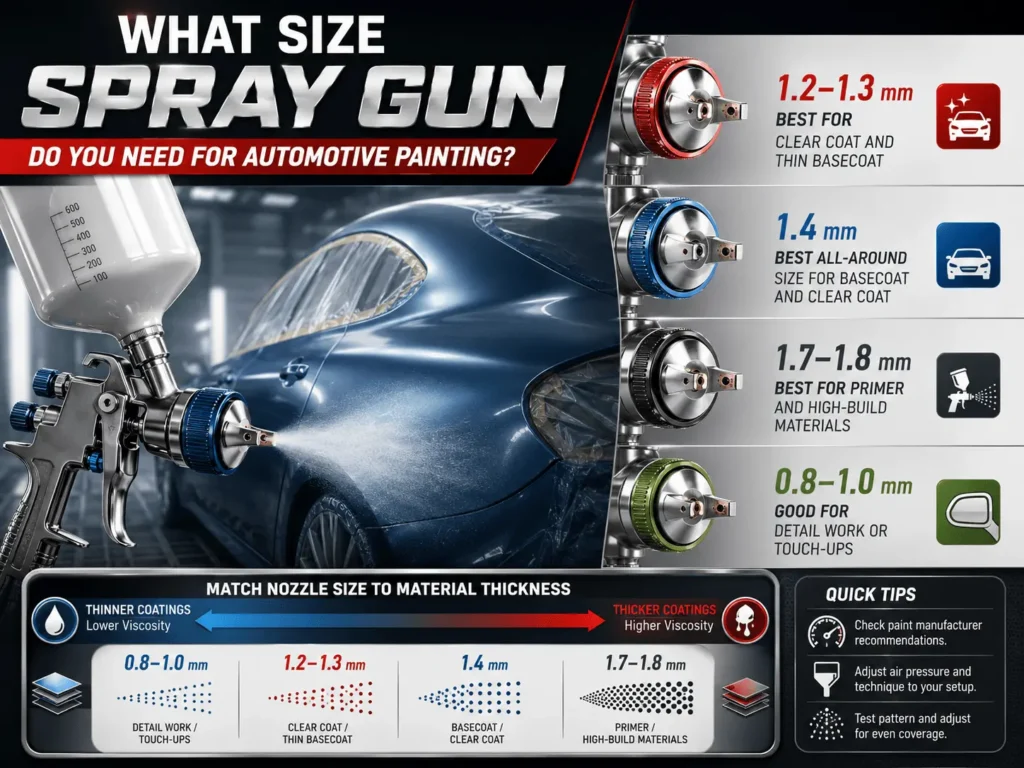
The right spray gun size depends less on the size of the gun body and more on the fluid tip, nozzle opening, and spray pattern. For most automotive paintwork, a 1.3 mm or 1.4 mm tip works well for base coat and clear coat. Thicker materials, such as high-build primer, often need a 1.7 mm to 2.0 mm tip.
That simple answer covers many paint jobs, but it is not a fixed rule. Paint thickness, reducer ratio, gun design, air pressure, panel size, and the coating maker’s technical sheet can all change the best choice.
Using the wrong tip can leave dry spray, runs, orange peel, poor coverage, or a rough primer coat. A correctly matched setup gives the material enough room to flow while still breaking it into fine, even droplets.
What does spray gun size mean in automotive painting?
Spray gun size usually refers to the diameter of the fluid nozzle, measured in millimeters. A 1.3 mm nozzle has a smaller opening than a 1.8 mm nozzle, so it normally releases less material with the same settings.
Painters sometimes use “gun size” to describe three different things:
- Fluid tip or nozzle size
- Full-size, compact, or mini spray gun
- Width of the spray fan
The fluid tip is the main concern when matching a gun to automotive paint. It controls how much liquid can pass through the front of the gun.
A smaller opening suits thin materials and fine finish work. A larger opening suits thicker coatings that need more material flow.
The air cap, needle, paint viscosity, and fluid control setting also affect delivery. Two spray guns with matching 1.3 mm tips may not spray in exactly the same way. Internal design, air pressure, and nozzle shape can make one gun feel faster or wetter than another.
What is the best all-around spray gun tip size for automotive paint?
A 1.3 mm or 1.4 mm fluid tip is the best general-purpose choice for most automotive base coats, clear coats, and many single-stage paints.
A 1.3 mm tip usually gives slightly finer control and lower material delivery. It can be useful for metallic base coats, thinner clears, and painters who prefer several controlled passes.
A 1.4 mm tip releases a little more material. It is often easier for beginners because it can lay down a wetter coat without opening the fluid control as far.
A 1.3 mm or 1.4 mm tip suits most solvent base coats, while clear coat usually sprays well through a 1.2 mm to 1.4 mm opening. Single-stage paint often works best around 1.4 mm, though the exact choice still depends on the paint formula and gun design.
For someone buying one gun for base coat and clear coat, a 1.3 mm or 1.4 mm setup is the most practical starting point. It will not replace a larger primer gun, but it can cover most finish-coat work.
Spray gun tip size chart for automotive paint
The following ranges are common starting points rather than universal settings.
| Automotive coating | Common spray tip size |
| Solvent base coat | 1.3–1.4 mm |
| Waterborne base coat | 1.1–1.3 mm |
| Clear coat | 1.2–1.4 mm |
| Single-stage paint | 1.3–1.5 mm |
| Sealer | 1.3–1.4 mm |
| Wet-on-wet primer | 1.3–1.4 mm |
| Primer surfacer | 1.6–1.8 mm |
| High-build primer | 1.7–2.0 mm |
| Epoxy primer | 1.4–1.8 mm |
| Polyester primer | 2.0–2.5 mm |
| Metallic or pearl effect coat | 1.2–1.3 mm |
| Small spot repair | 0.8–1.2 mm |
These figures should never replace the product data sheet. A paint maker may call for a different nozzle because its resin content, solids level, reducer system, or target film thickness differs from another brand.
What size spray gun tip should you use for primer?
Most automotive primers need a larger tip than base coat or clear coat because primer contains more solids and has a heavier body.
A 1.7 mm to 1.8 mm tip is a sound starting point for primer surfacer. High-build primer may call for a 1.8 mm to 2.0 mm tip, while thick polyester primer may need a 2.0 mm to 2.5 mm opening.
A smaller tip may still push primer through, but the gun can struggle. The painter may need to add too much reducer, raise air pressure, or pull the trigger more slowly. Those workarounds can change film build and drying behavior.
A tip that is too large creates the opposite problem. The gun may flood the panel, create runs, or apply primer much thicker than intended.
Primer surfacer
Primer surfacer fills sanding scratches and small surface flaws before blocking. It usually sprays well through a 1.6 mm, 1.7 mm, or 1.8 mm tip.
A 1.6 mm tip gives tighter control with thinner surfacers. A 1.8 mm tip moves more material and suits heavier coats.
Primer surfacer can spray through a 1.4 mm, 1.6 mm, or 1.8 mm tip, depending on its thickness. A lighter product may atomize cleanly through the smaller opening, while a heavier surfacer usually needs more fluid flow.
High-build primer
High-build primer is designed to create enough film thickness for sanding and surface correction. A 1.8 mm to 2.0 mm tip is normally the safer range.
Trying to force high-build primer through a 1.3 mm finish gun often leads to poor atomization and uneven material flow. The painter may also thin the primer beyond its stated mixing instructions, which can reduce its filling ability.
Epoxy primer
Epoxy primer varies widely. Some epoxy sealers spray well through a 1.3 mm or 1.4 mm tip, while heavier epoxy primers may need 1.6 mm to 1.8 mm.
The intended use matters. A reduced epoxy used as a sealer is much thinner than an unreduced epoxy used for corrosion protection and film build.
Polyester primer
Polyester primer is among the thickest sprayable automotive coatings. It often needs a 2.0 mm to 2.5 mm tip.
Many painters keep a separate gun for polyester material because residue can harden quickly and cleaning demands more care. A dedicated gun also avoids moving between a large primer setup and a fine finish setup.
What tip size is best for automotive base coat?
A 1.3 mm tip is one of the most common choices for automotive base coat. A 1.4 mm tip can also work well, particularly with thicker solvent base coats or painters who prefer faster coverage.
Base coat needs fine, even atomization. Poor droplet control can create mottling, striping, patchy metallic orientation, or uneven color.
A 1.2 mm tip may suit thin base coats and detailed work. Waterborne systems may also work well with smaller openings because the coating and gun are designed around controlled material delivery.
The right opening also depends on whether the color is solvent-based or waterborne. Solvent base coat commonly sprays through a 1.3 mm or 1.4 mm tip, while many waterborne colors work well with 1.1 mm to 1.3 mm openings.
Solid-color base coat
Solid colors are usually more forgiving than metallics. A 1.3 mm or 1.4 mm tip can provide even coverage without releasing too much paint.
The gun should still create a uniform fan from top to bottom. A heavy center or weak edge can leave visible overlap marks.
Metallic base coat
Metallic paint benefits from fine atomization and careful material control. A 1.2 mm or 1.3 mm tip is often a good match.
Too much material can cause metallic particles to gather or lie unevenly. The result may look darker in some areas and lighter in others.
Gun distance, overlap, air pressure, reducer speed, and final orientation coat all matter as much as the tip size.
Pearl and effect coats
Pearl midcoats are normally thin and are applied in controlled passes. A 1.1 mm to 1.3 mm tip is common.
These coats do not usually need heavy flow. The painter is building visual effect rather than hiding the surface in one pass.
What size spray gun tip should you use for clear coat?
Most automotive clear coats spray well through a 1.2 mm, 1.3 mm, or 1.4 mm tip. A 1.3 mm tip is the most common middle choice.
A smaller tip can create fine atomization and good control, but the gun may need slower passes or more fluid adjustment. A larger tip can produce a wetter coat more quickly, though it leaves less room for hesitation.
A 1.3 mm automotive refinish gun can handle waterborne base coat, solvent base coat, and many 1K and 2K topcoats. That versatility is one reason this size is so common in dedicated finish guns.
When a 1.2 mm tip makes sense
A 1.2 mm clear coat setup can work well for a painter who moves slowly, sprays thin clear, or wants tight fluid control.
It may also suit compact repairs where excessive material could cause runs around panel edges and body lines.
The risk is applying the clear too dry. If the gun cannot deliver enough product, the finish may have coarse orange peel or weak flow.
When a 1.3 mm tip makes sense
A 1.3 mm tip is a balanced choice for many modern clears. It can provide enough material for a wet coat without feeling overly aggressive.
It also works well for painters who use the same finish gun for base coat and clear coat, provided the gun is cleaned properly between materials.
When a 1.4 mm tip makes sense
A 1.4 mm tip suits thicker clears, faster painters, and large-panel work. It can lay down a fuller coat with less fluid adjustment.
The extra delivery requires disciplined gun speed. Pausing at the end of a pass or moving too slowly can create sags quickly.
What size tip should you use for single-stage automotive paint?
A 1.3 mm to 1.5 mm tip is a sensible range for single-stage automotive paint. A 1.4 mm nozzle is the most common starting point.
Single-stage paint combines color and gloss in one coating system. It often needs more material flow than base coat because the painter is building coverage and finish depth at the same time.
Some single-stage urethanes spray well through 1.3 mm. Heavier products may feel better through 1.4 mm or 1.5 mm.
The data sheet remains the deciding source. Mixing ratio and reducer selection can change how the paint behaves through the gun.
Do you need separate spray guns for primer, base coat, and clear coat?
Separate guns are not always required, but using at least two guns makes automotive painting easier.
A practical setup is:
- One 1.7 mm or 1.8 mm gun for primer
- One 1.3 mm or 1.4 mm gun for base coat and clear coat
- A three-gun setup gives more control:
- Primer gun: 1.7–2.0 mm
- Base coat gun: 1.2–1.3 mm
- Clear coat gun: 1.3–1.4 mm
Primer residue can be difficult to remove from small passages. Even a small amount left inside the gun can contaminate base coat or clear coat.
A dedicated clear gun also avoids color contamination. Dark base coat left around the needle packing or fluid passage can enter the clear during a later job.
Modern replaceable-nozzle systems can cover many coating types with one gun body. Some systems offer heads from 0.9 mm through 2.0 mm, allowing the painter to change material type without buying a separate body for every coating.
Full-size, compact, or mini spray gun: which one do you need?
A full-size gun is better for complete vehicles and large panels. A mini gun is better for bumper corners, mirror caps, door jambs, and small repairs.
The fluid tip number alone does not describe how much area the gun can cover. Spray fan width and air cap design also matter.
Full-size spray gun
A full-size automotive spray gun commonly creates a fan around 10 to 12 inches wide, depending on the model and settings.
It suits:
- Complete vehicle resprays
- Hoods
- Roofs
- Doors
- Quarter panels
- Large bumpers
The wider fan reduces the number of passes needed. That helps maintain a wet edge across a large panel.
Compact spray gun
A compact gun sits between a full-size and mini gun. It offers more control in tight spaces without creating such a narrow pattern that large panels become slow.
It can work well for:
- Motorcycle tanks
- Bumpers
- Fenders
- Small body panels
- Door jambs
- Medium spot repairs
- Mini spray gun
A mini gun often uses a 0.8 mm to 1.2 mm tip and a narrower spray pattern.
It suits:
- Small blend areas
- Mirror caps
- Pillars
- Trim pieces
- Wheel repairs
- Small primer spots
- Touch-up work
A mini gun is not the best choice for painting an entire car. The narrow fan requires many passes, making it harder to keep metallic orientation and wetness consistent across wide panels.
Does HVLP or RP technology change the nozzle size?
HVLP, compliant, and reduced-pressure guns can use similar nozzle sizes, but they may deliver paint differently.
HVLP guns use a high volume of air at lower cap pressure. They often provide good transfer efficiency but may need a compressor that can supply strong, steady airflow.
Reduced-pressure guns usually work at a somewhat higher cap pressure and can atomize paint with a faster, sharper feel. Depending on the model, they may move material more quickly even when the stated tip size matches an HVLP gun.
A 1.3 mm HVLP gun and a 1.3 mm reduced-pressure gun should not be treated as identical. The air cap, internal passages, needle taper, and recommended inlet pressure can change the result.
Air demand can remain fairly high even with a reduced-pressure finish gun. A 1.3 mm RP automotive spray gun may use about 290 liters per minute, or roughly 10.2 CFM, so a small compressor can still struggle during long passes.
How does paint viscosity affect spray gun tip size?
Thicker paint normally needs a larger fluid tip. Thinner paint can pass through a smaller opening and still atomize cleanly.
Viscosity changes with:
- Paint chemistry
- Reducer amount
- Activator choice
- Shop temperature
- Product temperature
- Solids content
- Time after mixing
Cold paint usually feels thicker than warm paint. A coating that sprays well in a warm booth may move slowly in a cold garage.
Adding extra reducer is not always the right answer. Excessive reduction can lower coverage, alter film build, slow hiding, and change drying behavior.
When correctly mixed paint still feels restricted, move up one nozzle size instead of adding extra reducer. If the gun releases too much material and floods the panel, move down one size.
How does compressor size affect spray gun choice?
A spray gun cannot atomize paint correctly without enough air volume. The compressor must meet the gun’s cubic-feet-per-minute requirement at the stated pressure.
Many full-size HVLP guns require roughly 9 to 15 CFM. Some use more. Mini guns often need less air, though the exact figure depends on the air cap and gun design.
A small compressor may reach the set pressure while idle but fall behind during a long pass. The spray pattern then becomes weaker as tank pressure drops.
Common signs of inadequate airflow include:
- The fan narrows during spraying
- Droplets become coarse
- Paint lands dry
- Pressure falls while the trigger is held
- The compressor runs without catching up
- Metallic paint begins to look patchy
The regulator reading should be checked with the trigger fully pulled. Static pressure does not show what the gun receives during actual spraying.
Hose diameter, hose length, quick-connect fittings, moisture filters, and wall plumbing can also restrict airflow.
What happens when the spray gun tip is too small?
A tip that is too small restricts material flow and may create a dry, uneven coat.
The painter may respond by opening the fluid control fully, moving closer, slowing down, or raising pressure. Each correction can introduce another problem.
Common results include:
- Dry spray
- Rough texture
- Weak coverage
- Coarse orange peel
- Uneven metallic distribution
- Excessive overspray
- Too many coats
- Reduced primer build
A small tip is not automatically better because it creates finer droplets. The gun still has to deliver enough coating to meet the paint system’s film requirements.
What happens when the spray gun tip is too large?
A tip that is too large releases more paint than the job may need.
The coating can land too wet, especially on vertical panels. Runs often appear around body lines, panel edges, handles, and lower sections where gun speed changes.
Other problems can include:
- Sags
- Solvent popping
- Excessive film thickness
- Slow curing
- Trapped solvent
- Poor metallic control
- Wasted paint
- Heavy orange peel caused by overloading the surface
A larger tip can still be used with reduced fluid settings, but the control range may feel sensitive. A small turn of the fluid knob can create a large change in delivery.
How do you check whether the tip size is right?
A spray test on masking paper or a spare panel can reveal whether the gun and coating are working together.
Mix the paint exactly as stated. Set the inlet pressure with the trigger pulled, open the fan control, and begin with a moderate fluid setting.
Hold the gun at the working distance listed for the gun, usually around 6 to 8 inches for many automotive setups. Pull the trigger for a brief test.
A healthy pattern should look even from top to bottom. It should not be heavy in the center, split at both ends, or weak on one side.
Then spray a short pass on a test panel. Look for fine, consistent droplets that join into a smooth film without flooding the surface.
Changing pressure should not be the only correction. Fluid setting, fan width, travel speed, paint reduction, and tip size work together.
What spray gun setup should a beginner buy?
A beginner painting cars at home can cover most jobs with two guns.
Choose a 1.3 mm or 1.4 mm full-size finish gun for base coat, clear coat, and many single-stage paints. Add a 1.8 mm primer gun for primer surfacer and high-build primer.
A mini gun with a 1.0 mm or 1.2 mm tip is useful later for small repairs, but it is not the first purchase for someone planning to paint full panels.
The compressor deserves equal attention. A high-quality gun connected to an undersized compressor will still spray poorly.
A sensible starter setup includes:
- 1.3 mm or 1.4 mm finish gun
- 1.8 mm primer gun
- Regulator mounted near the gun
- Water separator
- Air hose large enough for the gun
- Mixing cups and strainers
- Test panels or masking paper
- Suitable respiratory and skin protection
Can one 1.4 mm gun paint an entire car?
Yes, a 1.4 mm gun can apply base coat and clear coat across an entire vehicle, provided the paint system approves that nozzle size and the compressor can support the gun.
It can also spray some sealers and reduced primers. It is less suitable for thick high-build primer.
Using one gun for both color and clear calls for careful cleaning. The cup, fluid passage, nozzle, air cap, and needle area must be free of pigment before clear coat enters the gun.
A single gun setup saves money, but it also slows the job. Separate finish guns let the painter keep base coat and clear coat ready without rushing through cleaning between stages.
The right spray gun size starts with the coating, not the car
The most useful general rule is simple: use a 1.3 mm or 1.4 mm tip for base coat and clear coat, a 1.7 mm to 2.0 mm tip for primer, and a 0.8 mm to 1.2 mm mini gun for small repairs.
Those ranges give you a sensible starting point, not a substitute for the paint maker’s instructions. The technical sheet, gun manual, paint temperature, reducer choice, and test pattern should guide the final setup.
A good painter does not try to force every coating through one nozzle. Matching the opening to the material makes the gun easier to control and gives the paint a better chance to settle into a clean, even finish.