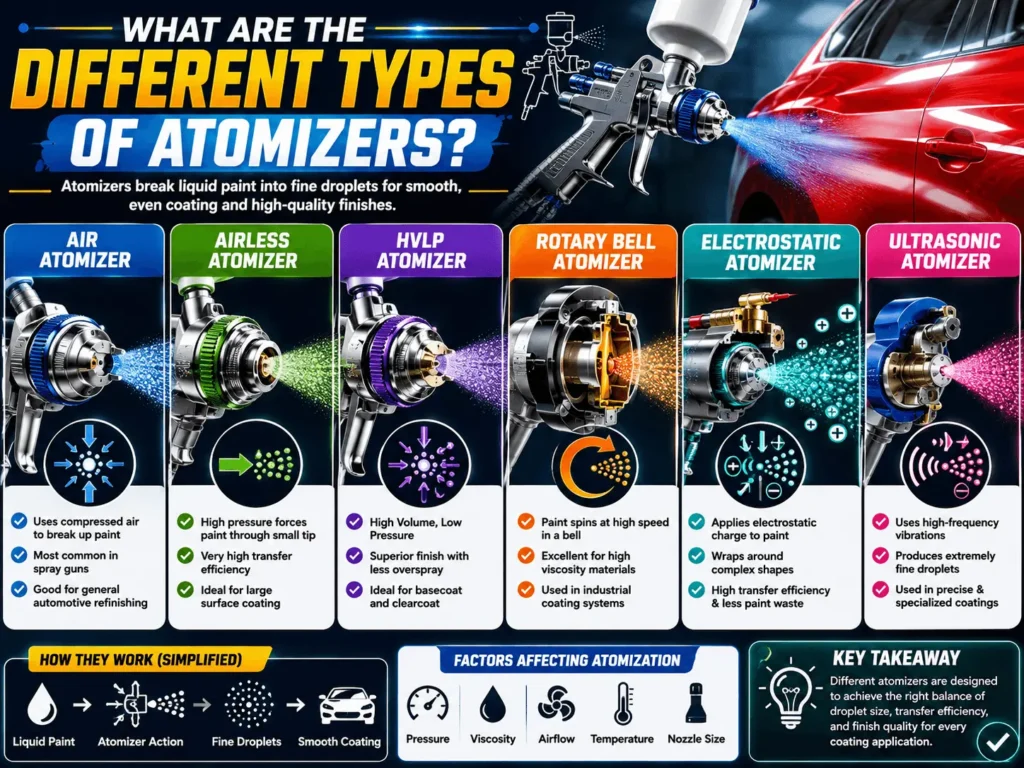
Atomizers turn a continuous liquid supply into droplets, but they do not all create a spray in the same way. Some force liquid through a small opening. Others use compressed air, fast-spinning cups, ultrasonic vibration, or an electrical charge.
The main types of atomizers are hydraulic, pneumatic, airblast, air-assisted airless, rotary, ultrasonic, and electrostatic atomizers. Pressure-swirl and effervescent designs also serve specialized industrial processes.
Choosing the wrong type can lead to coarse droplets, overspray, poor coating coverage, blocked nozzles, wasted material, or unstable combustion. The right choice depends on liquid viscosity, desired droplet size, flow rate, spray pattern, production speed, and the surface or process receiving the spray.
What is an atomizer?
An atomizer is a device that breaks bulk liquid into a spray of small droplets. It supplies energy to the liquid through pressure, moving air, rotation, vibration, or electrical forces.
Atomization does not turn a liquid into individual atoms. The name refers to breaking liquid into droplets that are much smaller than the original stream.
A perfume bottle, paint gun, agricultural sprayer, fuel injector, medical nebulizer, and rotary paint bell all perform atomization. Their internal designs differ because each application needs a particular droplet size, spray speed, flow rate, and coverage pattern.
Droplet size matters because smaller droplets provide more total surface area than the same liquid volume divided into larger drops. That extra surface area can support faster evaporation, combustion, drying, chemical reaction, or film formation.
Very fine droplets also lose momentum quickly and can drift away from the target. A successful atomizer must create droplets that are small enough for the process without making them so fine that control is lost.
What are the main types of atomizers?
Atomizers are commonly grouped according to the energy used to break the liquid apart. The main groups include pressure atomizers, twin-fluid atomizers, rotary units, ultrasonic devices, and electrically assisted systems.
Several names can overlap. A spray gun may be both pneumatic and electrostatic, while a rotary bell may use centrifugal force, shaping air, and an electrical charge at the same time.
Hydraulic pressure atomizers
A hydraulic atomizer uses liquid pressure to force material through a carefully shaped orifice. The sudden pressure drop and interaction with the surrounding air cause the liquid sheet or jet to break into droplets.
No separate atomizing air supply is required. A pump, pressure vessel, or pressurized liquid line provides the energy.
Hydraulic nozzles are widely used because their design is relatively simple. They appear in water cooling, dust suppression, chemical processing, humidification, agriculture, fire protection, washing, and coating work.
Droplet size changes with nozzle geometry, liquid pressure, viscosity, surface tension, and flow rate. Raising pressure generally produces finer atomization, though the relationship is not unlimited. Very high pressure also increases pump demand, nozzle wear, mist production, and safety risks.
Small orifices can produce finer sprays at lower flow rates, but they are more likely to block when the liquid contains particles or dried material. Filtration and regular inspection become more important as the opening becomes smaller.
Pressure-swirl atomizers
A pressure-swirl atomizer is a hydraulic design that gives the liquid a rapid spinning motion inside a swirl chamber. The rotating liquid leaves the orifice as a thin conical sheet, which then separates into ligaments and droplets.
This design often creates a hollow-cone spray, meaning much of the liquid is concentrated around the outer part of the cone. Full-cone versions can also be produced through changes in the internal geometry.
Pressure-swirl units are found in oil burners, gas turbines, industrial furnaces, spray dryers, cooling systems, and agricultural equipment. They can create relatively fine droplets without an external air supply.
Performance may become less stable at very low flow rates because enough pressure and swirl must be maintained. Thick liquids can also resist sheet formation and produce larger droplets than a lower-viscosity liquid under the same conditions.
Airless atomizers
Airless atomization is a high-pressure hydraulic method commonly used for paint, protective coatings, roof materials, fireproofing compounds, and other medium- to high-viscosity products.
The coating is pumped through a small tip at high pressure. Once it leaves the tip, the liquid stream expands and breaks into a fan of droplets.
Airless spraying can apply a large amount of material quickly. It is well suited to primers, protective coatings, and larger surfaces where production speed and film build matter more than an exceptionally fine decorative finish.
The method does not mix compressed air with the coating at the spray tip. This cuts compressed-air demand, but high fluid pressure can create a harder spray pattern and more bounce-back on some surfaces.
Airless injection injuries are a serious hazard because the fluid can penetrate skin. Equipment must be depressurized before tip cleaning, repair, or hose removal.
Pneumatic or two-fluid atomizers
A pneumatic atomizer uses a fast-moving gas, usually compressed air, to break liquid into droplets. It is also called an air atomizer, twin-fluid nozzle, or two-fluid atomizer because liquid and gas both enter the spraying device.
The air creates shear forces that tear the liquid stream or film into fine droplets. Liquid pressure can remain lower than it would in a hydraulic system because the gas supplies much of the atomizing energy.
Pneumatic atomizers offer broad control over droplet size and spray shape. Operators can change air pressure, liquid flow, or both to adjust the spray.
They are used in spray drying, coating, lubrication, humidification, pharmaceutical production, food processing, chemical treatment, and combustion.
Compressed-air use is the main operating drawback. Air systems need compressors, filters, regulators, and piping. Excessive atomizing air may also produce very fine droplets that dry early, drift, or create overspray.
Internal-mix atomizers
An internal-mix atomizer brings liquid and compressed gas together inside the nozzle before the mixture leaves the outlet. Their contact creates turbulence and breaks the liquid apart.
Internal mixing can produce a fine spray at relatively low liquid pressure. It works well when close control over droplet size is needed and when the liquid can pass through small internal passages.
The narrow passages make these atomizers less suitable for fluids that contain abrasive particles, fibers, or solids likely to settle. Material may also enter the air path when pressure settings are poorly balanced.
Applications include coating tablets, applying flavors, spraying release agents, humidifying air, and adding controlled moisture to products.
External-mix atomizers
An external-mix atomizer keeps liquid and gas separate until both leave the nozzle. The fast-moving gas meets the liquid outside the nozzle and breaks it into droplets.
This layout can handle thicker liquids and materials that may cause trouble inside an internal-mix design. Liquid and air flow can often be controlled more independently.
External mixing can also reduce the chance of material backing into the air passages. The spray may be less uniform than a carefully selected internal-mix unit in some low-viscosity applications.
Adhesives, viscous coatings, glazes, oils, food ingredients, and abrasive suspensions are common candidates for external-mix atomization.
Airblast atomizers
An airblast atomizer uses a large volume of moving air to spread a liquid film and tear it into droplets. Air velocity is usually more important than extremely high air pressure.
Many designs first spread the liquid over a surface called a prefilmer. High-speed air then passes across the thin film and breaks it into ligaments and droplets.
Airblast atomizers are widely associated with aircraft engines, industrial gas turbines, furnaces, and high-capacity combustion systems. They can handle high liquid flow while producing fine fuel droplets across a useful operating range.
Their performance depends on airflow, liquid distribution, internal geometry, and the relationship between gas and liquid flow, all of which affect droplet size, velocity, and liquid distribution within an airblast spray. Poor liquid distribution can create uneven droplet sizes and unstable spray regions.
Air-assisted airless atomizers
Air-assisted airless spraying combines hydraulic atomization with a smaller amount of compressed air. Fluid pressure first forms most of the spray, while low-pressure air at the cap softens and completes the pattern.
The method usually operates at lower fluid pressure than traditional airless spraying. It can create a finer finish with less forceful spray behavior while retaining a good production rate.
Wood finishing, metal fabrication, machinery coating, cabinets, and waterborne coating lines often use air-assisted airless guns. The method handles materials that may be too thick for conventional air spray but still need a smoother appearance than basic airless spraying provides.
Setup requires balance. Too little assisting air can leave heavy edges or “tails” in the fan. Too much air may create dry spray, mist, and material loss.
Conventional air-spray atomizers
A conventional air-spray gun mixes a low-pressure liquid supply with compressed air at the air cap. Air jets break up the liquid and shape it into a round or fan pattern.
This atomizer can produce fine droplets and a smooth decorative finish. It remains common in automotive refinishing, furniture work, small-part coating, touch-up jobs, and applications where appearance has high value.
The trade-off is lower material transfer compared with some other methods. Fast air can carry droplets past the workpiece, creating overspray and higher booth loading.
Fluid nozzle size, air-cap design, air pressure, coating thickness, and gun distance all affect the result. A setup that works well with clearcoat may perform poorly with a thick primer.
HVLP atomizers
High-volume, low-pressure atomizers use a high airflow at relatively low air-cap pressure. The softer spray lowers droplet velocity compared with many conventional air-spray guns.
HVLP equipment is popular in automotive refinishing, woodworking, furniture coating, and smaller industrial finishing lines. It can provide strong control and good material transfer when the air supply and fluid setup match the coating.
A large enough air volume is still needed. Undersized compressors, narrow hoses, restrictive fittings, or clogged filters can starve the gun and produce coarse atomization.
HVLP is not automatically the right choice for every thick material. High-viscosity coatings may need thinning, a larger fluid tip, heating, or another atomization method.
LVLP and compliant atomizers
Low-volume, low-pressure atomizers use less air than many HVLP designs. They are often chosen where compressor capacity is limited or where smaller repair work does not call for a high-output gun.
Compliant spray guns are built to meet specified air-pressure or transfer requirements while producing a finish closer to conventional air spray. Naming and legal definitions can vary between regions.
Both types sit between broad spray categories rather than representing entirely separate physical atomization principles. Air still breaks and shapes the liquid, but the gun and air-cap geometry control how much air is needed and how quickly droplets travel.
How do rotary atomizers work?
Rotary atomizers use centrifugal force from a fast-spinning cup, bell, wheel, or disc. Liquid enters near the center, spreads into a thin film, moves toward the edge, and breaks into droplets as it leaves.
Rotation speed, liquid flow, cup diameter, edge shape, viscosity, and surface tension affect the final droplet distribution.
Rotary atomization can process high liquid flow without forcing material through a very small opening. That reduces certain blockage problems, though the rotating assembly requires accurate balance and mechanical care.
Rotary bell atomizers
A rotary bell atomizer uses a cup-shaped bell rotating at very high speed. Paint flows across its inner surface and leaves the bell edge as fine droplets.
Shaping air controls the diameter and direction of the spray cloud. Many automotive paint robots use electrostatically charged rotary bells because they can produce a uniform finish while transferring a large share of the sprayed coating onto a grounded vehicle body.
Bell speed may be adjusted to change atomization, though speed cannot be viewed alone. Paint flow, shaping air, bell-cup design, electrical settings, and robot motion all affect film build and appearance.
Rotary bells suit large, automated finishing lines. Their cost, controls, cleaning needs, and high-voltage safety requirements usually make them less practical for simple manual spraying.
Rotary disc and wheel atomizers
Rotary discs and wheels spread liquid outward from a spinning surface. They are common in spray drying, cooling, chemical processing, and pollution-control equipment.
A spray dryer may use one large rotary atomizer near the top of the chamber. Feed liquid or slurry reaches the wheel, leaves as droplets, and contacts hot gas. Moisture evaporates, leaving dry particles.
Rotary wheels can handle substantial flow and may accept liquids or slurries that would block a very small pressure nozzle. Wear, deposits, imbalance, bearing condition, and drive maintenance remain key operating concerns.
What is an ultrasonic atomizer?
An ultrasonic atomizer uses high-frequency mechanical vibration to break a thin liquid film into very small droplets. A piezoelectric transducer changes electrical energy into vibration, which travels to the atomizing surface.
The liquid spreads across the vibrating tip or surface. Waves form in the film until the liquid separates into droplets and leaves as a soft, low-velocity mist.
Ultrasonic atomization does not need the high liquid pressure used by airless systems or the large compressed-air supply used by pneumatic nozzles. The gentle spray can reduce bounce-back and may help when coating small, delicate, or valuable parts.
Electronics, medical devices, fuel cells, thin-film coating, laboratory work, humidification, and some pharmaceutical processes use ultrasonic atomizers.
Flow capacity is often lower than that of large hydraulic or rotary systems. Thick fluids, high solids, large particles, and rapidly drying materials can interfere with the vibrating surface. The liquid must also wet and spread across the atomizing face properly.
Operating frequency affects droplet formation. Higher frequencies generally create smaller droplets, while liquid properties and flow rate also influence the result.
What is an electrostatic atomizer?
An electrostatic atomizer gives droplets an electrical charge so they are attracted to an oppositely charged or grounded target. Electrostatic force does not always create the droplets by itself; it often works alongside air spray, air-assisted airless, or rotary atomization.
Charged paint droplets follow the electric field toward the part. This can increase coating coverage on edges, tubes, frames, and curved shapes. Some droplets can wrap around the rear-facing sides of narrow objects.
Electrostatic systems are common in automotive plants, appliance factories, metal furniture lines, bicycle-frame coating, and general industrial finishing.
Good grounding is central to safe and reliable operation. Dirt, poor contact, insulated hangers, thick coating deposits, or incorrect electrical resistance can weaken attraction.
Deep recesses can remain difficult because the electric field may concentrate around outer edges. This behavior is linked with the Faraday cage effect. Voltage, flow, spray distance, part shape, and grounding need to be set for the actual component.
Electrohydrodynamic atomizers
Electrohydrodynamic atomization uses a strong electric field to deform liquid at a small outlet. Under suitable conditions, the liquid forms a cone and emits a fine jet that breaks into charged droplets.
This method is often known through electrospray applications. It can create very small, narrowly distributed droplets at low flow rates.
Mass spectrometry, microencapsulation, pharmaceutical research, material deposition, and particle production use forms of electrospray.
The method is less suited to ordinary high-volume coating because output from one emitter is small. Multi-emitter arrays can raise capacity, but electrical control, liquid conductivity, outlet condition, and spacing become more demanding.
What are effervescent atomizers?
An effervescent atomizer mixes a small amount of gas into the liquid before discharge. Gas bubbles expand as pressure falls near the outlet, causing the liquid to break apart.
Unlike many twin-fluid nozzles, the gas-to-liquid ratio can be relatively low. This may cut compressed-gas demand while still producing fine droplets.
Effervescent units can handle thicker fuels, slurries, waste liquids, and variable fluid properties better than some pressure-only nozzles. Applications include combustion, spray drying, waste treatment, and experimental fuel systems.
Internal passages and mixing quality affect performance. Large particles or deposits can still cause blockage, while unstable gas supply may change the spray.
Are nebulizers and misters types of atomizers?
Nebulizer and mister are application-based names rather than single atomizer designs. They describe equipment intended to create a fine aerosol or mist.
A medical nebulizer may use compressed gas, a vibrating mesh, or ultrasonic energy. An industrial misting system may use high-pressure hydraulic nozzles or twin-fluid atomizers.
Fogging units follow the same pattern. Thermal foggers use heat and moving gas, while cold foggers may use air shear, pressure, or rotation.
The name alone does not reveal how the droplets are produced. Buyers should check the atomization principle, droplet range, output rate, fluid compatibility, and cleaning needs.
How are atomizers classified by spray pattern?
Atomizers can also be grouped according to the shape and liquid distribution of the spray. Common patterns include flat fan, full cone, hollow cone, round jet, and wide mist.
A flat-fan pattern forms a thin sheet suited to moving production lines, overlapping passes, washing, and surface coating.
A full-cone pattern spreads droplets throughout a circular area, with pressure and flow rate affecting its spray angle and droplet distribution. Cooling, chemical injection, fire control, and washing often use this pattern.
A hollow-cone spray concentrates droplets near the outside of the cone. Pressure-swirl fuel nozzles, cooling applications, and some agricultural sprayers use hollow cones.
Round sprays support spot coating, lubrication, marking, and narrow-area treatment. Wide mists suit humidification, dust control, odor treatment, and evaporative cooling.
Spray pattern should not be selected by appearance alone. Droplet size, liquid distribution, reach, angle, momentum, and overlap also matter.
Which atomizer produces the smallest droplets?
No single atomizer always produces the smallest droplets under every operating condition. Ultrasonic, pneumatic, electrospray, and high-speed rotary systems can all create very fine sprays.
Electrospray can form extremely small droplets at low flow, making it useful in laboratory and analytical work. Ultrasonic atomizers create gentle microdroplet sprays without high pressure. Twin-fluid nozzles can produce fine droplets across practical industrial flow rates, while rotary bells provide fine coating droplets at much higher production rates.
The smallest possible droplet is rarely the best target. Tiny droplets may evaporate before reaching the surface, follow booth airflow, increase inhalation risk, or create dry spray.
The useful question is: which atomizer provides the droplet range, flow, and momentum required by the process?
How do you choose the right atomizer?
Atomizer selection begins with the liquid and the result the process must produce. Equipment price alone gives little guidance when operating cost, maintenance, coating waste, compressed-air demand, and product quality are included.
Start with viscosity. Thin liquids pass through small passages more easily, while thick coatings may need larger openings, heating, air assistance, or rotary equipment.
Check solids content and particle size next. Suspensions, slurries, fibers, and abrasive particles can block or wear small hydraulic and internal-mix passages.
Required flow rate narrows the options further. Electrospray and some ultrasonic devices suit low flows, while hydraulic, airblast, rotary, and large twin-fluid atomizers can support industrial production volumes.
Droplet size must match the application. Combustion and spray drying may need rapid evaporation. Protective coating may call for larger droplets and higher film build. Agricultural spraying must balance plant coverage with drift control.
Available utilities also matter. Pneumatic atomizers need clean compressed air or gas. Hydraulic designs need suitable pumps. Rotary units require a drive and controls. Electrostatic systems need high-voltage equipment and effective grounding.
Maintenance access should be considered before installation. A fine spray is of little value if operators cannot clean the nozzle, replace wear parts, or inspect the rotating assembly without long production stops.
Which atomizer is best for industrial painting?
Air spray, HVLP, air-assisted airless, airless, electrostatic, and rotary bell atomizers all serve industrial painting, but each answers a different production need.
Conventional air spray and HVLP suit decorative work where finish appearance and operator control carry more weight than maximum output.
Air-assisted airless suits medium- and high-viscosity coatings that need a cleaner finish than basic airless application normally provides.
Airless equipment works well for heavy protective coatings, large structures, and high film build.
Electrostatic guns help coat conductive or grounded parts while reducing material that misses the target.
Rotary bells are a strong choice for high-volume automated automotive and industrial lines where repeatable film thickness, fine finish, and high coating transfer justify the added system cost.
A paint supplier or equipment specialist should test the actual coating whenever possible. Technical data such as viscosity and solids content helps, but a live spray test reveals fan quality, edge behavior, droplet size, appearance, and deposition on the real part.
The best atomizer is the one matched to the process
Atomizers range from simple pressure nozzles to high-speed electrostatic bells and precision ultrasonic devices. Their shared purpose is to divide liquid into controlled droplets, yet the energy source and spray behavior vary widely.
Hydraulic atomizers offer simplicity and high output. Pneumatic nozzles provide broad spray control. Air-assisted airless equipment balances production speed with finish quality. Rotary units support large automated processes. Ultrasonic devices create soft, low-velocity mists, while electrostatic systems draw charged droplets toward grounded targets.
A reliable choice comes from matching the atomizer to the liquid, desired droplet range, flow rate, target geometry, available utilities, and production goals. That decision leads to steadier spray performance, cleaner application, lower material loss, and fewer maintenance problems over the life of the system.