Automated paint booth systems with robotic spray painting technology give manufacturers a controlled way to apply coatings with higher repeatability, cleaner air management, and less wasted paint. Instead of depending only on manual spray skill, the booth, robot, conveyor, spray gun, atomizer, filtration, curing, and control software work as one connected finishing cell.
An automated robotic paint booth is built to make coating quality more consistent while reducing overspray, labor strain, rework, and production delays. It is not just a robot inside a room. It is a complete painting environment where airflow, motion, paint flow, part handling, and safety controls all need to match.
That is where many buyers get stuck. They think the robot is the main purchase. In real life, the booth around the robot decides whether the finish looks smooth, whether material use stays under control, and whether the system can keep up with production.
We know that paint work is where a lot of shops either win trust or lose time. A vehicle can be repaired well, the bodywork can be clean, and the prep can be right, but if the finish is uneven, dusty, thin at the edges, or hard to match, the job still comes back to the paint process.
We focus on making automotive painting more controlled and more repeatable. A paint booth should not just be a place where spraying happens. It should help the painter, protect the finish, control overspray, manage airflow, and support a cleaner result from job to job.
For many shops, the real challenge is not effort. The team is already working hard. The problem is that manual painting can depend on too many moving parts: painter fatigue, booth condition, air movement, spray distance, gun angle, coating waste, drying time, and small changes from one job to the next. Automation helps bring more of those details under control.
We help businesses understand how automated paint booth systems, robotic spray painting, and better process planning can improve daily workflow without taking the craft out of the work.
If you are thinking about upgrading your painting process, exploring robotic spray painting, or planning a more efficient booth setup, we are here to help. Contact us to talk through your goals, your current workflow, and the kind of finish quality you want to achieve. We can help you understand what type of automated paint booth system may make the most sense for your shop.
Automated paint booths are becoming the new standard in controlled finishing
An automated paint booth is a closed or semi-enclosed spray area designed to control paint application, capture overspray, manage fumes, protect workers, and produce a cleaner finish. When robotic spray painting technology is added, the booth becomes a repeatable production cell rather than a simple spray enclosure.
This type of system is used in automotive manufacturing, aerospace parts, metal fabrication, furniture finishing, plastics, rail components, agricultural equipment, appliances, and general industrial coating. The reason is not hard to understand. Coating is one of the most sensitive steps in manufacturing. A small change in distance, angle, paint flow, humidity, air pressure, or part position can change the final surface.
A human painter may have excellent skill, but fatigue, posture, lighting, part complexity, and shift length can affect the result. A robot does not get tired halfway through a batch. It follows the same programmed path again and again. The booth then supports that motion with stable airflow, proper exhaust, filtration, temperature control, and safe containment.
The strongest automated paint booth systems are not built around speed alone. They are built around repeatability. A finish that looks good once is useful. A finish that looks the same on the 500th part is what production teams actually need.
Robotic spray painting also changes how paint is used. Manual spraying often sends a large share of material into the air as overspray. Better booth design, electrostatic spray technology, and controlled robot paths can help more coating land on the part instead of filters, booth walls, or the floor.
In automotive coating, published technical work has placed overall transfer efficiency around 50% to 60% in many real production conditions, which shows how much material can still be lost when the process is not tightly controlled. A well-designed robotic booth can reduce that waste through better atomization, cleaner path planning, and more stable application distance.
This matters even more when coatings are expensive. High-performance primers, basecoats, clearcoats, powder coatings, anti-corrosion coatings, fire-resistant coatings, and specialty finishes can carry a high cost per gallon or kilogram. Every percentage point of wasted coating adds up across months of production.
A robotic paint booth also helps with labor conditions. Spray finishing can expose workers to mist, solvents, combustible residues, and airborne coating particles. Safety rules require mechanical ventilation in spraying areas to remove flammable vapors, mists, or powders and carry them to a safe location. A robotic booth does not remove every safety duty, but it can reduce how often workers need to stand inside the spray zone during active coating.
The result is a cleaner split between people and process. Workers can load parts, inspect surfaces, manage recipes, maintain equipment, and handle quality checks while the robot performs the most repetitive spray motion inside a controlled space.
How a robotic paint booth system works from start to finish
A robotic paint booth system starts with part movement. The part may arrive on a conveyor, turntable, rail cart, fixture, hanger, indexing table, or automated guided vehicle. In high-volume production, the part often moves through a planned sequence: pretreatment, drying, primer, flash-off, basecoat, clearcoat, curing, cooling, and inspection.
The booth itself controls the spray environment. Air enters through intake filters, flows across or around the work area, captures overspray, and exits through exhaust filtration designed for spray coating work. The airflow pattern may be crossdraft, downdraft, semi-downdraft, or side-downdraft depending on the part, coating, floor space, and finish target.
The robot sits inside or beside this airflow path. Most industrial paint robots use six or more axes so the spray tool can reach complex surfaces from different angles. The robot carries the spray gun, rotary bell atomizer, powder gun, or other application head. Paint lines, solvent lines, air lines, electrical cables, and control wiring are routed through or along the arm in a way that allows movement without contamination or snagging.
The control system stores spray recipes. A recipe may include robot speed, spray distance, fan width, atomizer speed, paint pressure, flow rate, shaping air, electrostatic charge, trigger timing, overlap, and path order. Once a recipe is proven, operators can run the same program across repeated batches.
During operation, the robot moves the applicator across the part at a set speed and distance. It turns spray on and off at planned points to avoid wasting paint at edges, gaps, and open spaces. It may slow down near curves, speed up across flat areas, and angle the applicator to keep the coating film more even.
Sensors may also support the process. Some systems use part detection, barcode scanning, vision, thickness feedback, pressure monitoring, filter loading sensors, temperature sensors, humidity sensors, and exhaust monitoring. More advanced systems can adjust paths or recipes when part position changes slightly.
The booth then captures the material that does not land on the part. Wet booths use water curtains or water wash systems to trap overspray. Dry booths use filter banks, cardboard media, fiberglass filters, or multi-stage filtration. Powder coating booths may recover unused powder and return clean material back into the process when the coating and color program allow it.
After spraying, the part may move into a flash zone, drying oven, infrared curing area, or heated air cure booth. The right curing method depends on coating chemistry, part material, coating thickness, and production speed. Liquid coatings often need flash time before curing so solvents or water can leave the film. Powder coatings usually need enough heat and time for the powder to melt, flow, and cure into a solid film.
Every part of this chain affects the final finish. A perfect robot path cannot fix poor filtration. A high-end spray gun cannot overcome unstable air. A clean booth cannot save a badly fixtured part. The system works best when the booth, robot, coating, part handling, and curing are planned together.
Main parts of an automated paint booth system
An automated paint booth may look simple from the outside, but the system is made from several parts that must work together. Each part has a role in finish quality, safety, production flow, and maintenance cost.
Spray enclosure and booth structure
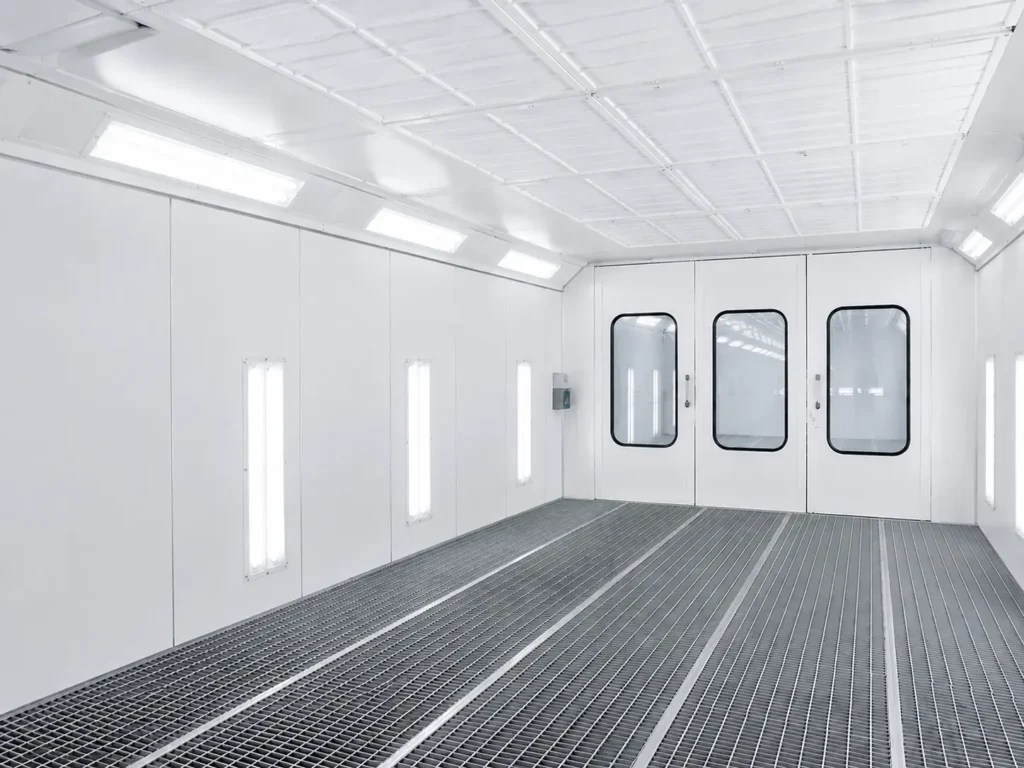
The booth enclosure contains the spraying operation and separates it from the wider shop. It is usually made from steel panels, insulated panels, or modular booth sections. The enclosure needs enough space for the robot, part, fixtures, applicator reach, cleaning access, lighting, and safe maintenance.
The booth layout must also match the production style. A small batch shop may use a robot with a turntable inside a single booth. A large automotive line may use several robots arranged around a moving car body. A heavy equipment plant may need a large booth with rail-based part movement and long robot reach.
Good booth design leaves room for service. Operators need access to filters, pumps, valves, spray equipment, robot arms, sensors, and floor areas where residue builds up. A booth that is hard to clean can become expensive quickly because paint buildup affects airflow, fire risk, and finish quality.
Ventilation and airflow control
Ventilation is one of the most serious parts of any spray booth. It removes vapors, mist, and airborne particles from the spray area. It also helps keep dust away from wet paint.
Airflow must be strong enough to capture overspray, but not so aggressive that it pulls the spray pattern away from the part. Poor airflow can cause dry spray, orange peel, dirt in finish, uneven film build, or solvent odor outside the booth.
Crossdraft booths move air from one side to the other. Downdraft booths move filtered air from the ceiling down through the floor or lower exhaust. Semi-downdraft systems combine ceiling supply with side or rear exhaust. Each design has tradeoffs in cost, floor work, finish quality, and energy use.
Robotic painting usually benefits from stable airflow because the robot repeats the same movement. If the air changes from one shift to another, the finish may change even when the robot path stays the same.
Robotic spray arm
The robot is the motion system. A typical paint robot uses sealed joints, smooth surfaces, explosion-protection features where needed, and paint-safe construction. The arm must be able to reach the part without hitting fixtures, booth walls, conveyors, or other robots.
Robot selection depends on reach, payload, wrist flexibility, speed, protection rating, programming method, and coating type. A small plastic part may need a compact arm with fast movement. A vehicle body may need long reach and coordinated motion with a conveyor. A large steel frame may need a rail-mounted robot or multiple robots.
The robot also needs a clean cable and hose setup. Paint lines, air lines, and electrical paths must survive repeated movement. Bad routing leads to downtime, leaks, and inconsistent spray delivery.
Spray applicator, gun, or rotary atomizer
The applicator decides how paint leaves the system and reaches the part. Robotic booths may use automatic spray guns, HVLP guns, air-assisted airless guns, electrostatic guns, powder guns, or rotary bell atomizers.
Electrostatic rotary bell systems are common in high-quality automotive finishing because they create fine droplets and charge the coating so it is attracted to the grounded part. Toyota has shown airless atomizer work with over 95% coating efficiency, showing how much attention major manufacturers place on keeping coating on the target rather than losing it to overspray.
The right applicator depends on the coating and part geometry. Flat panels, tubes, castings, cabinets, bumpers, wheels, and vehicle bodies do not behave the same way. A booth supplier should test the coating and part shape before recommending one spray method.
Paint supply and mixing system
A robotic booth needs steady paint delivery. The system may include pressure pots, pumps, circulation lines, color-change valves, flow meters, heaters, agitators, filters, and mixing systems. Two-component coatings need ratio control so resin and hardener mix correctly before spraying.
Color change time is a major cost factor. A booth that changes color slowly wastes paint, solvent, air, and production time. High-volume lines often invest in short paint lines and fast color-change blocks to reduce loss.
Paint supply stability affects film build. If pressure or viscosity changes, the robot may follow the correct path but still apply too much or too little coating.
Filtration and overspray capture
Filters protect the booth, exhaust system, workers, and outside air. Intake filters stop dust from entering the booth. Exhaust filters capture paint overspray and coating particles before air leaves the system.
Dry filter booths are common because they are easier to install and maintain than water wash booths in many settings. Water wash booths can handle heavy overspray loads but need water treatment, sludge handling, and more mechanical upkeep. Powder booths often focus on recovery, cyclone separation, cartridge filters, and color cleanliness.
Filter loading must be tracked. Clogged filters change airflow and can damage finish quality. Automated monitoring can warn operators before airflow drops too far.
Curing, drying, and flash-off zones
Spraying is only part of coating. The finish must dry or cure correctly. Flash-off zones allow solvents or water to leave the coating before the next layer or heat stage. Ovens and infrared systems help coatings reach their required cure schedule.
Curing problems can cause soft films, poor adhesion, bubbling, dull finish, cracking, or early corrosion. A robotic paint booth should be planned with coating data sheets, part mass, substrate type, and line speed in mind.
Control software and operator interface
Control software ties the system together. Operators use it to select recipes, start jobs, monitor alarms, track production, adjust parameters, and view maintenance needs.
A good interface reduces training problems. Operators should be able to choose part programs, confirm color, view booth status, and respond to alarms without guessing. Engineers may need deeper access for path editing, flow control, and quality tuning.
Modern systems may store production data. Paint flow, batch number, filter status, robot cycle time, booth temperature, humidity, and alarm history can help teams find root causes when defects appear.
Benefits of robotic spray painting inside automated booths
Robotic spray painting offers the most value when the part, coating, and production volume justify repeatable automation. The benefits go beyond replacing manual labor. The bigger gain is control.
More consistent coating quality
A robot can hold the same distance, angle, and speed across repeated parts. This helps reduce variation in film thickness, color match, gloss, and texture. Consistency is one of the main reasons automotive and industrial manufacturers move toward robotic painting.
Manual painters often adjust by feel. That skill is valuable, but it can vary from person to person. A robot uses a proven path. Once the recipe is tested, the system can repeat it with less variation.
Lower paint waste and overspray
Paint waste comes from poor transfer, wide spray patterns, late trigger shutoff, bad part positioning, and unstable airflow. Robotic systems can reduce these losses because spray timing and path overlap are controlled.
Electrostatic systems can improve transfer because charged paint droplets are attracted to grounded parts. In the right setup, this can reduce overspray and lower coating use per part. The result is not just lower material cost. Less overspray also means longer filter life and less booth cleaning.
Better worker separation from the spray zone
Paint booths deal with vapors, mist, and residues that require serious air control. Automation can keep workers farther away from active spraying. People still need proper training and protective practices during setup, cleaning, maintenance, and inspection, but robotic application can reduce direct exposure during production.
This can also help with labor availability. Skilled painters are hard to find in many regions. Automation lets experienced staff manage the process while the robot handles repetitive motion.
Higher throughput in repeatable production
A robot can keep a stable cycle time across long runs. It does not slow down from fatigue. It does not change technique near the end of a shift. When paired with conveyors, turntables, or indexing systems, it can support steady production flow.
Throughput gains depend on part complexity, color changes, loading method, flash time, and curing time. The booth may still be limited by drying or part handling, not the robot itself. That is why full process planning matters.
Cleaner data and easier quality tracking
Manual spray work can be hard to track. A robotic booth can record recipe settings, alarms, cycle times, and material use. When a defect appears, teams can compare data instead of relying only on memory.
This is useful for regulated industries and high-value products. Aerospace, automotive, medical equipment, electronics, and defense-related manufacturing often need stronger traceability than basic batch painting.
Where robotic paint booths are used most often
Robotic paint booth systems appear wherever repeatable coating quality has high value. Automotive plants are the most visible example, but they are not the only market.
Vehicle body painting uses multiple robots to spray primer, basecoat, clearcoat, interiors, door openings, bumpers, wheels, and trim. The parts are often large, curved, and sensitive to color or gloss variation.
Aerospace suppliers use robotic coating for parts that need uniform thickness, careful masking, and repeatable corrosion protection. Large parts may still need custom fixtures and careful reach studies.
Metal fabrication shops use automated booths for cabinets, frames, panels, enclosures, doors, racking, and machinery parts. Powder coating robots are common where part families repeat often enough.
Wood and furniture finishing can also use robotic spraying, especially when doors, panels, cabinet fronts, and shaped furniture parts repeat in batches. Here, coating appearance and edge coverage are major concerns.
Plastic parts need careful coating control because substrates can be sensitive to heat, solvents, and static. Bumpers, housings, appliance parts, and consumer product shells often benefit from stable robotic paths.
Heavy equipment and agricultural machinery bring different demands. Parts may be large, dirty, welded, or irregular. The booth may need strong pretreatment, rugged fixtures, and large access doors.
Robotic paint booths are now beginning to attract more attention in auto body shops, collision repair centers, vehicle repainting businesses, fleet repair facilities, and parts refinishing operations. These businesses are not using robotic painting as widely as OEM plants yet, but the interest is growing. The strongest opportunities are usually in larger collision centers, busy repainting businesses, fleet facilities with steady paint volume, and parts refinishing operations where similar panels or components are painted again and again.
Robotic painting technology is becoming smarter, but basics still matter
Robotic spray painting is gaining better software, sensors, and path tools. New work on 3D point-cloud path planning for robotic spraying shows how systems can create spray paths for complex free-form surfaces. Vehicle painting robots are benefiting from better path planning methods that can automatically create coating routes for complex automotive surfaces, an area that has often required skilled manual engineering.
These tools are promising, especially for high-mix production where parts change often. A robot that can adapt faster to new shapes can make automation useful outside very large production lines.
Still, the basics remain the backbone of the system. A smart robot cannot fix poor cleaning, weak grounding, bad masking, wrong viscosity, clogged filters, or unstable humidity. Robotic painting works best when the process is disciplined. The booth must be clean. Parts must be prepared. Coating data must be followed. Operators must know what a good finish looks like.
The future of automated paint booths will likely combine better path software, more sensor feedback, improved transfer methods, and cleaner energy use. Yet the core goal stays the same: put the right amount of coating on the right surface, at the right time, with as little waste and rework as possible.
What is the difference between a paint booth and an automated robotic paint booth?
A standard paint booth controls the spray environment. An automated robotic paint booth controls both the environment and the application process.
A manual booth gives painters a filtered, ventilated space to spray parts. The worker still controls gun angle, distance, overlap, trigger timing, and movement speed. In a robotic booth, those actions are programmed and repeated by the robot.
The automated system may also connect to conveyors, part sensors, recipe software, color-change systems, curing zones, and production tracking. That makes it closer to a complete finishing line than a single booth.
The difference shows up most in repeatability. A manual booth can produce excellent work with a skilled painter. A robotic booth is better when the same quality must repeat across hundreds or thousands of parts.
Which spray technology works best in robotic paint booths?
The best spray technology depends on the coating, part shape, finish target, and production volume. Common options include automatic air spray, HVLP, air-assisted airless, electrostatic spray, rotary bell atomizers, and powder coating guns.
HVLP and automatic air spray are useful when shops need controlled liquid coating with a familiar spray pattern. Air-assisted airless works well for heavier coatings or larger surfaces. Electrostatic spray helps improve transfer on conductive or grounded parts. Rotary bell atomizers are strong choices for high-quality automotive-style finishes because they can create fine atomization and strong transfer control.
Powder coating robots are different because they spray charged powder instead of liquid paint. Powder booths may include recovery systems that collect unused powder and return it to the process when color and quality rules allow.
No single applicator is best for every job. A supplier should review coating chemistry, solids content, viscosity, part material, grounding, target film thickness, color-change needs, and finish class before choosing the spray head.
How much does an automated robotic paint booth cost?
Automated robotic paint booth cost can range from a smaller six-figure investment to several million dollars, depending on booth size, robot count, safety systems, conveyors, curing, paint supply, color change, and controls.
A compact robotic booth for small parts may include one robot, a dry filter booth, basic paint delivery, and a turntable. A large automotive or industrial line may include multiple robots, water wash booths, advanced air handling, ovens, pretreatment, conveyors, robot rails, vision, and plant-level control software.
The robot itself is only one part of the cost. Booth construction, ventilation, ductwork, fire suppression, electrical work, floor changes, permitting, coating tests, programming, training, and ongoing maintenance can add a large share.
A better way to judge cost is to compare it with paint savings, labor allocation, rework reduction, scrap reduction, quality claims, throughput gains, and worker safety improvements. The payback period depends on volume and defect cost.
When does robotic spray painting make financial sense?
Robotic spray painting makes financial sense when a shop has repeatable parts, steady coating demand, high labor strain, costly rework, expensive coatings, or strict finish requirements.
The case is strongest when the same part family runs often. Repeated parts allow the program to be tuned once and used many times. High coating cost also supports automation because transfer gains can save material every day.
A shop with low-volume custom work may still use robotics, but the system needs easier programming and flexible fixtures. Collaborative painting robots and scan-based path tools are making this more realistic, but the payback must still be checked carefully.
The best candidates usually share these traits:
- Repeated parts or part families
- High finishing labor demand
- Coating waste that can be measured
- Frequent rework or quality variation
- Enough floor space for booth and part handling
- Management support for training and maintenance
- Stable pretreatment and masking process
Robotics should not be used to cover up a weak coating process. If parts arrive dirty, wet, poorly masked, or inconsistently grounded, automation may repeat the same defects faster.
What safety rules matter for robotic paint booths?
Robotic paint booths need ventilation, fire protection, electrical safety, explosion-risk control, guarding, emergency stops, lockout practices, and safe maintenance access.
Spray areas require mechanical ventilation to remove flammable vapors, mists, or powders and carry them to a safe location. Ventilation must operate during spraying and continue long enough afterward to clear vapors from drying coatings and residue. Booths using flammable or combustible materials may also need special electrical classifications, fire suppression, approved lighting, and strict housekeeping.
Robots add motion hazards. A robot can move with force and speed, so guarding, interlocks, safety-rated doors, light curtains, teach mode limits, and emergency stops must be planned. Maintenance staff also need safe lockout procedures before entering the cell.
Safety planning should begin before purchase, not after installation. Local codes, insurance rules, coating data sheets, and authority requirements can affect booth design.
What problems can happen in robotic paint booth systems?
Common problems include poor film thickness control, orange peel, dry spray, runs, dirt in finish, fisheyes, color mismatch, weak edge coverage, robot path errors, clogged filters, poor grounding, and color-change waste.
Many defects come from small process changes. A filter loads up and airflow drops. A coating warms up and viscosity changes. A fixture wears out and the part sits slightly off position. A ground clamp becomes dirty. A nozzle starts to clog. A robot program still runs, but the finish changes.
Good systems use checks to catch these issues early. Operators should monitor airflow, booth pressure, paint flow, atomizer condition, filter loading, humidity, temperature, grounding, and part position.
The most expensive mistake is blaming the robot too quickly. Robotic motion is only one piece. Most finish problems come from the full process around the robot.
How do you choose the right automated paint booth system?
Choose the system by starting with the part, coating, finish target, production volume, and safety requirements. The robot should be selected after the process is clear.
A buyer should gather part drawings, coating data sheets, production rates, color counts, quality standards, defect history, available floor space, utility details, and future volume plans. These details help suppliers size the booth, choose airflow type, select the robot, design fixtures, and estimate cycle time.
A proper selection process should include coating trials. Testing reveals how the spray pattern behaves on real surfaces, how much film builds on edges, how much overspray forms, and whether the booth can support the target finish.
The supplier should also discuss training and support. A robotic booth needs people who can clean it, maintain it, adjust recipes, troubleshoot alarms, and protect the process. The best machine will still fail if no one owns daily care.
What maintenance does a robotic paint booth need?
A robotic paint booth needs regular cleaning, filter changes, spray gun service, atomizer care, pump checks, hose inspections, robot maintenance, airflow checks, sensor cleaning, and software backup.
Paint residue builds up over time, especially around booth surfaces, exhaust paths, filters, fixtures, and spray equipment. If it is ignored, it can affect airflow, contaminate finishes, increase fire risk, and make maintenance harder. Filters need replacement based on pressure drop and loading, not guesswork alone.
Spray equipment needs close attention. Nozzles, needles, bell cups, seals, hoses, valves, and color-change blocks can wear or clog. Small spray defects can become large quality losses if they are not caught early.
Robot maintenance includes lubrication, calibration checks, cable inspections, seal checks, and backup of programs. Paint robots work in harsh environments, so preventive care is cheaper than emergency downtime.
What should manufacturers expect after installation?
Manufacturers should expect a learning period. Even a well-installed robotic paint booth needs tuning, operator training, recipe work, fixture adjustments, and quality checks before it reaches stable production.
The first goal is not maximum speed. The first goal is a repeatable good part. Once that baseline is proven, teams can adjust cycle time, paint flow, trigger points, and path order.
Operators and engineers should keep a defect log during startup. Film thickness, gloss, color, edge coverage, overspray, dry spray, and contamination should be tracked. This creates a record of what changed and what improved.
A robotic booth is not a set-and-forget machine. It is a production system. The more disciplined the team is with cleaning, checks, training, and recipe control, the better the booth will perform.
A well-planned robotic paint booth pays back through control
Automated paint booth systems with robotic spray painting technology are not just about replacing manual spraying. They are about building a coating process that can repeat quality, manage waste, protect workers, and give production teams better control.
The real value appears when the booth, robot, applicator, airflow, filtration, curing, safety system, and software are planned together. A strong system can reduce coating waste, cut rework, improve finish consistency, and make production more predictable.
Manufacturers that treat robotic painting as a complete process, not a single equipment purchase, usually get the best results. The robot may be the most visible part of the booth, but the quiet details around it decide whether every finished part leaves the line looking exactly the way it should.