Robotic car painting can reduce paint waste and overspray when the system is set up with the right applicator, robot path, paint flow, booth airflow, and electrostatic control. Automation can place more paint on the vehicle surface and send less paint into filters, booth water, floors, and exhaust systems.
Wasted paint is not only a material cost, it also adds cleanup work, filter loading, VOC concerns, rework risk, and uneven film build. Manual painting can still produce beautiful results in skilled hands, especially for repairs, custom work, and low-volume jobs. But in repeatable production, robotic car painting gives shops a steadier way to control distance, speed, angle, atomization, and overlap across every panel.
For manufacturers and high-volume refinish operations, the real value is not “robots versus people.” It is better control over a process where small mistakes can become expensive very quickly.
What does paint waste mean in car painting?
Paint waste is the portion of coating material that does not become a useful, cured film on the vehicle. It can include overspray, paint left in lines, purge waste during color changes, booth sludge, filter waste, and extra paint used during rework.
Overspray is the most visible part of paint waste. It happens when atomized paint misses the panel or bounces away from the surface. In spray painting, transfer efficiency measures how much paint actually lands on the target compared with the total amount sprayed. Conventional spray guns can have transfer efficiency around 20% to 40%, which means a large share of the sprayed coating may become overspray instead of forming a useful film on the surface.
In automotive production, the numbers vary because paint type, robot settings, booth design, charge level, humidity, part shape, and operator method all affect the result. Across automotive spray coating, transfer efficiency has often been estimated around 50% to 60%, showing how much material can be lost when the application process is not tightly controlled.
That gap is where robotic car painting can help. If a shop raises transfer efficiency from 60% to 75%, it is not just saving 15 percentage points on paper. It is buying less coating, changing filters less often, cleaning less booth waste, and lowering the chance of film build problems.
Can robotic car painting reduce paint waste?
Yes, robotic car painting can reduce paint waste because robots repeat the same spray path, angle, speed, and distance with far less variation than a human painter can maintain over hundreds of vehicles.
A skilled painter can adjust in real time. That is valuable. But fatigue, panel access, wrist angle, hose drag, lighting, booth heat, and job pressure can change the way paint is applied. Robots are different. Once the recipe is dialed in, the robot follows the same motion again and again.
Paint waste often comes from small variations. A gun held too far from the surface creates a wider spray cloud. A pass that is too slow can build excess film. A pass that is too fast may need correction. A poor angle can make paint glance off the panel instead of landing cleanly. Robotic painting systems reduce these swings through programmed motion.
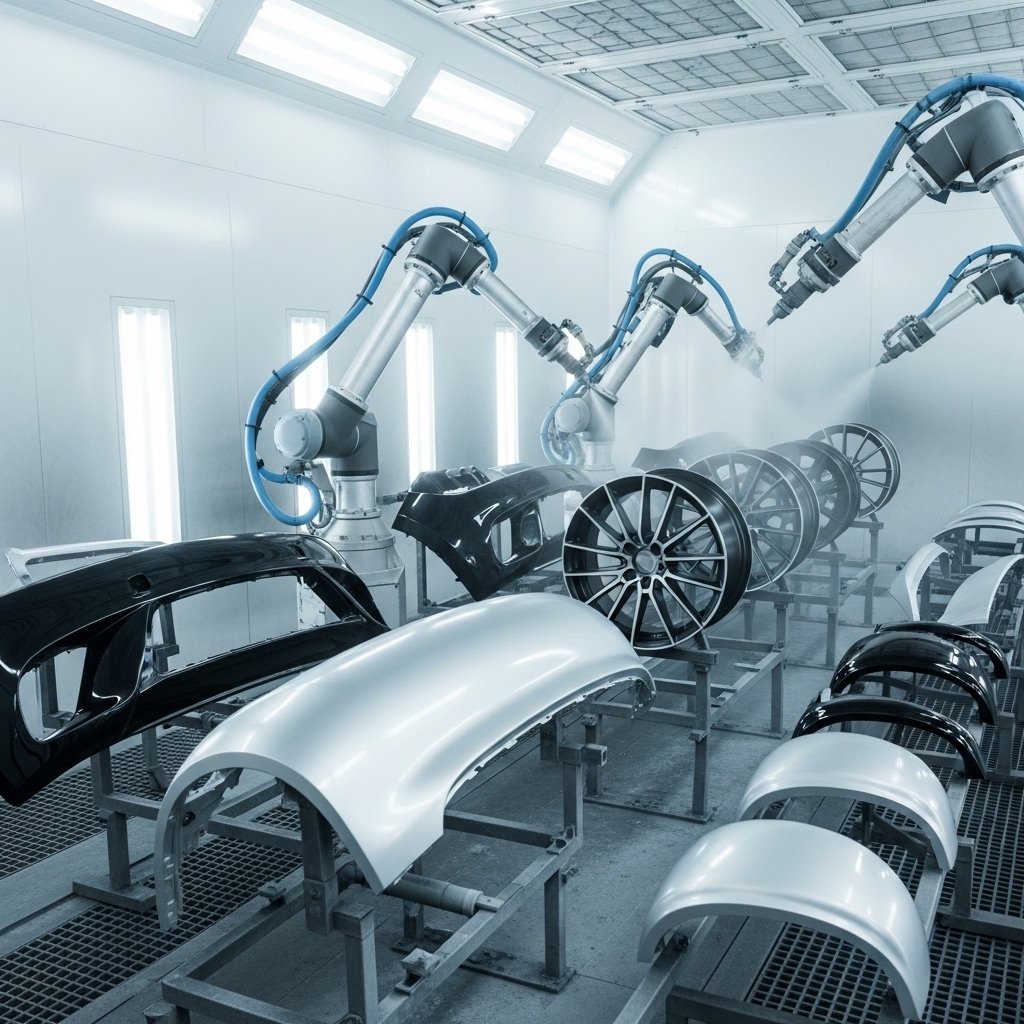
Modern automotive paint robots are built for exterior panels, interior openings, bumpers, doors, hoods, fenders, wheels, and smaller parts. The robotic systems support lower overspray, reduced paint waste, and more consistent color across repeated vehicle painting work.
The savings are strongest when the vehicle shape, coating system, and production flow are repeatable. That is why robots are common in OEM plants and growing in larger repair, fleet, and parts-painting environments.
How does robotic painting reduce overspray?
Robotic painting reduces overspray through controlled motion, stable gun distance, precise overlap, electrostatic application, and well-matched atomization settings.
Overspray often increases when the spray plume is larger than the part, when the painter is too far away, or when the spray angle is inconsistent. Robots can follow the geometry of a car body with a programmed path that keeps the applicator at a set distance from the surface. That helps more paint reach the panel.
Electrostatic systems add another layer of control. Charged paint particles are attracted to the grounded vehicle body, which can improve wraparound and reduce the amount of material drifting past the panel. Standard air spray methods can create heavy overspray, while higher-transfer application methods can reduce the amount of coating that misses the vehicle surface.
Robots also reduce overspray through steady overlap. Manual painters often use experience to judge each pass. A robot can repeat a defined overlap pattern with tight control. That helps avoid dry edges, heavy bands, and uneven film thickness.
Spray pressure, distance, temperature, viscosity, humidity, and gun speed all play a direct role in paint quality, especially when robotic path planning is used to control film thickness. When those variables are controlled together, paint thickness becomes easier to manage.
Why transfer efficiency matters more than most people think
Transfer efficiency is one of the clearest ways to judge paint waste because it tells you how much coating becomes useful film.
A 60% transfer efficiency means 40% of the sprayed material does not end up on the vehicle. Some of that loss is captured by booth filters or water wash systems. Some becomes cleanup waste. Some contributes to air-handling load. None of it adds value to the finish.
Toyota’s airless paint atomizer gives a useful example of what better application technology can do. Toyota reported that its new airless painter reached over 95% coating efficiency, compared with a conventional range of about 60% to 70%.
That does not mean every robotic paint shop will reach 95%. It depends on the applicator and process. But it shows why manufacturers care so much about application method. A gain in transfer efficiency can have a direct effect on paint purchasing, waste handling, booth maintenance, and environmental controls.
Some newer paint atomizers can improve transfer efficiency by more than 10% and reduce paint waste by at least 30% compared with earlier equipment.
These are not small numbers in a paint shop. Paint is one of the most expensive parts of vehicle finishing. Even a few percentage points can matter when a line paints thousands of vehicles or parts.
Is robotic car painting always better than manual painting?
No, robotic car painting is not automatically better in every situation. It works best where the job is repeatable, the volume supports the investment, and the process can be tested and tuned.
Manual painting still has a place. A trained painter can handle unusual damage, custom blends, one-off panels, restorations, and on-the-spot judgment calls. In low-volume repair work, the flexibility of a human painter may be more practical than a full robotic cell.
Robots shine in repeat work. If the shop paints the same model, part, or vehicle type many times, the robot can apply a repeatable film with less variation. That repeatability is where waste reduction usually appears.
The fairest comparison is not “robot versus painter.” It is “uncontrolled variation versus controlled process.” A strong robotic car painting system still needs skilled people. Engineers, programmers, painters, booth technicians, and quality teams all play a role. The robot is a tool. The process around it decides how much waste it can cut.
What role does electrostatic painting play?
Electrostatic painting helps reduce overspray by attracting charged paint particles to the vehicle surface. In robotic car painting, this can work especially well because the robot keeps the applicator in a controlled position while the electrostatic system guides more paint toward the grounded body.
Electrostatic rotary bell atomizers are widely used in automotive painting because they can apply coating at high speed with strong transfer efficiency. The bell spins paint into fine droplets, while electrostatic charge helps the droplets move toward the panel.
This does not remove all overspray. Panel geometry, Faraday cage areas, recessed shapes, grounding quality, humidity, and paint chemistry still matter. Deep pockets, edges, and complex openings can be harder to coat evenly.
But electrostatics paired with robotic motion gives the paint shop a better chance of controlling where the coating lands. That is why many automatic car painting systems combine robots, rotary atomizers, electrostatic charging, and digital process control.
How much paint can robots save?
Paint savings vary, but real-world examples show that robotic and advanced automatic painting systems can cut waste by meaningful amounts when compared with older spray methods.
Toyota reported over 95% coating efficiency with its airless paint atomizer, compared with about 60% to 70% for conventional systems. ABB’s RB 1000i-S atomizer is reported to improve transfer efficiency by more than 10% and cut paint waste by at least 30% compared with its earlier version.
Inkjet-style automotive paint technology can go even further for certain use cases. They can also avoid much of the overspray linked with two-tone painting, where 20% to 30% of paint may otherwise be wasted, because the coating is applied directly to the vehicle surface.
The exact savings depend on the starting point. A shop already using high-quality electrostatic equipment may see smaller gains than a shop moving from older manual spraying to automated painting. The part shape also matters. Flat panels are easier. Complex edges, wheel arches, door jambs, and inner structures need more careful programming.
The best way to estimate savings is to measure current paint use per vehicle or per part, then compare it with film thickness, rejection rate, purge waste, booth filter load, and rework hours after automation.
Does robotic painting reduce VOC emissions?
Robotic painting can help reduce VOC-related waste when it lowers overspray and reduces the amount of coating sprayed for the same finished film. It does not make VOC concerns disappear.
VOC output depends on paint chemistry, solvent content, booth ventilation, curing, cleaning solvents, and local rules. Waterborne basecoats, high-solids clearcoats, low-VOC products, and better application control can all play a role.
Paint that misses the car can still become waste that must be captured, filtered, cleaned, or treated. If robotic painting improves transfer efficiency, less sprayed material is needed to get the required film build. That can reduce the coating burden on the booth and waste-handling systems.
Regulators also care about overspray capture. In regulated vehicle refinishing settings, spray booth filters are often expected to capture at least 98% of paint overspray. Reducing overspray at the source can make those control systems work with less loading.
A robotic system is not a permit by itself. Shops still need compliant booths, approved coatings, safe cleaning practices, proper records, and trained staff. The robot simply gives the process more control.
What makes robotic car painting more consistent?
Robotic car painting is more consistent because it can hold process variables steady across every panel, shift, and vehicle.
Paint finish quality depends on many details. Gun distance, angle, speed, overlap, flow rate, atomization, bell speed, shaping air, charge, booth temperature, humidity, flash time, and surface preparation all affect the result. Manual painters can manage these with training, but human variation is still present.
Robots reduce that variation. A programmed robot can approach a hood, door, bumper, or fender at the same angle each time. It can slow down near edges, speed up across larger panels, and adjust the spray pattern based on part geometry. Sensors and software can help track settings and flag changes before defects rise.
This consistency also helps reduce rework. Runs, dry spray, thin spots, mottling, orange peel, and color variation can all lead to sanding, repainting, or rejection. Rework adds more paint, more labor, more booth time, and more energy use.
Less rework is one of the hidden waste savings of automatic car painting. The paint saved is not only the paint that would have become overspray. It is also the extra material that would have been used to fix preventable defects.
What paint shop conditions affect overspray?
Booth airflow, temperature, humidity, grounding, filtration, paint viscosity, and part cleanliness all affect overspray. A robot cannot fix a weak process on its own.
Airflow is one of the biggest factors. Too much turbulence can disturb the spray plume. Poor balance can pull paint away from the surface before it lands. Dirty filters can change booth pressure. A well-designed booth helps the spray pattern behave more predictably.
Paint viscosity also matters. If the coating is too thick or too thin, atomization changes. Droplet size affects coverage, gloss, film build, and waste. Temperature and humidity can change how the paint behaves before it reaches the surface.
Grounding is especially relevant for electrostatic painting. If the vehicle body or part is not grounded correctly, charged paint particles may not be attracted as strongly. That can raise overspray and reduce wraparound.
Surface preparation matters too. Paint will not behave well on dust, oil, silicone, moisture, or poorly sanded surfaces. Robotic painting can apply coating with great repeatability, but it still needs a clean, stable base.
Can robots reduce paint waste in small shops?
Robots can reduce paint waste in smaller shops, but the business case depends on volume, job mix, space, budget, and repeatability.
A small custom shop that paints one unique vehicle at a time may not see the same payback as a fleet repair center painting repeated panels or a parts supplier coating the same components every day. Automation works best when the robot can repeat proven recipes.
Smaller operations may start with semi-automatic systems, automatic spray guns, part-positioning tools, or compact robotic cells instead of a full OEM-style paint line. The aim is to control the areas where waste is highest.
For example, a shop painting bumpers, wheels, motorcycle parts, commercial panels, or fleet doors may benefit from a robot because the same geometry appears often. Once the program is built, the robot can repeat the coating path with less material variation.
The key is not buying the biggest robot. The key is matching the robot, atomizer, booth, paint system, and production need. A smaller, well-planned cell can sometimes save more paint than a large system that is poorly matched to the work.
What are the limits of robotic car painting?
Robotic car painting has limits in cost, setup time, programming, maintenance, and process discipline. It is not a plug-and-play cure for paint waste.
The upfront cost can be high. A full system may include robots, atomizers, pumps, color change valves, booths, conveyors, safety systems, software, ventilation, and training. The paint shop may also need layout changes.
Programming takes time. Vehicle bodies have complex shapes, and each model may need spray paths tested for film build, edge coverage, and appearance. If the program is wrong, the robot will repeat the mistake perfectly.
Maintenance also matters. Nozzles, bells, hoses, seals, filters, pumps, and sensors need care. A dirty atomizer or unstable fluid delivery system can raise defects and waste.
Robots also need clean data. If paint recipes, part positions, and booth conditions are inconsistent, results will suffer. Automatic car painting rewards disciplined shops. It does not hide poor preparation.
How does robotic painting affect booth cleanup and filter waste?
Robotic painting can reduce booth cleanup and filter waste when it sends more paint onto the vehicle and less into the air-handling system.
Every bit of overspray has to go somewhere. In dry filter booths, it loads filters. In water-wash booths, it becomes sludge. On booth walls and floors, it becomes cleaning work. In exhaust paths, it adds maintenance pressure.
Lower overspray can extend filter life, reduce booth cleaning, and cut the volume of paint solids handled as waste. These gains are sometimes less visible than paint purchase savings, but they affect daily operating cost.
A cleaner booth can also support better finish quality. Heavy overspray buildup can create dirt risk, airflow issues, and maintenance delays. When robotic painting reduces the amount of stray coating in the booth, the whole process becomes easier to manage.
Does robotic painting help with color consistency?
Yes, robotic painting can help with color consistency because it applies paint with controlled film thickness, spray angle, and overlap. This is especially useful for metallics, pearls, and colors that reveal application variation.
Color can change when film build changes. Metallic flake orientation can shift with spray distance, air pressure, and wetness. A painter may compensate by feel, but that can vary from person to person.
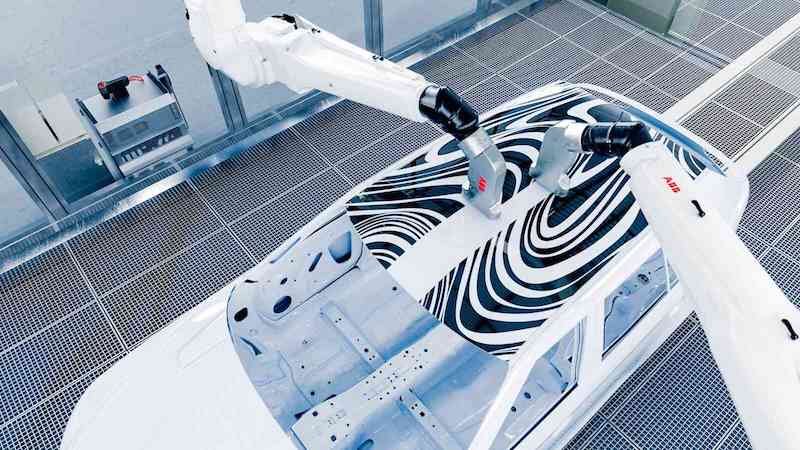
Robots can repeat the same motion and settings across each vehicle. That helps keep color and texture closer from one unit to the next. It also helps when several robots paint different areas of the same body, as each robot can be programmed to match the required film build and overlap.
Color consistency does not come from the robot alone. Paint mixing, agitation, temperature, flash time, booth lighting, and substrate condition all matter. Still, robotic application gives the shop a stronger base for repeatable appearance.
What should a shop measure before and after robotic painting?
A shop should measure paint use, transfer efficiency, film thickness, overspray waste, filter change frequency, defects, rework hours, and cycle time before and after adding robotic painting.
Paint use per vehicle or per part is the first number to track. It shows whether the system is using less coating for the same finished result. Film thickness readings then confirm that savings are not coming from under-application.
Defect rates matter too. A robot that uses less paint but creates more rework is not saving money. Track dirt, runs, dry spray, thin spots, color mismatch, orange peel, and customer returns.
Booth data is also useful. Filter loading, booth cleaning hours, sludge volume, and maintenance downtime can reveal savings that paint purchase records may miss.
A good comparison should run long enough to account for color mix, part variation, production volume, weather, and operator learning. One day of data is rarely enough. Several weeks or months will give a clearer picture.
Is automatic car painting better for sustainability?
Automatic car painting can support better sustainability when it reduces coating waste, cuts rework, lowers booth burden, and uses energy and materials more carefully.
Paint shops are resource-heavy areas. They use coatings, solvents, compressed air, ventilation, filtration, heat, and curing energy. Waste reduction in this area can have a meaningful effect.
Robotic systems can support cleaner production through higher transfer efficiency, reduced overspray, tighter process control, and fewer repeat jobs. The strongest results come when automation is paired with efficient booth design, low-waste color change, waterborne or lower-solvent coatings where suitable, and proper waste handling.
The environmental case is strongest when the robot reduces total sprayed material while keeping the same quality standard. Less paint sprayed usually means less overspray captured, less cleanup, and less waste to manage.
When does robotic car painting make the most sense?
Robotic car painting makes the most sense when a shop needs repeatable quality, lower paint waste, lower overspray, faster cycle times, and stronger process control across a steady flow of vehicles or parts.
OEM production lines are the clearest fit because the same body styles repeat at scale. Fleet operations, parts manufacturers, bumper painters, wheel coaters, and high-volume refinish centers may also benefit.
Manual painting may still be the better answer for small custom jobs, rare restorations, or repair work where each task is different. Many shops can also use a mixed model: skilled painters handle complex judgment work, while robots handle repeatable coating tasks.
That balance is often the most realistic path. Automation does not remove craftsmanship from car painting. It moves skilled people toward setup, quality control, process tuning, inspection, and finishing decisions.
Can robotic car painting reduce paint waste and overspray in the real world?
Yes, robotic car painting can reduce paint waste and overspray in real-world operations, but only when the full paint process is designed around control.
The robot helps most when it is paired with the right atomizer, electrostatic setup, booth airflow, paint recipe, part handling, and quality checks. Strong results come from the full system, not the robot arm alone.
The evidence is clear enough to take automation seriously. Conventional spray methods can lose a large share of paint to overspray. Automotive transfer efficiency has often sat around 50% to 60% in broad industry estimates. Advanced automatic systems have shown much higher coating efficiency, with some examples reaching above 95% and some newer atomizers cutting paint waste by at least 30%
For shops asking whether robotic painting is worth studying, the answer is yes. Start with your current paint waste, rework rate, booth maintenance, and material cost. Then compare those numbers against a properly planned automatic car painting process. The decision becomes less about hype and more about measurable savings, cleaner work, and a finish that stays consistent from the first vehicle of the day to the last.