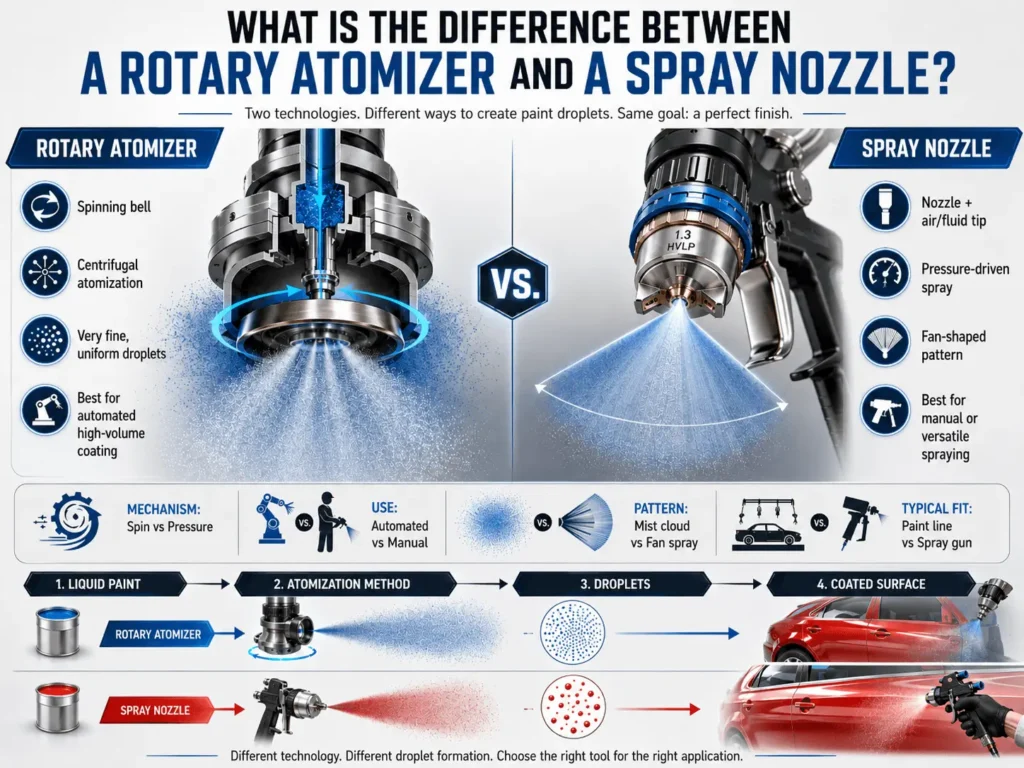
A rotary atomizer and a spray nozzle both break liquid paint into small droplets, but they do it in very different ways. A rotary atomizer spins a bell-shaped cup at very high speed and throws paint from its edge. A spray nozzle forces paint through a small opening, often with fluid pressure, compressed air, or both.
That difference affects almost every part of the coating process. Rotary atomizers are commonly selected for high-volume robotic painting where finish consistency, paint savings, and production speed matter most. Spray nozzles are simpler, less expensive, and better suited to manual work, small parts, narrow areas, touch-ups, and coatings that need high fluid pressure.
Neither device is automatically better in every factory. The right choice depends on the shape of the part, coating material, production volume, finish standard, budget, and available maintenance skills.
Rotary atomizer vs spray nozzle: the main difference
The main difference is the force used to create paint droplets. A rotary atomizer uses centrifugal force from a fast-spinning bell cup, while a spray nozzle forms droplets by pushing liquid through a small orifice or mixing it with compressed air.
Paint enters the center of a rotary bell and spreads across its inner surface. The cup may rotate at tens of thousands of revolutions per minute. Once the paint reaches the cup edge, centrifugal force breaks it into fine droplets and sends them outward.
A spray nozzle contains a fixed opening rather than a spinning cup. Fluid pressure, compressed air, or a combination of both breaks the coating into droplets as it leaves that opening.
This basic mechanical difference changes the spray pattern, droplet distribution, paint flow, operating cost, and type of work each applicator can perform.
What is a rotary atomizer?
A rotary atomizer is an industrial paint applicator that uses a rapidly spinning bell cup or disc to turn liquid coating into fine droplets. It is often mounted on a painting robot in automotive and high-volume manufacturing lines.
The applicator receives paint through a central fluid channel. Paint flows onto the inner face of the bell cup and spreads into a thin film. As the cup rotates, the coating moves toward the outer edge and breaks apart.
Many modern systems add shaping air around the bell. This controlled airflow narrows or widens the spray pattern and helps direct droplets toward the workpiece.
Electrostatic charging is also common. The paint droplets receive an electrical charge, while the metal part is grounded. The charged droplets are attracted to the part, which can raise paint deposition and reduce the amount of coating lost inside the booth.
Rotary atomizers are closely associated with robotic car painting, but they are also used on plastic components, appliances, wheels, agricultural equipment, metal furniture, and other products made in large numbers.
What is a spray nozzle?
A spray nozzle is a fixed component that controls liquid flow and turns it into a selected spray shape. In painting, it may be part of an air spray, HVLP, airless, air-assisted airless, or electrostatic spray gun.
The nozzle opening controls how much coating can pass through and how the spray leaves the gun. Depending on the design, it may create a flat fan, round pattern, cone, or narrow jet.
Several nozzle-based atomization methods are used in painting. A broader look at the different types of atomizers can help explain where rotary bells, air spray guns, airless tips, and other applicators fit within industrial coating systems.
Conventional air spray nozzles
A conventional air spray gun mixes paint with compressed air near the nozzle. The moving air breaks the liquid stream into fine droplets and shapes the spray fan.
This method can produce a smooth finish, though higher air velocity may create more overspray and bounce-back than lower-pressure systems.
HVLP spray nozzles
High-volume, low-pressure guns use a large amount of air at relatively low pressure at the air cap. The softer spray can improve operator control and reduce paint bounce.
HVLP equipment is common in vehicle refinishing, woodworking, furniture production, and smaller industrial coating operations.
Airless spray nozzles
An airless system uses high fluid pressure rather than compressed atomizing air. The coating passes through a small tip orifice, where the sudden pressure drop forms the spray.
Airless nozzles handle thicker materials and high production rates well. They are widely used for protective coatings, structural steel, large fabricated parts, walls, ships, and heavy equipment.
Air-assisted airless nozzles
Air-assisted airless equipment uses fluid pressure for most of the atomization and adds a small amount of compressed air to soften and shape the pattern.
It sits between air spray and airless equipment. The method can provide a finer finish than standard airless spraying while still handling medium- and high-viscosity coatings.
How does each applicator break paint into droplets?
A rotary atomizer creates droplets through mechanical rotation. A spray nozzle creates them through pressure, airflow, or both. The energy source behind atomization is the clearest technical distinction between the two systems.
Centrifugal atomization in a rotary bell
Inside a rotary atomizer, paint travels across the surface of the spinning bell cup. The coating becomes a thin film as rotational speed carries it toward the edge.
At the rim, the liquid can no longer remain attached to the cup. It separates into ligaments and then into droplets. Bell speed, paint flow, viscosity, bell-cup design, electrical settings, and shaping air all influence the final spray.
Higher cup speed often produces finer droplets, though simply raising speed is not a cure for every coating fault. Excessive speed can place more stress on the turbine, change the droplet distribution, and affect metallic flake orientation.
Pressure and air atomization in a nozzle
A nozzle creates a pressure difference across a small opening. Once the coating exits, the liquid sheet or stream becomes unstable and breaks into droplets.
Air spray equipment adds compressed air around the fluid outlet. Airless equipment relies on high coating pressure. Air-assisted airless guns combine the two.
Nozzle size, fluid pressure, air pressure, coating temperature, viscosity, flow rate, gun distance, and tip condition all affect atomization. A worn tip can increase material flow and distort the fan, even when the pressure setting has not changed.
Key differences between a rotary atomizer and a spray nozzle
The two devices differ in far more than appearance. Their working principles shape how they perform on a production line.
Atomization method
A rotary atomizer relies on centrifugal force from a spinning bell cup. A spray nozzle relies on pressure, compressed air, or a mixture of both.
The rotary bell has moving internal parts, including a high-speed air turbine and rotating shaft. The nozzle itself remains stationary, although it forms part of a gun with valves, needles, air caps, and fluid controls.
Spray pattern
Rotary atomizers normally produce a round spray pattern. Shaping air changes the diameter and controls the edge of the pattern.
Spray nozzles can produce a flat fan, round pattern, narrow stream, hollow cone, or full cone. Flat-fan patterns are common in painting because they suit overlapping passes across panels and fabricated parts.
A round bell pattern works well on large vehicle surfaces when robot paths are written around it. A narrow nozzle fan may fit recessed channels, edges, brackets, and small components more easily.
Droplet size and consistency
Rotary atomizers can create a controlled droplet distribution across broad production conditions. Their stable bell speed and regulated paint flow support repeatable robotic coating.
Nozzle systems can also produce fine atomization, but their droplet size depends heavily on pressure, air-cap condition, tip size, coating viscosity, and operator settings.
The nozzle category is broad. A fine-finish air spray nozzle behaves very differently from a large airless tip used for a thick protective coating. It is inaccurate to treat all nozzle systems as if they create the same droplet size.
Transfer efficiency
Transfer efficiency is the percentage of sprayed coating that reaches and remains on the target. Electrostatic rotary atomizers often achieve high material deposition because the charged droplets are attracted to a grounded workpiece.
Some industrial rotary systems are rated for transfer efficiency reaching roughly 85% to 95% under suitable conditions. Actual results depend on part geometry, grounding, paint conductivity, airflow, robot path, bell settings, booth conditions, and the method used to measure efficiency.
A nozzle-based system can also use electrostatic charging. HVLP and air-assisted airless guns may provide good material use when properly set up. Standard air spray can lose more paint through overspray, especially when air pressure is higher than the job requires.
Transfer efficiency should never be judged by applicator name alone. A poorly programmed bell can waste paint, while a well-adjusted spray gun may perform very well on the right part.
Finish quality
Rotary atomizers are widely used where a smooth, uniform cosmetic finish must be repeated across thousands of products. Automotive body panels are a clear example.
Fine droplets, controlled shaping air, regulated flow, and robotic motion can create an even film across doors, roofs, hoods, and side panels. Bell systems also support stable color and clearcoat application at high line speeds.
Nozzle systems can produce excellent finishes as well. Skilled refinish painters regularly create high-grade automotive finishes with HVLP guns. Automatic air spray guns also coat furniture, plastic parts, and metal products with strong visual results.
The difference is often repeatability at scale. A rotary bell is built around automated production, while a manual nozzle still depends on hand speed, distance, angle, overlap, and trigger control.
Paint flow and production speed
Rotary atomizers suit continuous, high-volume production. They can cover broad surfaces while a robot moves rapidly around the workpiece.
Nozzle systems cover a much wider range of flow rates. A small airbrush-style nozzle handles delicate work, while an airless tip can apply a thick coating at a high rate.
High flow does not always mean a better production result. A large nozzle can apply material quickly, but the coating still needs the correct film build, edge control, flash time, and appearance.
Ability to coat complex shapes
Electrostatic rotary bells work well on large three-dimensional metal parts. Electrical attraction can help droplets move toward edges and partially wrap around grounded surfaces.
Deep cavities can still be difficult. Faraday cage effects may keep charged paint away from recessed corners because the electrical field becomes concentrated around the outer edges.
A spray nozzle may provide better physical access to bolt holes, channels, narrow openings, undersides, and sharply recessed sections. Small automatic guns can be placed close to a target, and a robot can aim their fan directly into difficult areas.
Some factories use both devices in the same process. Bells coat the broad exterior surfaces, while spray guns handle areas the round bell pattern cannot reach effectively.
Coating compatibility
Rotary atomizers can apply many waterborne, solventborne, one-component, and two-component materials when the applicator and charging system are designed for them.
Material properties still matter. Highly abrasive coatings, heavy fillers, very high solids, unusual conductivity, fast curing chemistry, and large particles may call for a different applicator or special fluid passages.
Spray nozzles offer more choices for difficult materials. Airless and air-assisted airless guns are often selected for high-viscosity protective coatings. Nozzle size can be changed to match the material and required flow.
Paint suppliers and equipment makers should review the complete fluid path before production begins. Compatibility covers seals, hoses, valves, pumps, grounding, solvent resistance, pressure rating, and cleaning method, not only the opening where paint exits.
Electrostatic operation
Electrostatic charging is strongly linked with rotary atomizers, especially in automotive painting. Direct-charge and external-charge bell systems are both available.
Direct charging places electrical charge into the coating through the applicator. External charging uses electrodes near the spray to charge droplets after atomization. External systems are often used when the coating itself makes direct charging difficult.
Nozzle-based electrostatic guns are also available. A spray nozzle and electrostatic charging are not opposing ideas. The true comparison is between centrifugal bell atomization and pressure- or air-based nozzle atomization.
Equipment cost
A rotary atomizer usually carries a much higher initial cost than a spray nozzle or conventional spray gun. The system may include the atomizer, high-speed turbine, bell controller, high-voltage equipment, shaping-air controls, metering pumps, color changers, cleaning units, robot integration, and safety systems.
The investment can make sense when paint savings and production output are large enough to recover it. Even a small reduction in coating waste can have major financial value across a line painting thousands of parts each day.
Nozzle systems are easier to enter at a lower cost. A manual spray gun, pump, hose, and air supply may be enough for a small shop. Automatic nozzle guns cost more but remain mechanically simpler than a full rotary bell package.
Purchase price is only one part of the decision. Paint use, booth exhaust, filter loading, solvent use, cleaning time, rejected parts, production stops, spare components, and labor can cost more over the life of the system.
Maintenance needs
Rotary atomizers require trained maintenance staff. The bell cup must remain clean and balanced, while the turbine, bearings, shaft, shaping-air ring, valves, and fluid passages need inspection.
A damaged or contaminated cup rotating at high speed can create a serious operational problem. Approved procedures and dedicated tools are normally used for removal, cleaning, balancing, and replacement.
Spray nozzles are simpler to inspect and replace. Common problems include tip wear, air-cap blockage, dried paint, needle wear, damaged seals, and partial fluid obstruction.
Simple does not mean maintenance-free. A worn nozzle can quietly raise paint consumption and change film thickness long before the defect becomes obvious on the finished part. Other common atomizer problems include clogging, dripping, unstable material flow, distorted spray patterns, coating buildup, and poor droplet breakup.
Color-change performance
Modern rotary bell packages may contain compact color changers, metering controls, and cleaning circuits near the applicator. Short internal passages reduce the volume of paint and solvent lost during a color change.
The system still needs careful timing. Paint recovery, purge air, solvent flow, valve sequencing, bell cleaning, and restart conditions must work together.
Nozzle systems can also change colors quickly, especially when using disposable cups or dedicated fluid lines. Large central paint circulation systems may take longer because more hose and pipe volume must be flushed.
The better option depends on the number of daily color changes, paint value, line arrangement, batch size, and acceptable cleaning waste.
Rotary atomizer and spray nozzle comparison
The differences can be reduced to a practical side-by-side view:
Working force: A rotary atomizer uses centrifugal force; a nozzle uses fluid pressure, compressed air, or both.
Main spray shape: Rotary bells commonly create a round pattern; nozzles commonly create flat fans or round patterns.
Typical installation: Rotary atomizers are often fitted to paint robots; nozzles may be manual, fixed, reciprocator-mounted, or robot-mounted.
Best production setting: Rotary bells suit high-volume automated finishing; nozzles suit both small-batch and mass-production work.
Material use: Electrostatic bells can deposit a high share of paint on suitable grounded parts; nozzle performance varies by spray method and setup.
Access to narrow areas: Small nozzles usually handle recesses and confined sections more easily.
Material range: Nozzle systems offer broad choices for thin decorative finishes and thick protective coatings.
Initial investment: Rotary bell systems cost more and need added controls; nozzle systems usually have a lower entry cost.
Service requirements: Rotary equipment needs specialist care; spray tips and air caps are easier to service.
Finish repeatability: Robotic bells provide strong repeatability on high-output lines; nozzle results depend on equipment type and process control.
Is a rotary atomizer always more efficient than a spray nozzle?
No. A rotary atomizer can provide very high transfer efficiency, particularly when electrostatic charging, grounding, booth airflow, and robot paths are correctly set. Yet part shape and coating properties can reduce that advantage.
A charged bell may perform poorly on ungrounded plastic, deeply recessed geometry, or parts contaminated with dust and oil. Paint may collect on leading edges while inner corners receive too little coating.
A nozzle can be more efficient when it places a narrow pattern exactly where it is needed. Coating a small bracket with a broad rotary pattern would send unnecessary paint past the part. A small automatic gun may use less material simply because its fan matches the target.
Efficiency also includes more than transfer percentage. A plant may care about color-change waste, cleaning solvent, booth energy, repair time, rejected parts, and production availability.
The more efficient applicator is the one that creates the required finish with the lowest total resource use for that specific process.
Which one gives a better paint finish?
A rotary atomizer often gives more repeatable cosmetic results on automated high-volume lines. A good nozzle system can match a demanding finish standard on smaller batches, repair jobs, complex parts, and carefully controlled automatic lines.
Bell atomizers are strong at applying an even film over broad surfaces. This is one reason they are common in automotive basecoat and clearcoat zones.
The fine spray alone does not create a perfect finish. Paint temperature, viscosity, booth humidity, flash time, film thickness, robot speed, gun distance, surface preparation, and curing conditions also shape the final appearance.
Nozzle atomization may be preferred when the coating needs a particular texture or heavy film build. Airless nozzles can apply protective materials that would be unsuitable for a fine cosmetic bell process.
The finish requirement should be written in measurable terms, including gloss, color, orange peel, distinctness of image, film thickness, sag resistance, and defect rate. Equipment can then be tested against the same target.
When should a manufacturer choose a rotary atomizer?
A rotary atomizer is a strong choice when the factory paints many similar parts, requires a high-grade appearance, uses expensive coating material, and has enough production volume to support the added investment.
Common use cases include:
- Automotive bodies and exterior panels
- Vehicle interiors and closures
- Plastic vehicle components
- Wheels and large metal assemblies
- Appliances with cosmetic outer panels
- High-output robotic finishing lines
- Processes where paint recovery and low color-change waste carry high value
The plant also needs reliable utilities, stable booth conditions, good grounding, trained technicians, spare parts, and strict cleaning routines.
A rotary bell may be excessive for a low-volume shop painting a few varied parts per day. The equipment can perform the work, but its financial and service demands may not match the production need.
When is a spray nozzle the better choice?
A spray nozzle is often the better choice for lower production volumes, varied product shapes, confined target areas, manual refinishing, thick coatings, and operations with a limited equipment budget.
Typical applications include:
- Auto body repair and refinishing
- Furniture and cabinet coating
- Structural steel
- Industrial maintenance painting
- Marine and protective coatings
- Small plastic and metal parts
- Touch-up stations
- Recesses, channels, and bolt holes
- Production lines with frequent product changes
Nozzle systems are also easier to adapt. Changing the tip, air cap, fluid pressure, or gun type can prepare the system for a different coating without replacing a large application package.
That flexibility is valuable in contract finishing shops, where the next batch may have a different size, shape, paint chemistry, and surface requirement.
Can rotary atomizers and spray nozzles be used together?
Yes. Many automated paint lines use rotary atomizers and spray guns for separate parts of the same coating task.
The rotary bell may cover the roof, hood, doors, quarter panels, and other broad surfaces. Automatic spray guns can then coat door jambs, narrow cavities, edges, openings, and areas hidden from the bell pattern.
This mixed arrangement lets each applicator handle the geometry it suits best. It can also prevent engineers from forcing one device to perform every task, which often creates unnecessary overspray or weak coverage.
Process programming becomes more involved because film thickness must remain even where the two spray zones meet. Robot paths, flow ramps, trigger timing, electrostatic settings, and overlap need controlled trials before full production.
What factors should guide the final choice?
The choice should come from the coating process rather than a preference for one piece of equipment. Part geometry, paint chemistry, output, finish target, and lifetime cost should be reviewed together.
Start with the workpiece. Large open panels favor broad, repeatable coverage. Small parts and deep cavities favor a focused spray that can approach the target from several angles.
Next, examine the coating. Its viscosity, conductivity, solids content, particle size, curing chemistry, and abrasiveness may rule out some applicators.
Production volume then shapes the financial case. A rotary bell can save a large amount of paint across high daily output, but the same percentage saving may never repay the equipment cost on a small line.
Maintenance capacity matters as well. A plant without technicians trained in high-speed turbines and electrostatic systems may face longer stops and higher service costs.
A controlled spray trial gives the clearest answer. Measure paint consumption, film thickness, appearance, overspray, cycle time, cleaning waste, defect rate, and maintenance work with each suitable setup.
The right applicator depends on the job, not the name
A rotary atomizer and a spray nozzle solve the same basic problem through different physical methods. The rotary bell spins paint into fine droplets and fits high-output robotic processes where repeatability and material savings carry great value. A spray nozzle forms its pattern through fluid pressure and air, offering lower cost, easier service, and greater flexibility across many coating types.
Large automotive surfaces often justify the control and paint deposition of an electrostatic rotary bell. Repair work, small components, heavy protective coatings, and deep recesses often favor a nozzle-based gun.
Some production lines gain the best result from using both. The practical goal is not to choose the more advanced device. It is to select the applicator that puts the required coating on the part, at the required quality, with the least waste and production difficulty.