An HVLP spray gun in robotic car painting is a paint applicator that uses high air volume and low air pressure to break paint into fine droplets and place more of that paint onto the vehicle surface instead of letting it drift away as overspray. It is a softer, more controlled spray gun that can be mounted on a robotic arm for repeatable coating work.
Body shops and automotive paint lines often choose HVLP robotic spraying because it gives them better control over paint placement, spray pattern, and repeatability. A robot gives steady speed, distance, angle, and path. The HVLP spray gun adds a gentler spray pattern that can reduce paint waste, lower overspray, and help produce a smooth finish when the paint, air settings, robot path, and booth airflow are all set correctly.
HVLP is not always the fastest or highest-efficiency choice compared with modern electrostatic bell systems, but it remains useful for controlled spraying, smaller parts, repair work, training cells, and robotic setups where precision matters more than raw production speed.
What does HVLP mean in robotic car painting?
HVLP means High Volume Low Pressure. The spray gun uses a large amount of air at a lower pressure to atomize paint into droplets and guide those droplets toward the car body or part.
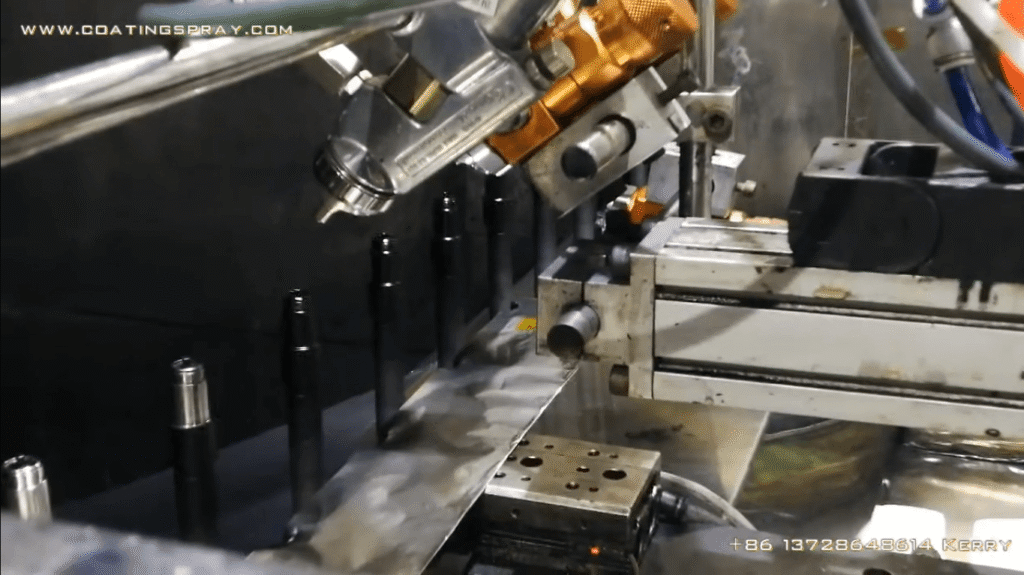
In robotic car painting, the HVLP gun is usually attached to the wrist of a robot. The robot moves the gun across panels at a programmed speed and distance. Paint and air are fed through hoses, valves, regulators, and sometimes a color-change system.
The “high volume” part refers to the amount of air moving through the gun. The “low pressure” part refers to the pressure at the air cap, often linked with the well-known HVLP limit of about 10 psi at the cap in many industry and regulatory settings. Lower atomizing pressure helps reduce bounce-back, which is one reason HVLP became popular in automotive refinishing and spray booths.
A simple way to picture it is this: a conventional spray gun can hit the surface harder, pushing more mist into the air. An HVLP gun throws the paint more gently. That softer delivery can help more coating land where it should.
How does an HVLP spray gun work on a painting robot?
An HVLP spray gun works by mixing paint with controlled air at the nozzle, breaking the liquid coating into small droplets, and forming a fan-shaped spray pattern. The robot then moves that spray pattern across the surface in a fixed path.
A robotic painting setup usually controls four things at the same time: robot movement, paint flow, atomizing air, and fan air. Paint flow affects how much coating leaves the gun. Atomizing air affects droplet formation. Fan air shapes the spray width. Robot speed and distance control how thick the wet film becomes on the surface.
The robot does not “paint better” by itself. It paints better because it repeats the same motion again and again without hand shake, fatigue, or changes in spraying angle. If the robot keeps the gun 6 to 8 inches from the panel, it can keep that distance across every pass. If the path calls for 50% overlap, it can repeat that overlap across the door, hood, bumper, or fender.
That repeatability is one of the main reasons HVLP guns can work well in robotic car painting. The gun gives a controlled spray. The robot gives controlled motion. Together, they create a stable process.
Why is HVLP used in robotic car painting?
HVLP is used because it can reduce overspray, improve paint transfer, and give better control on parts where a softer spray pattern is preferred. It can be a practical choice for body shops, small automation cells, prototype lines, and component painting.
Paint transfer efficiency is the share of sprayed coating that actually lands on the target. Older conventional air spray systems often waste more material because more paint becomes airborne mist. HVLP systems were developed to improve that ratio by lowering air pressure at the cap.
The exact numbers vary, but the takeaway is simple: HVLP spray guns usually put more paint on the surface and less into the air. Some tests show HVLP guns reaching at least 65% transfer efficiency, while conventional guns stayed below 40%. With the right setup and technique, HVLP can also improve transfer efficiency from around 40% to 49%, or even up to 61%.
Inside a robotic car painting cell, that difference can show up in paint cost, booth filter loading, cleanup time, and air quality. Less overspray also helps keep booth walls, fixtures, grates, and robots cleaner for longer.
Is an HVLP spray gun the same as a regular spray gun?
No, an HVLP spray gun is not the same as a conventional spray gun. Both atomize paint with air, but HVLP uses lower air-cap pressure and higher air volume to create a softer, more controlled spray.
A conventional air spray gun can produce a fine finish, but it usually uses higher pressure. That higher pressure can create more overspray and bounce-back, especially on curved automotive panels.
An HVLP gun is designed to slow that cloud down. The droplets still need enough energy to reach the surface and lay down smoothly, but not so much that they rebound into the booth air.
In manual painting, this can make the gun feel slower. In robotic painting, the slower, controlled pattern can be an advantage because the robot can repeat the same pass speed and overlap without rushing.
What parts of a robotic HVLP spray system matter most?
The most important parts are the spray gun, air cap, fluid nozzle, paint supply, air controls, robot path, booth airflow, and cleaning system. A weak setup in any one area can ruin the final finish.
The spray gun and air cap shape the pattern. The fluid nozzle controls how much coating can pass through. Air regulators control atomization and fan width. The paint supply system controls pressure and flow. The robot controls angle, distance, speed, and overlap.
Booth airflow matters as well. Even a well-tuned HVLP gun still creates overspray. Downdraft booths and correct ventilation help carry airborne mist away from the painted surface and the worker area. HVLP guns and downdraft booths can greatly reduce overspray concentrations, but they do not remove all airborne exposure.
The cleaning system also deserves attention. Automotive coatings can dry quickly inside passages. If the nozzle, needle, or air cap gets dirty, the spray fan can become uneven. A robot will keep repeating the same path, but the coating will not look right if the gun is spitting, streaking, or spraying heavy on one side.
How does HVLP reduce overspray in robotic painting?
HVLP reduces overspray by lowering the force of the air that pushes paint toward the surface. With less air pressure at the cap, fewer droplets bounce away from the panel.
Overspray happens when paint misses the part, rebounds from the surface, or gets carried away by booth airflow before it lands. Robotic painting reduces some of this because the robot keeps the gun angle and distance steady. HVLP helps from the spray side by making the cloud less aggressive.
The combination can be useful on edges, bumpers, mirrors, brackets, and smaller automotive parts. These shapes are harder to coat cleanly because air turbulence and part geometry can pull paint away from the target.
Still, HVLP is not magic. If the robot is too far from the panel, the droplets may dry before they land. If the gun is too close, the film may become too wet. If the fan is too wide for a narrow part, paint will still miss the surface. A good robotic HVLP process is built around the part shape, coating type, booth air, and required film thickness.
What is transfer efficiency, and why does it matter for HVLP?
Transfer efficiency is the percentage of sprayed paint that stays on the part. A higher number means less paint is wasted as overspray.
In car painting, transfer efficiency directly affects cost and booth cleanliness. Automotive coatings are expensive. Clearcoat, basecoat, primers, reducers, hardeners, and cleaning solvents all add up. A small gain in transfer efficiency can save a shop a lot of material over hundreds or thousands of jobs.
Research on automotive spray coating has placed overall paint transfer efficiency in the automotive industry around 50% to 60%, with the final number depending on the technology, part shape, coating, and process settings.
HVLP is often chosen because it can raise transfer efficiency compared with older conventional spray guns. In high-volume car factories, though, electrostatic rotary bell applicators often sit above HVLP in transfer efficiency. Those systems charge the paint droplets and use an electrostatic field to pull coating toward the body. HVLP can still fit well in smaller robotic paint cells, parts painting, and body shop automation because it is simpler and easier to understand than a full bell atomizer setup.
Is HVLP better than electrostatic painting robots?
HVLP is not always better than electrostatic robotic painting. HVLP is simpler and controlled, while electrostatic systems can place more paint on the car with less waste when the part, coating, and grounding conditions are right.
Electrostatic rotary bells are common in large automotive production because they can give very high transfer efficiency and a fine, even finish. A bell cup spins at high speed, breaks paint into droplets, and charges those droplets so they are attracted to the vehicle body. Many production systems favor this method for exterior body coating.
HVLP can still be the better choice in certain cases. A small body shop may not need the cost and complexity of electrostatic bells. A robot painting plastic parts, repair panels, test panels, or lower-volume batches may benefit from an automatic HVLP gun. HVLP can also be easier to set up when coatings, colors, or parts change often.
The best choice depends on the job. A large OEM car plant may prefer electrostatic bells for full body painting. A small robotic booth painting bumpers, spoilers, motorcycle tanks, replacement panels, or custom parts may find HVLP more practical.
Is HVLP better than airless or air-assisted spray in robotic painting?
HVLP is better for controlled finish work, while airless and air-assisted systems may be better for speed, thicker coatings, or industrial parts. Visible automotive surfaces benefit from HVLP because the spray feels softer, easier to control, and better suited to finish-quality coating.
Airless spray pushes coating through a small tip at high pressure without using compressed air at the nozzle. It can move a lot of material quickly, but it may not offer the same fine control needed for show-quality automotive panels. Air-assisted airless adds air to improve atomization while keeping higher fluid pressure.
HVLP sits closer to finish spraying. It is often used where appearance, pattern control, and reduced overspray are more valuable than raw output.
In robotic car painting, the choice often comes down to the coating. Primer or underbody materials may use one type of applicator. Basecoat or clearcoat may use another. Plastic trim, wheels, small panels, and repair parts may call for a different setup again.
What settings affect HVLP spray quality on a robot?
The main settings are air pressure, fluid flow, fan width, robot speed, spray distance, gun angle, overlap, and trigger timing. These settings work together, so changing one often changes the whole result.
If air pressure is too low, droplets may be too large and the finish may look coarse. If pressure is too high, overspray can increase and the pattern may become dry. If fluid flow is too high, the paint can sag. If flow is too low, coverage may look weak or patchy.
Robot speed affects film build. A slow pass lays down more paint. A fast pass lays down less. Spray distance affects wetness and coverage. A gun held too far away can create a dry, rough texture. A gun held too close can overload the panel.
Overlap is another major factor. Many spray processes use overlapping passes so each pass blends into the previous one. If overlap is uneven, striping can appear. A robot can repeat overlap very accurately, which is one of its biggest benefits in HVLP painting.
Trigger timing also matters. The gun should usually turn on before reaching the part and turn off after passing the edge, depending on part shape and masking. Poor trigger timing creates heavy edges, dry edges, or wasted paint.
What kind of finish can an HVLP robotic spray gun produce?
A well-tuned HVLP robotic spray gun can produce a smooth, even automotive finish with controlled film thickness and reduced striping. The final result depends on the coating, part prep, booth conditions, and robot programming.
HVLP can produce fine atomization for basecoat, clearcoat, primer surfacer, sealers, and many industrial coatings. It is often valued for appearance work because the painter or robot can control the spray fan gently.
On a robot, the finish can become more consistent than manual spraying because the movement does not change from job to job. The robot does not get tired near the end of a shift. It does not speed up on easy areas or slow down too much on awkward curves unless programmed to do so.
Still, surface prep remains just as serious. A robotic HVLP gun cannot hide poor sanding, dust, silicone contamination, bad masking, or uneven primer. Automation improves repeatability, not basic paint chemistry or repair discipline.
Can HVLP spray guns be used on a 6-axis painting robot?
Yes, HVLP spray guns can be mounted on 6-axis painting robots. The robot’s wrist movement helps the gun maintain proper angle and distance around curved car parts.
A 6-axis robot can move forward, backward, up, down, and around complex shapes. It can rotate the spray gun so the fan stays square to the surface. This is useful on doors, hoods, bumpers, fenders, mirror housings, spoilers, wheels, and interior trim.
The robot may carry an automatic HVLP gun rather than a manual gun. Automatic guns are built for remote triggering and process control. They usually connect to paint lines, air lines, solenoid valves, and a controller. The controller tells the gun when to spray and when to stop.
A robotic HVLP setup may also include sensors, recipe storage, and paint flow monitoring. More advanced systems can adjust parameters for different parts or colors. Recent robotic painting research has also focused on automated path planning because vehicle bodies require many constraints: coverage, collision avoidance, spray distance, overlap, and shared work between multiple robot arms.
Where is an HVLP robotic spray gun most useful?
An HVLP robotic spray gun is most useful in smaller car painting cells, body shops, parts painting, training labs, prototype work, and production lines where controlled spray is needed without the full cost of electrostatic bell equipment.
A small body shop might use a robot with HVLP for repeatable bumper jobs or fleet parts. A parts supplier might use it for mirror caps, plastic covers, interior panels, or small metal components. A research team might use it for coating tests where every sample needs the same spray path.
HVLP also fits situations where color changes are frequent. Large OEM systems are built for speed and huge volume, but smaller robotic HVLP cells can be more flexible for mixed parts.
Custom work may still need manual support, even when HVLP is part of the robotic painting setup. Robots are strong at repeatable coating. Humans are better at judgment-heavy tasks like masking decisions, repair blending, inspection, and final touch-up.
What are the main benefits of HVLP spray guns in robotic car painting?
HVLP spray guns can cut overspray, reduce material waste, improve coating control, and support repeatable robotic paint quality. The benefits are strongest when the robot path and gun settings are tuned together.
Paint savings
More coating reaches the part, so less material is lost in the booth. Even a modest transfer-efficiency gain can matter because automotive coatings are costly.
Cleaner spray booth
Less overspray can mean less buildup on booth walls, floors, filters, fixtures, and robot covers. That can reduce cleaning time and filter loading.
Finish control
HVLP can create a soft spray pattern that works well for visible panels and smaller parts. Combined with robot repeatability, the process can produce more stable film thickness than hand spraying.
Worker exposure reduction
Workers still need protection and booth controls, but reduced overspray can lower airborne mist when the system is set up and maintained correctly. Spray painting still involves toxic materials, flammable vapors, particulates, and other hazards that require ventilation, protective equipment, and safe work practices.
What are the limits of HVLP in robotic car painting?
HVLP has limits in speed, air demand, coating thickness, and transfer efficiency compared with some electrostatic systems. It also needs careful setup to avoid orange peel, dry spray, striping, or sagging.
HVLP uses a lot of air. A shop needs enough clean, dry compressed air to feed the gun at a stable rate. If air supply drops during spraying, atomization can change. Moisture or oil in the air line can also damage the finish.
HVLP may also be slower than high-output systems while full vehicle production puts heavy pressure on speed, cycle time, and coating consistency. That is one reason many car plants prefer electrostatic bells for large exterior surfaces.
Another limit is part geometry. Deep recesses, sharp edges, and complex plastic parts can still cause spray loss. A robot can adjust its angle, but it cannot change the physics of airflow around a hard-to-paint shape.
HVLP also does not remove the need for process checks. Wet film thickness, dry film thickness, gloss, color match, orange peel, dust nibs, and adhesion still need inspection.
Is an HVLP robotic spray gun good for small body shops?
Yes, an HVLP robotic spray gun can be a good fit for some small body shops, but only when the shop has enough repeatable work to justify the robot, booth setup, programming, and maintenance.
A small shop does not need a robot just because HVLP exists. Manual HVLP guns are already common in refinishing. The robot makes sense when the same type of work comes through often enough: bumpers, fleet panels, motorcycle parts, replacement hoods, or production-style repair parts.
The payback depends on paint use, labor cost, rework rate, booth time, and job consistency. A shop spraying one-off collision jobs with many different repair shapes may find manual spraying more flexible. A shop painting batches of similar parts may see stronger value from robotic HVLP.
The most realistic path for a small shop is often a focused cell, not a full vehicle painting robot. A compact robot painting bumpers or parts can be easier to train, easier to guard, and easier to measure.
What should buyers check before choosing an HVLP spray gun for a painting robot?
Buyers should check coating compatibility, air demand, fluid delivery, robot mounting, cleaning method, control options, spare parts, and local safety requirements before choosing a robotic HVLP gun.
The gun must match the coatings being sprayed. Waterborne basecoat, solventborne basecoat, clearcoat, primer, and specialty coatings may need different fluid tips, needles, seals, or stainless passages.
The air system must be sized for HVLP demand. A gun that needs high air volume will not perform well with weak or unstable air supply. Dry, filtered air is also needed for automotive finishes.
Control compatibility is another key point. An automatic gun should work with the robot controller, paint valves, trigger signals, and recipe system. The shop should also check how easy it is to clean the gun between colors.
Maintenance should not be treated as an afterthought. Nozzles, needles, seals, air caps, and hoses wear over time. A gun with easy parts access can save real downtime.
Safety planning is part of the buying decision too. Spray coating work needs proper booth design, ventilation, fire protection, respiratory protection, and safe handling of coatings and solvents. OSHA’s spray-finishing rules address risks such as toxic materials, flammable mists, vapors, particulates, protective clothing, equipment, and facility controls.
How is an HVLP robotic spray gun maintained?
An HVLP robotic spray gun is maintained through regular cleaning, air-cap inspection, nozzle checks, seal replacement, hose inspection, and spray pattern testing. Small problems at the gun can quickly show up as finish defects.
After spraying, the system should flush coating from the passages before material dries inside. The air cap should be cleaned carefully because blocked holes can distort the fan pattern. Needles and nozzles should be checked for wear because even tiny damage can cause uneven flow.
The robot path should also be checked after maintenance. If a gun is removed and reinstalled, the tool center point may need verification. A small mounting change can alter spray distance or angle.
A simple pattern test can catch many problems before a car part is sprayed. If the fan is heavy on one side, split in the middle, pulsing, or spitting, the issue should be fixed before production.
What defects can happen with robotic HVLP spraying?
Common defects include orange peel, dry spray, runs, sags, striping, mottling, poor edge coverage, and uneven film build. Most of these come from a mismatch between gun setup, robot path, coating viscosity, and booth conditions.
Orange peel can appear when droplets do not flow out smoothly after landing. Dry spray can happen when the gun is too far away, the robot moves too fast, air pressure is too high, or the booth air pulls droplets away too quickly.
Runs and sags can happen when too much paint lands in one area. This may come from slow robot speed, high fluid flow, poor overlap, or too much paint at edges and corners.
Striping can appear when pass overlap is wrong or fan shape is uneven. Mottling in metallic basecoat can happen when droplet size, spray distance, flash time, or gun angle is not controlled well.
Robotic spraying can reduce random human variation, but it can also repeat a bad setting perfectly. That is why setup panels, test parts, and process records are so useful.
What is the difference between manual HVLP and robotic HVLP painting?
Manual HVLP depends on the painter’s hand movement, judgment, and experience. Robotic HVLP depends on programmed paths, controlled settings, and repeatable motion.
A skilled painter can adjust instantly. If the surface looks too dry, the painter may slow down or move closer. If an edge is loading up, the painter may change angle. A robot does not make those judgment calls unless sensors and feedback systems are added.
The robot’s strength is repeatability. Once a good path is created, the robot can spray the same part the same way for every cycle. That makes robotic HVLP useful for batches, production parts, and repeat repair work.
Manual HVLP is usually better for unpredictable repairs, blending, custom paintwork, and jobs where visual judgment changes moment by moment. Robotic HVLP is better when the shop wants consistency across many similar parts.
Can AI improve HVLP robotic car painting?
AI can help HVLP robotic painting through better path planning, defect detection, part recognition, and spray parameter adjustment. It does not replace the spray gun, but it can help the system make better decisions around the gun.
Computer vision can identify part position, edges, and surface areas. A robot can then adjust its path if a part is slightly shifted on the fixture. Camera-based inspection can also catch coating defects earlier, before more parts are painted with the same problem.
AI-based planning can reduce the manual time needed to create robot paths. Vehicle painting paths are hard because the robot must avoid collisions, keep spray distance, control overlap, and coordinate with other arms. Recent research on vehicle painting robot path planning has focused on automating these decisions while still meeting painting constraints.
AI may be especially useful with HVLP in smaller flexible cells where parts change often. A system that can recognize a bumper, mirror cap, or panel and suggest a spray path could reduce programming time. The paint quality still depends on real coating behavior, booth airflow, and gun setup, but smarter planning can make robotic HVLP easier to run.
Is an HVLP spray gun still relevant in modern robotic car painting?
Yes, HVLP is still relevant, especially for smaller robotic cells, automotive parts, refinishing automation, and applications where a controlled spray pattern is more valuable than maximum production speed.
Large car plants often rely on electrostatic rotary bells for major body coating because they can deliver high transfer efficiency and fine finish quality at scale. HVLP still has a place because not every operation is a full OEM paint line.
Robotic HVLP can make sense for body shops moving into automation, parts suppliers handling mixed batches, labs testing coatings, and manufacturers painting smaller automotive components. It gives a familiar spray process with robotic repeatability.
The best way to think about HVLP is not as “old” or “new.” It is a tool. In the right job, it can save paint, reduce overspray, and deliver a clean finish. In the wrong job, it can be too slow or less efficient than a more advanced applicator.
A good HVLP robotic setup starts with control, not just the spray gun
An HVLP spray gun in robotic car painting is a controlled applicator that uses high air volume and low pressure to place paint gently and repeatably on vehicle surfaces. Its value comes from the way it pairs with robot motion: steady distance, steady angle, steady speed, and steady overlap.
Small body shops and parts painters may see HVLP as a practical entry point into robotic spraying. High-volume vehicle plants may use HVLP beside other spray technologies instead of treating it as a full replacement. The smartest choice depends on the part, paint, finish target, budget, booth, safety plan, and the amount of repeat work coming through the line.
A robot can carry the gun, but the finish still comes from the full process. Clean air, clean parts, correct coating mix, stable booth airflow, good programming, and regular gun care all shape the result. Get those pieces right, and an HVLP robotic spray gun can turn a messy, waste-heavy job into a cleaner and more repeatable painting process.