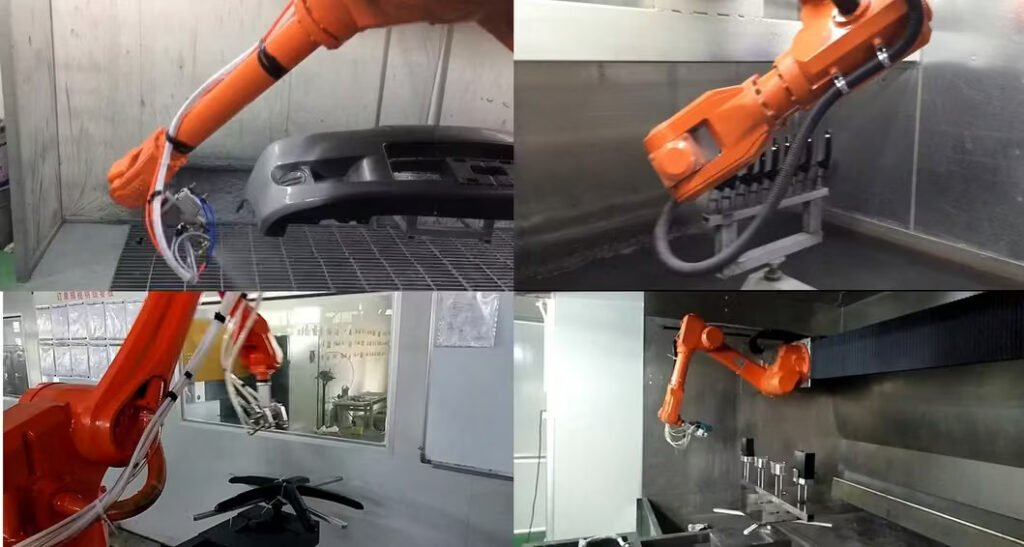
A 6 axis car painting robot is an industrial robotic arm that paints cars, car bodies, bumpers, doors, panels, and interior parts by moving a spray gun or rotary atomizer through six controlled directions of motion. It gives a paint shop a steady, repeatable “robotic painter” that can move around curved automotive surfaces with the same angle, distance, and speed again and again.
Car paint is unforgiving, a small change in spray distance can leave orange peel, dry spray, runs, thin edges, or uneven gloss. Human painters can do beautiful work, but fatigue, fumes, awkward positions, and repeat jobs make consistency hard.
A 6 axis robot solves much of that pain by following programmed paths inside a paint booth, applying coatings with controlled motion, stable spray settings, and high repeatability. Modern paint robot ranges from ABB and FANUC are built for automotive painting, coating, interiors, exterior panels, and parts production.
A 6 axis car painting robot explained
A 6 axis car painting robot is a programmable robotic arm with six joints that control the position and angle of a paint applicator. It is used to apply primer, basecoat, clearcoat, sealers, coatings, and sometimes adhesives on vehicles and automotive parts.
The “6 axis” part means the robot can move in six ways. Think of it like a human arm, shoulder, elbow, wrist, and hand working together. The robot can reach forward, swing sideways, move up and down, bend, rotate, and twist the paint tool into the right position.
Flexibility is the reason these robots are so common in automotive painting. A car is not a flat wall. It has doors, fenders, pillars, rooflines, bumpers, mirror areas, wheel arches, edges, curves, and recessed spots. A basic machine can move in straight lines, but it struggles with these shapes.
A 6 axis paint robot can keep the spray pattern at the right angle while moving around complex surfaces. That is what helps the paint film look smooth and even.
In large factories, these robots often work in groups. One robot may paint the left side of the body. Another may handle the right side. Others may paint interiors, door openings, hood areas, trunk areas, bumpers, or smaller components.
What do the 6 axes do?
The six axes allow the robot to place the spray tool exactly where it needs to be and point it in the correct direction. Each axis adds another layer of movement, which gives the robot more freedom around curved car surfaces.
Most 6 axis industrial robots use a layout similar to this:
| Axis | What it usually controls | Why it helps in car painting |
| Axis 1 | Base rotation | Lets the robot swing around the work area |
| Axis 2 | Arm forward and backward movement | Helps the robot reach the vehicle surface |
| Axis 3 | Upper arm movement | Adds reach for roofs, doors, bumpers, and panels |
| Axis 4 | Wrist rotation | Helps angle the spray tool |
| Axis 5 | Wrist bend | Keeps the applicator square to the surface |
| Axis 6 | Tool rotation | Controls spray direction and final wrist position |
The last three axes are especially useful in painting. The wrist has to move smoothly while the spray gun or bell cup stays at a stable angle. If the wrist cannot move freely, the robot may spray too close, too far, or at a poor angle.
That is where 6 axis motion has real value. It gives the robot the freedom to “wrap” its paint path around the car’s shape instead of forcing the car’s shape to fit a basic motion path.
How does a 6 axis car painting robot work?
A 6 axis car painting robot works by following a programmed path while controlling spray distance, spray angle, paint flow, atomization, and movement speed. The robot repeats the same motion for every vehicle or part unless the program is changed.
The process usually starts with a 3D model, teach pendant programming, offline programming, or manual path teaching. Engineers define where the robot should move, how fast it should travel, when it should start spraying, when it should stop, and how the paint tool should behave at each point.
Once the program is ready, the robot moves through the path inside a paint booth. The car body or part may be stationary, or it may move along a conveyor. In vehicle factories, multiple robotic arms may paint different sections while the car moves through the line. In vehicle painting, planning the movement of multiple robot arms can take a lot of manual work. Each arm needs its own body area, spray path, and sequence, which is one reason automated path planning is getting more attention.
During spraying, the robot tries to maintain a steady:
- Distance from the surface
- Spray angle
- Travel speed
- Paint flow rate
- Overlap between passes
- Start and stop timing
These details decide the finish. Paint is not only about putting color on metal or plastic. It is about building a controlled film layer. Too much material can cause runs or sagging. Too little can leave poor coverage. Bad overlap can create striping or patchy gloss.
Modern systems may also include sensors, booth controls, paint pumps, color change valves, electrostatic systems, and rotary atomizers. Robot-mounted paint atomizers are commonly used when a paint line needs tighter spray pattern control, better material use, and a more stable finish across repeated jobs.
Why are 6 axis robots used for car painting?
6 axis robots are used for car painting because they can paint complex vehicle shapes with repeatable motion, steady speed, and controlled spray angles. They help improve finish consistency, reduce overspray, lower worker exposure, and support faster production.
A car body has many areas that are hard to paint well. Door jambs, pillars, rocker panels, bumper corners, hood edges, and interior openings all need different tool angles. A painter can adjust by hand, but doing the same motion hundreds of times per day is hard.
A robot does not get tired. It does not rush one panel and slow down on the next. Once the path is set correctly, the robot can repeat it with the same rhythm.
This is one reason robotic painting is tied so closely to automotive production. FANUC’s paint robot range includes several 6 axis models, such as the P-40iA, P-50iB, P-250iB, and P-350iA/45, with reaches ranging from compact part-painting robots to larger automotive paint robots.
The value is not only speed. It is control. A controlled robot path can reduce variation between cars, between shifts, and between operators. For factories, that means fewer rework jobs, fewer paint defects, and better use of materials.
What parts of a car can a 6 axis painting robot paint?
A 6 axis car painting robot can paint exterior panels, full car bodies, bumpers, doors, hoods, roofs, fenders, interior openings, trim parts, wheels, plastic components, and other coated automotive parts.
In full vehicle production, robots are often used for:
- Primer application
- Basecoat painting
- Clearcoat painting
- Interior body painting
- Exterior body painting
- Bumper and plastic part painting
- Door, hood, and trunk opening areas
- Sealer or coating work in some stations
ABB’s paint robot applications cover automotive interiors, exteriors, tires, and small parts, which shows how wide the use case can be.
The robot setup changes based on the part. A large vehicle body needs longer reach and careful coordination with conveyors. A bumper cell may use a smaller robot with a fixture that rotates the bumper. A small parts booth may use one robot for many product types.
Body shops usually have a different challenge. A small collision repair shop may not need the same system used by an OEM factory. The cost, booth size, programming time, and job variety can make full automation harder. But for repeat parts, fleet work, industrial vehicle panels, or high-volume refinishing, a 6 axis paint robot can make more sense.
What spray tools are used on a 6 axis painting robot?
A 6 axis painting robot may carry a spray gun, HVLP gun, electrostatic spray gun, or rotary bell atomizer. The right tool depends on the coating, part shape, required finish, booth setup, and production volume.
A spray gun is familiar to most painters. It atomizes paint into a spray pattern and applies it to the surface. It can work well for smaller parts, varied work, and areas where a tighter spray fan is needed.
A rotary bell atomizer is common in high-volume automotive painting. It spins at high speed and breaks paint into fine droplets. Many systems also use electrostatic charging, where paint droplets are attracted to the grounded vehicle surface. That can help paint wrap around edges and reduce wasted material.
Newer rotary atomizers have also pushed paint savings further. ABB’s RB 1000i-S atomizer was introduced with more than 10% higher transfer efficiency and at least 30% less paint waste compared with the earlier version.
That does not mean every shop needs a bell atomizer. For small batches, repairs, or mixed parts, a robotic spray gun may be easier to manage. For OEM car body painting, rotary atomizers are often preferred because paint savings and finish control can have a large financial effect at scale.
What are the main benefits of a 6 axis car painting robot?
The main benefits of a 6 axis car painting robot are repeatable finish quality, lower paint waste, safer working conditions, faster cycle times, and better control over hard-to-reach surfaces.
The biggest benefit is consistency. A robot can repeat the same motion across every car body or part. That helps reduce uneven film build, patchy coverage, overspray, and operator-to-operator differences.
Paint savings are another major reason. Paint is expensive, and overspray does not only waste material. It also affects filters, booth cleaning, air handling, and environmental controls. Better spray control can reduce material loss, especially when the applicator, robot motion, booth airflow, and electrostatic settings are tuned together.
Worker safety also improves. Automotive paints, solvents, and coatings can expose workers to fumes and airborne particles. Robots keep people farther away from the spray zone during production. Robotic painting systems are valued because they can hold steady speed, repeat the same spray motion, support safer booth operation, and keep coating quality more consistent during long production runs.
A robot can also reach areas that are awkward for humans. Roofs, low rocker panels, door openings, and inner corners can force painters into uncomfortable positions. A 6 axis arm can be mounted on the floor, wall, ceiling, rail, or booth structure depending on the design.
Are 6 axis car painting robots better than human painters?
A 6 axis car painting robot is better for repeatable production work, but a skilled human painter is still valuable for custom work, repair judgment, masking decisions, blending, color matching, and unusual jobs.
Robots are excellent at repeating a known task. Give them the right path and settings, and they can apply paint the same way again and again. That is ideal for manufacturing lines and repeated parts.
Human painters are better when every job is different. Collision repair often needs judgment. The painter may need to blend into nearby panels, inspect old paint, adjust for previous repairs, and make small decisions in real time.
The best setup is not always “robot instead of human.” In many shops, it is “robot for repeat work, human for judgment work.” The robot handles the tiring, repetitive, hazardous spraying. Skilled staff handle setup, inspection, programming, color approval, and special cases.
That balance can help shops keep quality high without asking painters to spend all day inside harsh booth conditions.
What makes a painting robot different from a normal industrial robot?
A painting robot is built for coating environments, while a normal industrial robot may not be safe or suitable inside a paint booth. Paint robots often need explosion-proof design, smooth surfaces, sealed arms, paint-safe materials, and special control of hoses and applicators.
Paint booths can contain flammable vapors and fine particles. That makes safety design a serious part of the robot system. Some paint robots are built with protection ratings, sealed bodies, anti-static features, and booth-ready components.
FANUC’s paint robot line includes models made for painting and coating, with different reach and payload choices. Its CRX-10iA/L Paint cobot was announced in Europe as an explosion-proof collaborative paint robot for wet spraying, powder coating, and dispensing tasks.
Paint robots also manage hoses and paint lines carefully. A normal robot arm might snag or twist hoses during wrist movement. A paint robot is designed so paint supply, air, solvent, and control lines can move safely through repeated paths.
The robot surface also matters. Paint booth equipment should not trap dirt, dust, or old coating. Smooth robot arms are easier to clean and less likely to contaminate the finish.
How accurate is a 6 axis car painting robot?
A 6 axis car painting robot can be very repeatable, but the final paint quality depends on more than robot accuracy. Spray distance, booth airflow, paint viscosity, atomizer condition, part grounding, temperature, humidity, and path programming all affect the result.
Robot makers often publish repeatability values for specific models. For example, FANUC’s P-350iA paint robot is listed with 6 controlled axes, a 45 kg wrist payload, a 2606 mm reach, and ±0.06 mm repeatability. Its P-250iB/15 paint robot is listed with 6 axes, 15 kg payload, 2800 mm reach, and floor or ceiling mounting options.
Repeatability does not mean the paint film will always be perfect by default. It means the robot can return to the same programmed positions very closely. The paint process still has to be tuned.
A poor spray pattern on a highly repeatable robot will repeat the same poor result. A well-set robot, applicator, booth, and coating system can produce a highly stable finish.
How is a 6 axis car painting robot programmed?
A 6 axis car painting robot is programmed through teach pendants, offline programming software, 3D simulation, path planning tools, or manual lead-through methods. The goal is to create a smooth spray path that gives the right paint coverage without collisions or wasted motion.
Traditional teaching involves moving the robot through points and saving those positions. The programmer sets the path, speed, spray start, spray stop, and tool angle. This can work well, but it takes time.
Offline programming uses a digital model of the car or part. Engineers plan the robot path on a computer, simulate the movement, check reach and collision risks, and then send the program to the robot. This is useful when production cannot stop for long periods.
Path planning for car bodies is harder than it may look. The robot must avoid collisions, maintain the spray angle, cover the surface evenly, avoid too much overlap, and coordinate with other robots. This is called layered planning problem, where car body areas are assigned to robotic arms and then detailed spray paths are planned.
AI and advanced software are also entering this area. The practical value is not magic. It is faster path creation, better coverage checks, fewer trial runs, and less manual adjustment. For paint shops that change models often, that can save engineering time.
Can a 6 axis robot paint inside a car body?
Yes, a 6 axis robot can paint inside a car body, but interior painting needs careful reach, wrist motion, booth design, and sometimes extra equipment such as door openers or special fixtures.
Interior painting is harder than exterior painting because the robot has to reach into openings without hitting the body. Door openings, pillars, dashboard areas, trunk openings, engine bay edges, and inner panels can limit movement.
Automotive lines may use door openers, hood openers, trunk openers, and multiple robots so the applicator can reach the right surfaces. Older automotive paint line designs have also used multiple paint robots along with manipulators that open the hood, trunk lid, and doors during the painting process.
The challenge is not only reach. The robot must maintain spray quality inside tight spaces. Airflow can behave differently inside cavities. Overspray can bounce back. Edges can receive too much or too little paint if the path is not tuned.
A well-designed interior paint station handles these issues with robot placement, applicator choice, booth airflow, and careful programming.
How much does a 6 axis car painting robot cost?
The cost of a 6 axis car painting robot depends on robot size, paint applicator, booth changes, safety systems, pumps, color change equipment, software, installation, training, and support. The robot arm is only one part of the full investment.
A small robot for parts painting may cost far less than a full automotive body painting cell. A factory-grade system may include:
- Robot arm and controller
- Spray gun or rotary atomizer
- Paint pumps and regulators
- Color change valves
- Booth safety upgrades
- Explosion-proof equipment
- Fixtures or conveyors
- Programming and simulation software
- Installation and commissioning
- Operator and maintenance training
For this reason, asking “what does the robot cost?” can be misleading. The better question is “what does the full paint cell cost, and what savings will it create?”
The return usually comes from lower rework, better throughput, less wasted paint, lower exposure risk, and more stable quality. In high-volume production, even a small drop in paint waste or defects can matter because the system runs every day.
Small body shops need a more selective business case. A robot may be worth it when the shop has repeat jobs, fleet panels, industrial vehicle work, or parts painting volume. It may be harder to justify for one-off collision repair where every vehicle is different.
What should a shop check before buying a 6 axis car painting robot?
A shop should check part size, booth space, coating type, production volume, finish requirements, safety rules, programming support, maintenance needs, and expected return before buying a 6 axis car painting robot.
The robot has to match the job. A compact robot may work for bumpers, mirrors, motorcycle parts, or small panels. Larger car bodies need more reach, more booth space, and often more than one robot.
Payload also matters. The robot must carry the applicator, hoses, atomizer, valves, and any process equipment mounted near the wrist. Paint robot models can vary widely, from smaller 5 kg payload arms for compact parts to larger 45 kg payload robots built for heavier paint tools and bigger work zones.
Support is another big factor. A paint robot needs people who can program it, clean it, maintain it, and troubleshoot it. If a shop has no automation experience, training and vendor support become part of the purchase decision.
The coating process should also be reviewed. Waterborne paint, solvent paint, powder coating, clearcoat, primer, and specialty coatings may need different equipment. Booth ventilation, filtration, fire safety, and local rules must match the system.
What are the limits of a 6 axis car painting robot?
A 6 axis car painting robot is powerful, but it is not a cure for every paint problem. It cannot fix poor surface prep, dirty booths, bad masking, unstable paint mix, weak programming, or poor maintenance.
The robot will repeat what it is told to do. If the path is wrong, it repeats the wrong path. If the spray gun is dirty, it repeats a bad spray pattern. If the booth airflow is poor, the finish can still suffer.
Robots also need setup time. For high-volume jobs, that setup time is spread across many parts. For one-off jobs, programming time may be too high unless the shop has a fast teaching method.
Color changes can also add complexity. A system that paints many colors needs color change valves, flushing cycles, waste handling, and careful planning. Each color change can use time and cleaning material.
Maintenance cannot be ignored. Paint builds up. Hoses wear. Nozzles clog. Atomizers need care. Seals, filters, and pumps need attention. A paint robot that is not maintained can quickly become a source of defects rather than a solution.
Is a 6 axis car painting robot the same as an automatic car painting machine?
A 6 axis car painting robot is one type of automatic car painting machine, but not every automatic painting machine is a 6 axis robot. Some automatic systems use fixed spray guns, reciprocators, gantries, or simpler motion systems.
A fixed spray system may work for simple parts moving along a conveyor. A reciprocator may move up and down while parts pass by. A gantry may cover a large flat area.
A 6 axis robot is different because it can move the spray tool around the part with far more freedom. It can adjust angles, follow curves, reach into openings, and handle complex shapes.
That freedom is especially valuable in car painting. Vehicle surfaces are full of curves and tight areas. A 6 axis arm gives the system the motion needed to paint those areas with better control.
Why this technology keeps growing in automotive painting
A 6 axis car painting robot is not just a robot arm with a spray gun. It is a controlled painting system built to solve one of the hardest problems in automotive finishing: applying a smooth, even, repeatable coating on complex shapes at production speed.
Large manufacturers usually see the appeal quickly. Better consistency, less waste, safer booths, and faster cycle times all add up. For smaller shops, the choice depends on volume, job mix, space, and budget. The robot makes the most sense where repeatability pays back.
The future of car painting will likely mix skilled human judgment with smarter robotic systems. Painters will still matter. Their knowledge of surface prep, color, defects, and finish quality is hard to replace. The robot simply takes over the repetitive spray motion where precision, safety, and repeat runs matter most.