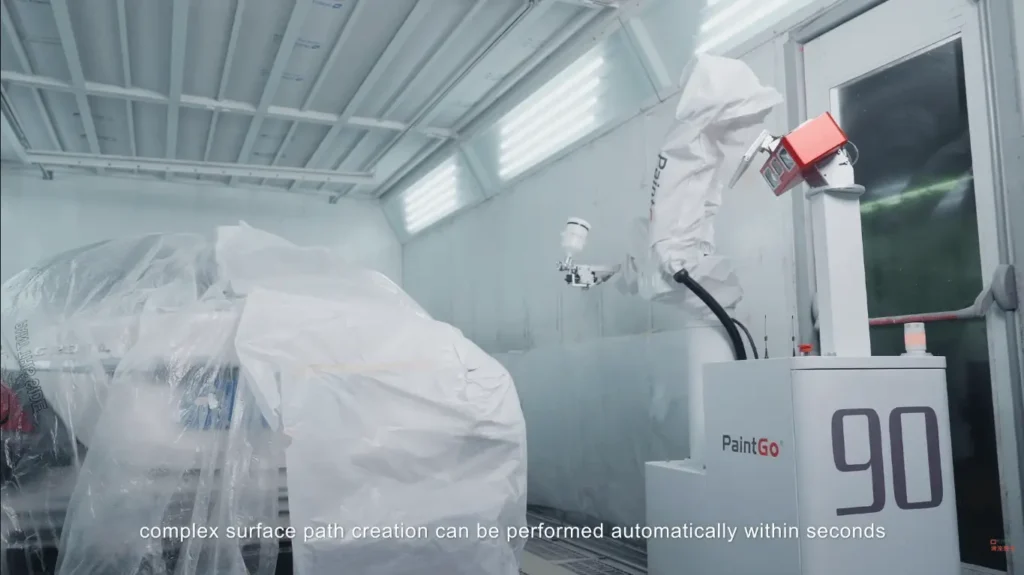
PaintGo is one of the more talked-about car painting robot brands entering the collision repair market, and the reason is easy to see. Most paint robots are built for factory lines. PaintGo is trying to bring that same kind of controlled spray movement into normal body shop paint booths.
PaintGo’s robots are designed to scan vehicle surfaces, plan spray paths, and apply coatings with repeatable robotic movement. The brand’s strongest fit appears to be collision repair shops that already have steady paint volume, skilled prep teams, and a paint booth that can support robotic movement. Still, PaintGo may not be the right fit for every shop.
A robot can repeat a spray path. It can reduce human variation. It can keep the painter out of the booth during application. But it still depends on prep quality, masking, booth airflow, paint mixing, technician training, and the shop’s ability to feed the paint department with enough work.
Let’s take a look at PaintGo’s technology – how it works, who is it for, is it worth it or not; we will answer all these questions. PaintGo is not just a robot that paints cars, it is a tool that changes how a body shop works.
PaintGo Brings Robotic Spray Painting Into Collision Repair Shops
PaintGo is designed around body shop painting rather than factory-only automotive production. That makes the brand worth looking at closely, because collision repair painting is far less predictable than painting new vehicles on an assembly line.
A factory paint line deals with repeated vehicle bodies, fixed process steps, and controlled production flow. A collision repair shop deals with different damage every day. One job may be a bumper. The next may be a hood, two doors, and a quarter panel. Another may need blending, edge control, clear coat consistency, and careful masking around parts that were never meant for factory-style robotic access.
PaintGo is trying to sit between these two worlds.
Its robots are promoted for auto body repair shops, paint shops, dealerships, fleet repair centers, and larger refinish operations. The idea is simple: bring machine vision, robotic arm movement, and AI-assisted path planning into a booth-based repair environment.
That is an ambitious target because body shops do not have the same rhythm as manufacturing plants. The robot has to deal with changing vehicle shapes, inconsistent job size, different panel positions, and shop schedules that are often tight.
Why Collision Repair Shops Are Looking at Car Painting Robots
Collision repair shops are considering car painting robots because paint work has become harder to staff, harder to control, and harder to keep profitable. Skilled refinish technicians are valuable, but many shops struggle to find enough of them.
Painting also carries physical and process pressure.
A painter may spend long hours inside the booth, moving around large panels, bending around bumper covers, reaching across hoods, and trying to keep a wet edge while managing distance and overlap. Even an experienced painter can have different results at the start and end of a busy day.
The business pressure is just as real – Paint and clear coat are expensive. Rework eats profit fast. Booth time is limited. Insurance repair timelines are tight. Customers expect a factory-like finish, even when the repair is happening under real shop pressure.
A car painting robot like PaintGo speaks directly to those pain points.
It gives shop owners a way to reduce variation in spray application. It may help painters focus more on prep, inspection, setup, color, and process control. It can also reduce chemical exposure because the operator can work outside the booth during spraying.
The robot does not remove the need for skill. It changes where that skill is used.
PaintGo Robot Models and Core Technology
PaintGo’s public product line centers on the PG-90E and PG-98E. These models are not aimed at exactly the same shop. The PG-90E is the more compact robot for normal collision repair, while the PG-98E is listed for larger vehicles such as vans and trucks.
Both systems are built around the same broad idea: scan the vehicle surface, create a spray plan, and move the spray gun through a controlled path. The model choice depends on vehicle size, booth space, panel type, and daily job mix.
PaintGo PG-90E Intelligent Spray Painting Robot
The PaintGo PG-90E is the model most standard body shops will care about first. It is promoted as an intelligent spray painting robot for auto body repair shops and collision repair centers.
The PG-90E is designed for common passenger vehicle work. That includes doors, hoods, fenders, bumpers, quarter panels, and exterior body surfaces. Its appeal comes from being more compact than larger industrial paint robots, making it more realistic for shops that do not have factory-size paint areas.
The system is described as using machine vision and AI algorithms to recognize vehicle appearance and plan spray paths. Some distributor information also lists external operation from outside the booth, 3D vision mapping, and support for common refinish workflows.
This makes the PG-90E less like a giant factory robot and more like a booth-based spray automation tool.
The strongest fit appears to be high-volume collision repair shops that already have enough paint work to keep a booth busy. A shop that paints only a few cars a week may like the technology, but the financial case will be harder.
PaintGo PG-98E and Other Listed PaintGo Systems
The PaintGo PG-98E is listed as the larger model for vans, trucks, and oversized vehicles. Public product descriptions position it for 5 to 7.5-meter vehicles, with a mechanical arm and lifting column designed to cover taller and longer surfaces.
That makes the PG-98E a different type of business tool.
A normal collision shop may not need that reach every day. A fleet repair shop, van repair center, commercial paint facility, or truck-focused operation might see more value. Large side panels, roofline areas, lower skirts, and long vehicle bodies are harder to spray evenly by hand, especially when the painter has to change body position often.
The PG-98E also appears to target shops where repeated commercial vehicle work can make robotic movement more useful. Fleet jobs often reward consistency. When the same type of van or truck comes through again and again, a robot has more chances to repeat a proven process. PaintGo’s model range shows that the brand is not only thinking about small panel repair. It is also aiming at larger refinish work where reach, surface area, and repeatability become daily issues.
Mobile Robotic Platform, Spray Arm, Vision System, and Control Software
PaintGo’s core system combines a robotic platform, spray arm, vision hardware, and control software. These parts work together to turn a vehicle surface into a planned spray path.
The mobile or booth-based platform gives the robot its working position. The spray arm carries the gun and moves it around the panel. The vision system reads the vehicle surface so the software can understand the shape. The control software turns that scanned shape into a spray movement plan.
A basic sprayer can move in a fixed pattern. PaintGo’s value comes from adapting to the vehicle shape. Doors, fenders, bumper covers, hoods, and quarter panels all have different curves and edges. The robot needs to recognize those shapes before it can spray them in a useful way. The system still depends on setup. If the vehicle is poorly positioned, if the surface is not ready, or if masking blocks key areas, the robot cannot create a perfect finish out of bad inputs.
How PaintGo’s Automated Painting Process Works
PaintGo’s process follows a logical sequence: the vehicle or panel is prepared, positioned in the booth, scanned by the robot, converted into a spray plan, and then painted through controlled robotic movement.
That may sound simple, but each stage affects the final result. Robotic spraying rewards clean process discipline. Shops that already have strong prep habits will be in a better position to benefit from the robot.
Vehicle Surface Scanning and 3D Panel Recognition
PaintGo uses machine vision and 3D surface recognition to read the shape of the vehicle or repair area. This scanning stage is one of the most important parts of the system.
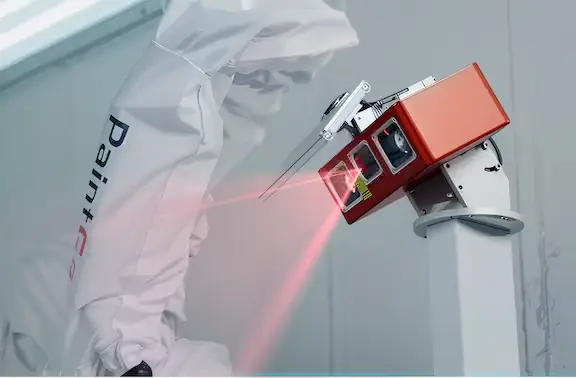
A car is not a flat wall. A hood may have crown. A bumper may have curves, cutouts, recesses, and edge lines. A quarter panel may blend into body lines and wheel openings. A door may have handles removed, trim masked, and repair zones that change how the painter wants coverage.
The robot needs to understand enough of that shape to plan a safe and useful gun path.
The scan gives the software a digital picture of the work area. From there, the system can plan movement across the panel while keeping the spray gun at a controlled working distance.
This is the difference between robotic painting and simple mechanized spraying. The robot is not just moving back and forth. It is responding to the shape it has scanned.
Robotic Spray Path Planning for Doors, Fenders, Hoods, Bumpers, and Quarter Panels
After scanning, PaintGo creates a robotic spray path. The spray path is the planned route the gun follows across the surface.
A door may be fairly predictable, but body lines and edges still need care. A hood has a large surface where overlap and gun speed affect texture and coverage. A fender has curves around the wheel opening. A bumper cover has more complex geometry, with corners, recesses, and edges that can change material build. A quarter panel may involve blend areas and adjacent panel control.
PaintGo’s robot has to create paths that match these shapes.
The goal is not only to cover the surface. The goal is to cover it evenly, with controlled overlap and a stable spray angle. Too much overlap can create excess film build. Too little can create patchy coverage or dry areas. Poor angle control can affect texture and gloss.
This is why path planning is one of the strongest selling points of PaintGo. It targets the exact part of spraying where human variation often creates waste or rework.
Spray Gun Movement, Overlap Control, Distance Control, and Paint Coverage
Robotic spray quality depends on movement control. The gun has to travel at the right speed, stay the right distance from the panel, maintain the right angle, and keep the right overlap between passes.
PaintGo’s promise is built on these details.
Manual painters learn this through practice. They know how far to hold the gun, how fast to move, how much to overlap, and how to adjust around curves. But even good painters vary slightly from pass to pass.
A robot can repeat the same motion with less variation.
That can improve coverage on large panels where human fatigue often shows up. It can also help reduce heavy spots, dry areas, and unnecessary extra passes when the spray plan is correct.
Paint coverage still depends on the material system. Gun setup, nozzle choice, air pressure, fluid flow, paint viscosity, booth temperature, and flash behavior all affect the result. PaintGo controls movement, but the paint system still has to be dialed in.
Color Coat and Clear Coat Application Inside the Paint Booth
PaintGo is promoted for automotive paint application inside a booth, including color and clear coat work. This is where the robot’s value becomes practical for collision repair.
A shop does not only need a robot that can spray one test panel. It needs a system that can work inside the normal rhythm of a refinish booth.
That includes loading the vehicle, confirming masking, applying base coat, respecting flash time, applying clear coat, and then inspecting the final finish. PaintGo can automate spray passes, but the team still has to manage the full refinish process.
Clear shows texture, flow, dry spray, dirt, and edge control. If the robot can lay clear evenly on real repair work, that is a stronger proof point than base coat alone. Shops should pay close attention to clear finish quality during any demo.
A robot’s movement may be consistent, but clear coat still needs the right wetness, overlap, air movement, and cure conditions.
PaintGo Paint Quality Review
PaintGo’s paint quality story is mainly about consistency. The robot is built to reduce variation in spray movement, not to replace every judgment a painter makes.
That is a fair strength. In production collision repair, consistent application often matters more than artistic style.
Finish Consistency Across Large Panels
Large panels are one of the best tests for PaintGo. Hoods, van sides, doors, and quarter panels reveal uneven speed, poor overlap, and distance changes quickly.
A painter can spray a large panel beautifully, but the job demands steady movement from edge to edge. The bigger the panel, the more body movement matters. Fatigue, reach, booth space, and stance all affect the result.
A robot can keep its programmed motion more consistent.
This can help create more even coverage and texture across broad surfaces. It may also reduce the need for extra material added “just to be safe,” which is one reason robotic systems often claim paint savings.
The final finish still depends on prep and booth cleanliness. A robot cannot hide sanding scratches, dust, poor masking, solvent issues, or bad color match.
Edge Coverage, Curves, Body Lines, and Hard-to-Reach Areas
Edges, curves, and recesses are harder than flat panels. This is where PaintGo’s scanning and path planning need to earn trust.
A robot has to manage wheel arches, bumper corners, lower skirts, door edges, and body lines without creating heavy build or dry coverage. These areas often need angle changes, shorter passes, or special attention.
PaintGo’s PG-98E is especially relevant here because it is promoted for larger vans and trucks, including side panels and lower skirt areas. Those surfaces are physically demanding for painters and can be inconsistent if sprayed from awkward positions.
Still, shops should test edge coverage carefully.
A demo should include curved panels, not only flat surfaces. The robot should show how it handles bumper contours, lower body areas, and panel edges where overspray and film build can become problems.
Orange Peel, Dry Spray, Runs, and Rework Risk
Orange peel, dry spray, runs, and rework are not caused by gun movement alone. They come from a mix of material setup, technique, airflow, temperature, reducer choice, flash time, and surface condition.
PaintGo can reduce some technique-related problems because it controls movement better than a human hand can over long repeated passes. Stable distance and speed can help reduce dry areas and heavy spots.
But the robot does not remove all risk.
If clear is mixed wrong, if booth airflow is weak, if the surface is contaminated, or if the spray parameters are wrong, the robot will still produce a flawed finish. It may even repeat the flaw consistently across the panel.
That is why PaintGo should be reviewed as part of the full paint process.
A good shop can use the robot to reduce variation. A weak process may simply automate bad habits.
Repeatability Compared With Manual Spray Painting
Repeatability is PaintGo’s strongest argument against fully manual spraying. A painter can be highly skilled, but no human repeats movement exactly all day, the robot can.
That matters for shops with multiple painters, tight cycle times, and repeated insurance repairs. If one painter sprays differently from another, finish texture and material use can change. PaintGo gives the shop a more controlled application method.
Manual spraying still has an advantage in judgment-heavy work. A painter can react instantly if a panel is not laying down correctly. A robot follows the planned path unless the operator changes the process.
This makes PaintGo best for repeatable production work. Manual skill remains valuable for blends, custom jobs, unusual repairs, and final quality decisions.
Material Savings and Production Claims
PaintGo’s public marketing and distributor pages mention material savings, labor savings, efficiency gains, and production increases. These claims are central to the buying decision, but they need careful reading.
The numbers may be useful as a starting point. They should not replace a shop’s own measurement.
Reported Paint and Clear Coat Savings
PaintGo USA mentions reported material savings from California collision repair facilities using PaintGo’s technology. The common explanation is that robotic movement can reduce waste through better transfer control, more stable overlap, and fewer inconsistent passes. That logic makes sense.
When a painter overlaps too much, moves too slowly, or keeps extra distance from the panel, more material can be wasted. When coverage is planned and repeated, the shop may use less base and clear to get the same visual result. Still, savings are not automatic.
A shop with excellent painters and strong material control may see smaller gains. A shop with heavy rework, inconsistent gun setup, or rushed spraying may see more. The only reliable way to judge PaintGo’s material savings is to compare it against the shop’s current paint and clear use per job.
Booth Throughput and Cycle Time Claims
PaintGo’s distributor information also talks about production gains and faster painting. The PG-98E is promoted with a spraying efficiency gain for larger vehicles, while the PG-90E is promoted as a compact robot for body shop use.
Throughput can improve when spray movement becomes more consistent and the painter can manage work from outside the booth. A robot may also reduce downtime caused by painter fatigue or skill gaps.
But booth cycle time is not only spray time.
The total cycle includes loading, masking, cleaning, scanning, spraying, flash time, clear coat, bake cycle, cool down, unloading, and inspection. PaintGo may reduce application variation, but it cannot erase every time constraint in the booth.
A shop should ask a practical question: how many more repair orders can the booth finish each week after PaintGo is installed?
That answer depends on the whole workflow, not the robot alone.
Where Material Savings Usually Come From in Robotic Painting
Material savings in robotic painting usually come from controlled distance, controlled overlap, controlled speed, and repeatable spray angle. These four factors affect how much paint lands on the panel and how much becomes overspray.
Manual painters may adjust constantly, which is useful for judgment but can create variation. A robot repeats a planned movement. If that plan is correct, the robot can lay material more evenly with less waste.
Savings can also come from fewer rework jobs.
A finish that needs sanding and repainting costs more than the material used on the first pass. If PaintGo reduces texture variation, patchy coverage, or heavy spots, the savings may show up in lower rework as much as lower paint use.
The best shops will track both.
Why Shop Results May Vary by Painter Skill, Booth Setup, and Job Mix
PaintGo results will vary because every body shop is different. Painter skill, booth size, airflow, job type, vehicle mix, paint brand, prep quality, and management discipline all affect the outcome.
A high-volume shop with strong prep and a busy booth may get more value. A low-volume shop with weak scheduling may not.
A fleet shop painting repeated vans may benefit more from the PG-98E than a custom shop doing one-off restorations. A collision center with daily bumper and panel work may find the PG-90E easier to justify than a small rural shop with limited paint volume.
The robot does not create profit by itself. It needs the right shop around it.
PaintGo Booth Requirements and Installation Fit
PaintGo is promoted as a booth-based system, but buyers should treat booth fit as one of the first serious checks. A robot that does not fit comfortably will slow the paint department down.
Installation fit is not only about physical dimensions. It also includes power, air, clearance, floor space, rail layout, operator access, and service access.
Minimum Booth Size, Power, Air, and Floor Space
Some distributor information lists minimum booth dimensions for the PG-90E around 22 feet long, 12 feet wide, and 10 feet high. Other regional listings use metric dimensions in a similar range.
Power and compressed air requirements also need to be confirmed before purchase. Public distributor materials mention 220V power and compressed air needs, but final requirements should be confirmed with the local distributor and installer.
Floor space is just as important as booth size.
The robot needs room to move without hitting the vehicle, booth walls, lights, filters, hoses, or masking materials. The shop also needs enough room for safe loading, positioning, and operator workflow.
Before buying, a shop should measure the booth with real vehicles inside, not an empty booth.
Existing Spray Booth Compatibility
PaintGo may fit some existing booths, but compatibility should never be assumed. Booth design varies widely.
Older booths may be too narrow, too low, or too crowded. Lighting may block movement. Floor condition may affect robot travel. Airflow may not support consistent finish quality. Door clearance may make setup awkward.
A booth can be technically large enough but still inconvenient.
The robot has to fit the daily workflow. Can the painter still use the booth manually when needed? Can the vehicle be loaded easily? Is there enough clearance around bumpers and sides? Can hoses be managed safely? Can the operator access controls without disrupting the process?
A smart buyer will ask the installer to review the booth before signing anything.
Ventilation, Filtration, Lighting, and Robot Movement Clearance
Ventilation and filtration are still central to finish quality. A robot cannot compensate for dirty filters, poor airflow, or bad booth balance.
Lighting also matters. The robot’s vision system needs reliable surface recognition, and the human team still needs to inspect the repair. Poor lighting can make scanning, masking checks, and final quality inspection harder.
Movement clearance is another major factor.
PaintGo’s spray arm needs room to maintain distance and angle. If the vehicle is too close to the booth wall or if masking materials hang into the work zone, the robot’s path may be restricted.
The booth should be treated as part of the robot system. A weak booth will limit the robot’s value.
Setup Challenges for Small Body Shops
Small body shops may be attracted to PaintGo because of labor pressure, but they may face the hardest setup challenges.
- Space – many small shops have older booths or tight buildings. Adding a robot may require changes to booth layout, utilities, or workflow.
- Volume – a shop needs enough paint work to justify the cost. If the robot sits idle for much of the week, the business case becomes weak.
- Process discipline – small shops often rely on flexible habits and experienced people doing many tasks. A robot works better when the process is measured and repeatable.
PaintGo can still work for smaller shops, but only when booth fit, work volume, and support are clear.
PaintGo Workflow Inside a Body Shop
PaintGo changes the spray stage, not the entire repair process. Body work, prep, masking, cleaning, inspection, and final correction still remain in human hands.
The robot works best when the shop treats painting as a controlled process from start to finish.
Vehicle Prep Before Robotic Painting
Vehicle prep still decides much of the final finish. PaintGo cannot fix poor sanding, bad featheredge work, contamination, missed pinholes, weak cleaning, or poor masking.
Before the robot sprays, the repair must be ready.
Panels need proper sanding, cleaning, tack-off, masking, and positioning. Edges need attention. Adjacent panels need protection. Blend areas need planning. The paint team must know what the robot is spraying and where human touch may still be needed.
Prep quality becomes even more visible with robotic application. Because the robot can apply coating consistently, defects from earlier stages may stand out more clearly.
A shop using PaintGo should tighten prep standards, not relax them.
Masking, Positioning, Scanning, Spraying, and Flash Time
The working sequence is practical. The vehicle is masked and positioned. The robot scans the surface. The software creates the spray path. The system sprays according to the planned movement. Flash time is managed according to the paint system.
Poor masking can block access or create edge issues. Poor positioning can reduce robot clearance. Bad scanning can affect path planning. Rushed flash time can hurt finish quality. None of these problems are solved just because a robot is in the booth.
PaintGo can make the spray pass more consistent, but the surrounding workflow must support it.
A shop should build standard procedures around vehicle placement, scan checks, spray settings, flash timing, and final inspection.
Painter Supervision and Manual Touch-Up Work
PaintGo still needs painter supervision. The operator needs to understand what the robot is doing, whether the scan looks right, and whether the spray plan makes sense for the job.
Manual touch-up may still be needed for edges, blend areas, small corrections, unusual shapes, or complex repairs. The robot can handle repeatable application, but human judgment remains part of quality control.
This should be seen as normal, not as failure.
In a strong shop, PaintGo supports the painter. It does not remove the painter from the process. The painter becomes more of a process lead, checking setup, material behavior, finish quality, and corrections.
That is a better use of skilled labor than spending every hour repeating standard spray passes.
Training Requirements for Painters and Paint Technicians
PaintGo requires training because it changes the painter’s job. Technicians need to learn scanning, setup, spray plan review, safety procedures, gun cleaning, maintenance, and fault handling.
Painters also need to learn when not to use the robot.
Some jobs may be faster or safer manually. Some custom work may need human control. Some blend areas may need special handling. Training should cover both operation and judgment.
Body shops should ask what training is included, who provides it, how long it takes, and whether new employees can be trained later.
Service support matters too. If the robot becomes a core part of production, downtime can hurt the shop quickly.
PaintGo Cost, ROI, and Business Case
PaintGo’s business case depends on more than the machine price. A shop has to account for installation, booth fit, training, maintenance, support, material savings, labor pressure, and actual weekly paint volume.
A painting robot is a production investment. It should be judged with numbers, not excitement.
Upfront Robot Cost and Installation Expenses
Public pricing for PaintGo robots is not consistently listed across official and distributor pages. Most sources push buyers toward a quote or demo.
That means the real cost will depend on model, region, installation needs, booth changes, training, support package, freight, and service terms.
The upfront robot cost is only one part.
A shop may need booth adjustments, utility work, air supply checks, network setup, layout changes, and staff training. It may also lose production time during installation.
Before buying, the shop should request a full installed cost, not just a machine price.
Paint Material Savings, Labor Pressure, and Rework Reduction
The strongest ROI areas for PaintGo are paint material savings, reduced painter strain, more consistent application, and lower rework.
Material savings may come from better transfer control and fewer extra passes. Labor value may come from allowing one skilled painter to supervise more work or reducing dependence on one person’s spray technique. Rework savings may come from more consistent finish quality.
These gains are possible, but they must be measured.
A shop should compare paint use per job, rework rate, booth cycle time, painter hours, and weekly painted units before and after installation. Without that baseline, ROI becomes guesswork.
PaintGo’s claims may open the conversation. The shop’s own numbers should close it.
Monthly Car Count Needed to Justify a Painting Robot
A PaintGo robot needs enough monthly work to pay for itself. The exact number depends on the robot cost, financing, labor market, paint material cost, and repair mix.
High-volume shops have the clearest path. If the booth is busy every day and paint is a bottleneck, even small gains per repair can add up.
Low-volume shops face a harder case. If the robot only sprays a few jobs each week, savings may not cover the cost quickly.
A practical review should ask: how many painted jobs per month will the robot handle, and how much profit improvement can be tied to each job?
That number is more useful than any general claim about automation.
When PaintGo Makes Financial Sense for a Collision Repair Center
PaintGo makes the most financial sense when a shop has steady paint volume, tight labor supply, high material costs, and enough booth space to run the robot without slowing other work.
It also makes sense when the shop already tracks production data. Owners who know paint cost per repair order, booth hours, rework rates, and painter output can judge the robot more fairly.
PaintGo may be harder to justify when the shop has low volume, a cramped booth, inconsistent prep, or no clear production bottleneck.
The robot should solve a measured problem. It should not be bought only because it looks modern.
PaintGo Compared With Manual Car Painting
PaintGo and manual painting should not be treated as enemies. They solve different parts of the paint process.
Manual painting brings judgment. PaintGo brings repeatability. A strong shop can use both.
Skilled Painter Control Versus Robotic Repeatability
A skilled painter can make real-time decisions based on how the paint is laying down. That is still valuable.
The painter can adjust speed, angle, fan pattern, and distance based on panel shape, temperature, humidity, color, clear behavior, and surface response. Human control is especially useful for unusual jobs.
PaintGo’s strength is repeatable movement.
The robot can keep the same spray distance and overlap without fatigue. On standard work, that can reduce variation and make finish results easier to repeat.
The best comparison is not “robot or painter.” It is “which parts of the job need judgment, and which parts benefit from repeatable movement?”
Labor Shortage Relief Without Fully Replacing the Painter
PaintGo can help with labor pressure, but it should not be sold as a full painter replacement.
The shop still needs people who understand paint, prep, masking, color, clear coat, defects, and repair planning. The robot can lower the burden of repeated spray passes, but it cannot replace full refinish knowledge.
If a shop depends too heavily on one senior painter, production becomes fragile. A robot can make the process less dependent on one person’s hands. It may also help newer technicians support the paint department under proper supervision.
That is a more realistic labor benefit than claiming the shop no longer needs painters.
Consistency on Repeat Jobs and Fleet Repair Work
PaintGo may shine on repeat jobs and fleet work. These jobs often reward consistency more than personal spray style.
Fleet panels, repeated van repairs, dealership work, bumper jobs, and standard insurance repairs can be strong candidates. The robot can repeat a known path and reduce variation between similar jobs.
This is where the PG-98E’s larger-vehicle focus becomes important. Vans and trucks have large areas where consistent application can be hard by hand. A robot with enough reach may help keep surface coverage more even.
PaintGo’s value rises when the work pattern repeats.
Limits of Automation in Custom Paint, Blending, and Complex Repairs
PaintGo has limits. Custom paint, artistic finishes, complex blends, restoration work, and unusual repairs may still need manual control.
A robot follows a planned path. A painter reads the job in real time. Some finishes need that human response.
Blending can also be more complex than simple panel coverage. The painter may need to feather material, adjust technique, and work visually with color behavior. PaintGo may support parts of that process, but it should not be assumed to handle every blend better than an expert.
Shops that specialize in custom paint should test PaintGo carefully before making it central to production.
PaintGo Compared With OEM Robotic Paint Systems
PaintGo should not be judged like a full OEM factory paint line. It belongs in a different category: booth-based refinish robotics.
That category is smaller, more flexible, and more realistic for collision repair shops.
Collision Repair Robot Versus Factory Paint Line Robot
OEM paint robots work in highly controlled production plants. The vehicle body, conveyor movement, spray zones, cure stages, and process settings are planned around mass production.
PaintGo works in the repair shop world, where each job can be different.
That makes PaintGo more flexible but also more dependent on local workflow. A factory robot works inside a complete production system. PaintGo has to fit into an existing booth, existing technicians, existing paint brands, and changing repair needs.
This is why PaintGo’s technology is interesting. It brings part of factory-style robotic painting into a much less predictable setting.
Flexible Booth-Based Painting Versus Fixed Production-Line Automation
PaintGo’s booth-based setup is more flexible than a fixed production line. A shop can use the robot for certain jobs and still use manual painting when needed.
Collision repair does not run like a conveyor. The shop may need to paint a bumper in the morning, a hood at noon, and a large SUV side later in the day. A booth-based robot needs to support that mixed schedule.
A fixed production-line system would be too much for most repair shops. PaintGo’s smaller format makes robotic painting more realistic for the refinish market.
Lower Entry Barrier Compared With Large Automotive Paint Robots
Large automotive paint robots are expensive, complex, and built for industrial production lines. PaintGo appears to offer a lower entry point for body shops that want automation without building a factory paint department.
That does not mean PaintGo is cheap or simple. It still requires money, space, training, and support.
But compared with major OEM paint automation, PaintGo is clearly aimed at a more accessible shop-level use case. This is its strongest market position.
It gives collision repair businesses a way to test robotic painting in a booth environment rather than waiting for factory-level systems to become practical.
Best Use Cases for PaintGo Robots
PaintGo’s best use cases are shops with enough volume, repeatable work, and paint department pressure to make robotic spraying useful.
The robot should be matched to the job mix, not bought as a one-size answer.
High-Volume Collision Repair Shops
High-volume collision repair shops are one of the strongest fits for the PG-90E. These shops often have steady insurance work, repeated panel repairs, and paint departments under pressure.
A robot can help standardize spray application across common repairs. It may also help reduce dependence on one highly skilled painter for every pass.
The more consistent the workflow, the stronger the PaintGo case becomes.
A high-volume shop should still run real tests. The robot needs to prove it can improve output without disrupting booth scheduling.
Multi-Shop Operators and Franchise Repair Networks
Multi-shop operators may be interested in PaintGo because consistency across locations is hard. One shop may have a great painter. Another may struggle with refinish quality or staffing.
A robotic system can create a more standardized spray process across locations.
That does not remove local training needs, but it can give management a repeatable method. If each location follows the same prep, scan, spray, and inspection process, quality control becomes easier to manage.
Franchise and network shops may also like the technology because it gives them a clear production story for insurers and customers.
Fleet Refinish Work and Repeated Panel Painting
Fleet refinish work is a strong match for robotic painting. Vans, service vehicles, delivery trucks, and commercial units often involve repeated shapes and large panels.
The PG-98E is especially relevant here because it is listed for 5 to 7.5-meter vans and trucks.
Repeated work gives the robot more value. Once a shop has a good process for a certain vehicle type, the robot can repeat it with less variation.
Fleet work also cares about speed and consistency. PaintGo fits that need better than highly custom one-off painting.
Shops Struggling With Painter Shortage or Finish Consistency
Shops struggling with painter shortage or inconsistent finish quality may see PaintGo as a way to stabilize production.
If a shop has more body work than the paint department can handle, the robot may help reduce pressure. If finish quality changes depending on who is spraying, robotic application may reduce variation.
The shop still needs skilled supervision. But the robot can make the spray stage less dependent on one person’s physical technique.
This is one of PaintGo’s clearest business arguments.
Where PaintGo May Not Be the Right Fit
PaintGo has strong use cases, but it is not right for every shop. Some businesses may be better off improving booth care, training, prep flow, or scheduling before buying a robot.
A clear review should say that openly.
Low-Volume Body Shops
Low-volume shops should be cautious. If the booth is not busy, the robot may not have enough work to create a strong return.
A small shop may love the idea of robotic painting, but the math can be hard. The robot needs steady use to justify installation, training, and support costs.
Low-volume shops may get more value from better spray guns, booth maintenance, painter training, scheduling, or paint material tracking before moving into robotics.
PaintGo is most convincing when the booth already has volume.
Shops With Small or Older Paint Booths
Small or older booths may create fit problems. The robot needs enough clearance, clean airflow, safe movement, proper lighting, and utility support.
A booth that barely fits vehicles today may not be ready for robotic spraying.
Upgrades can add cost. Wider clearance, rail changes, utility work, filter improvements, and lighting changes may be needed. These costs should be included in the buying decision.
A shop should not buy the robot first and solve booth problems later. Booth fit should come first.
Custom Paint Shops That Depend on Painter Style
Custom paint shops should review PaintGo differently from production collision shops. A robot can repeat controlled movement, but custom work often depends on painter style and on-the-spot judgment.
Candy colors, graphics, restoration finishes, special blends, and one-off creative work may not fit the robot’s strongest use case.
PaintGo may still help with some base or clear stages, but it should not be viewed as a replacement for the painter’s eye.
The more artistic the work, the more careful the shop should be.
Businesses Without Enough Throughput to Recover the Investment
Throughput is the core of the PaintGo business case. If a shop does not have enough painted jobs, material savings and labor relief may not add up fast enough.
A robot can be technically impressive and still be a poor purchase.
Businesses should calculate expected monthly use, savings per job, labor value, rework reduction, and financing cost. If the numbers do not work, the shop should wait.
PaintGo makes the most sense when the shop already has a paint bottleneck.
What to Check Before Buying a PaintGo Painting Robot
Buying a PaintGo robot should be treated like a production planning decision. The shop should check booth fit, model choice, paint compatibility, service support, and real-world finish quality before signing.
A demo is useful, but only if it reflects the shop’s actual work.
Booth Measurements and Utility Requirements
Measure the booth carefully. Length, width, height, door clearance, wall clearance, lighting, filters, vehicle position, floor space, power, compressed air, and network access all matter.
Do not rely on a basic square-foot measurement. The booth should be measured with a vehicle inside and with the robot’s working movement in mind.
Ask the distributor for exact requirements for the selected model. The PG-90E and PG-98E have different use cases, so they may have different space and setup needs.
The booth must support the robot without hurting daily workflow.
Paint Brand, Spray Gun, and Workflow Compatibility
PaintGo should be tested with the shop’s actual paint system. That includes base coat, clear coat, gun setup, air pressure, nozzle choice, booth temperature, and normal flash time.
Some distributor materials mention compatibility with familiar spray gun setups, but every shop should confirm what works with its own refinish brand and process.
The demo should include panels similar to real repairs. A flat test panel is not enough.
Ask for a hood, bumper, door, or larger side panel if those are common in your shop. Look closely at texture, edge coverage, gloss, and material build.
Training, Service Support, Warranty, and Local Distributor Help
Support may decide whether PaintGo becomes a strong tool or a production headache.
Ask who installs the system, who trains the staff, how long training takes, and what happens when new employees need instruction. Ask about warranty terms, spare parts, remote support, software updates, emergency service, and expected maintenance.
A shop should also ask how fast help is available if the robot goes down.
If PaintGo becomes central to booth production, service delays can affect the whole repair schedule. Local distributor strength matters as much as the machine itself.
Real Shop Demonstrations and Test Panels Before Purchase
A real shop demo is the best way to judge PaintGo. The robot should paint work that resembles the buyer’s daily jobs.
The shop should bring its own questions: How long does scanning take? How is the spray path reviewed? Can the operator adjust settings? How does the robot handle edges? What happens if masking blocks an area? Can the booth still be used manually? How is the gun cleaned? How often does maintenance happen?
Test panels should be inspected like customer work.
Look at clear texture, dry edges, dirt, runs, coverage, gloss, and match with the shop’s finish standards. The robot should prove itself on the kind of work the shop actually sells.
PaintGo’s Place in the Future of Automotive Refinish Painting
PaintGo sits in an important place in automotive refinish painting. It is not trying to be a giant factory paint line, and it should not be treated as a magic answer for every body shop.
Its strongest role is more practical.
PaintGo gives collision repair shops a way to bring robotic spray consistency into the booth. The PG-90E fits the conversation around passenger vehicle repair, while the PG-98E expands the idea toward vans, trucks, and fleet-style work.
The best buyers will be shops with steady paint volume, enough booth space, strong prep discipline, and a clear production bottleneck. These shops can use PaintGo to reduce variation, support painters, manage material use, and make paint application more repeatable.
The wrong buyers will expect the robot to fix poor process, weak prep, low volume, or a booth that is not ready.